Biography · Chemist no. 214 of 350
John B. Goodenough: The Scientist Who Kept Inventing into His Nineties
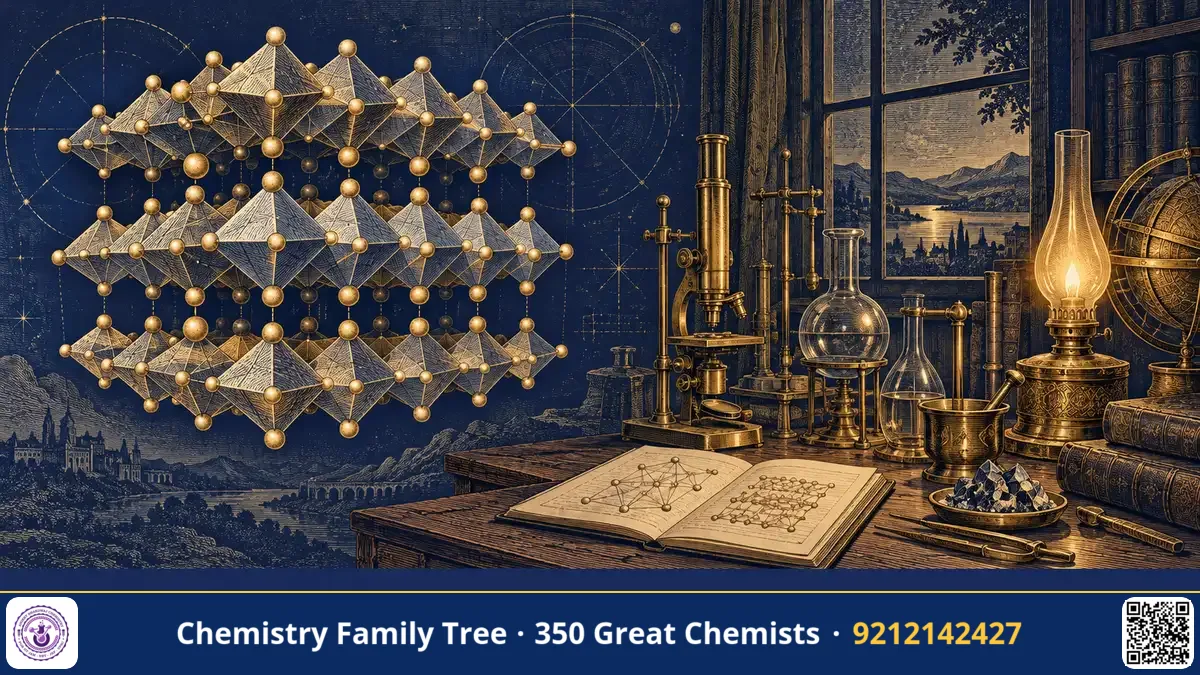
John Bannister Goodenough (25 July 1922 – 25 June 2023) was an American materials scientist, physicist and solid-state chemist. He shared the 2019 Nobel Prize in Chemistry with M. Stanley Whittingham and Akira Yoshino for the development of lithium-ion batteries. His legacy in one line: his cathode materials, LiCoO₂ and LiFePO₄, helped to put rechargeable energy into billions of pockets and vehicles.
Early Life and Family
Goodenough was born in Jena, Germany, to American parents. His father was a professor at Yale University, and the family moved back to the United States, where he grew up in Connecticut. He later recalled having dyslexia as a child, which made reading difficult in the early school years. He attended boarding school and later Groton School in Massachusetts. His early life was shaped by an academic family and by the challenges of school.
Education and Mentors
He entered Yale University and graduated with a degree in mathematics, summa cum laude, in 1944. During the Second World War he served in the United States Army Air Forces as a meteorologist. After the war he went to the University of Chicago to study physics, where he was taught by Enrico Fermi and Clarence Zener, among others. He received his doctorate in physics there in 1952, with Zener as a key mentor. His interest then turned to the electronic and magnetic properties of transition-metal oxides.
Career Timeline
| Year | Event |
|---|---|
| 1922 | Born in Jena, Germany |
| 1944 | Graduates from Yale in mathematics |
| 1952 | PhD in physics, University of Chicago |
| 1952-1976 | Works at MIT Lincoln Laboratory; contributes to magnetic core memory for early computers (RAM) and studies oxides |
| 1976 | Becomes head of the Inorganic Chemistry Laboratory at the University of Oxford |
| 1980 | Reports LiCoO₂ as a 4 V cathode |
| 1986 | Joins the University of Texas at Austin |
| 1996-97 | Identifies LiFePO₄ as a cathode |
| 2019 | Shares the Nobel Prize in Chemistry |
| 2023 | Dies at age 100 |
Major Scientific Contributions
- Magnetic oxides and the Goodenough-Kanamori rules: rules that predict the sign of magnetic superexchange between metal ions through oxygen, taught in advanced inorganic chemistry.
- Random-access memory: work at Lincoln Laboratory on magnetic cores contributed to RAM development.
- LiCoO₂ cathode: layered oxide cathode with 4 V operation.
- Spinel LiMn₂O₄: a low-cost manganese-based cathode.
- LiFePO₄: a safe, cheap olivine cathode.
- Solid electrolytes and solid-state batteries: in his last years he worked with colleagues on glass-based solid electrolytes, a direction still under debate.
See our companion post for the chemistry of the LiCoO₂ discovery.
Awards, Honours and Nobel Prize
In 2019, at the age of 97, he received the Nobel Prize in Chemistry with Whittingham and Yoshino, becoming the oldest Nobel laureate ever at the time. He also received the Japan Prize (2001), the Enrico Fermi Award (2009), the National Medal of Science (2011) and the Copley Medal (2019). He was a member of the United States National Academy of Sciences, National Academy of Engineering and the Royal Society (foreign member).
Personality, Struggles and Lesser-Known Facts
- Dyslexia: He lived with dyslexia as a child, which made reading hard, yet he excelled in mathematics and science.
- Late bloomer for the battery: He was in his late fifties when he developed LiCoO₂.
- No fortune from the patent: The LiCoO₂ work was done under a UK government-linked arrangement, and he is widely reported to have received no royalties from the cathode that powered a multi-billion dollar industry.
- Still working in his late nineties: He continued to come to the laboratory and publish well past 95.
- Humour and faith: He often spoke about his Christian faith and his dry sense of humour, and remained modest about his achievements.
Legacy and Influence on Modern Chemistry
The lithium-ion battery is arguably the most important energy-storage technology of our time, and Goodenough's cathodes are part of it. His life also shows that a physicist trained in magnetism could transform electrochemistry. The ongoing search for cobalt-free and solid-state cathodes, sodium-ion batteries and safer electrolytes follows directly from the principles he established.
Goodenough's long life also offers lessons in how to think about materials. He often explained that the properties of a solid, whether magnetic, electrical or electrochemical, depend on how electrons occupy bands built from atomic orbitals, and on the geometry of the lattice that connects the atoms. This way of thinking, which mixes ideas from molecular orbital theory and solid-state physics, allowed him to move easily from magnetic oxides to battery cathodes and later to ion conductors. He trained many students and postdoctoral researchers, and several of them have become leaders in battery science around the world. Even at the age of 100, he was still thinking about the next generation of energy storage. For Indian students preparing for JAM, NET or GATE, his work is a living example of why crystal field theory, band theory and thermodynamics are not abstract topics but the foundation of technologies that fill our daily lives.
Lessons for Students
- It is never too late. He made his greatest discovery after fifty and won the Nobel at 97.
- Difficulties are not barriers. Dyslexia did not stop him.
- Combine fields. Physics, chemistry and engineering all met in his work.
- Think about structure. Crystal structure explains battery behaviour.
- Do not chase money. His motive was understanding and usefulness.
Quick Facts Box
- Born: 25 July 1922, Jena, Germany
- Died: 25 June 2023, Austin, Texas, USA
- Nationality: American
- Field: Solid-state chemistry, physics, materials science
- Famous for: LiCoO₂ and LiFePO₄ cathodes; Goodenough-Kanamori rules
- Nobel: Chemistry 2019, shared with Whittingham and Yoshino
FAQ
How old was he when he won the Nobel Prize?
97 years old, the oldest laureate at the time.
Was he a physicist or a chemist?
He was trained as a physicist but worked as a solid-state chemist and materials scientist. His Nobel Prize was in Chemistry.
What are the Goodenough-Kanamori rules?
Qualitative rules that predict whether magnetic superexchange between two metal ions through an oxygen is ferromagnetic or antiferromagnetic, depending on the bond angle and orbital occupancy.
Which cathode is safer, LiCoO₂ or LiFePO₄?
LiFePO₄ is considered safer because of its stable phosphate framework.
Published by ABC Chemistry — IIT-JAM | CSIR-NET | GATE Chemistry Coaching. Visit abcchemistry.com
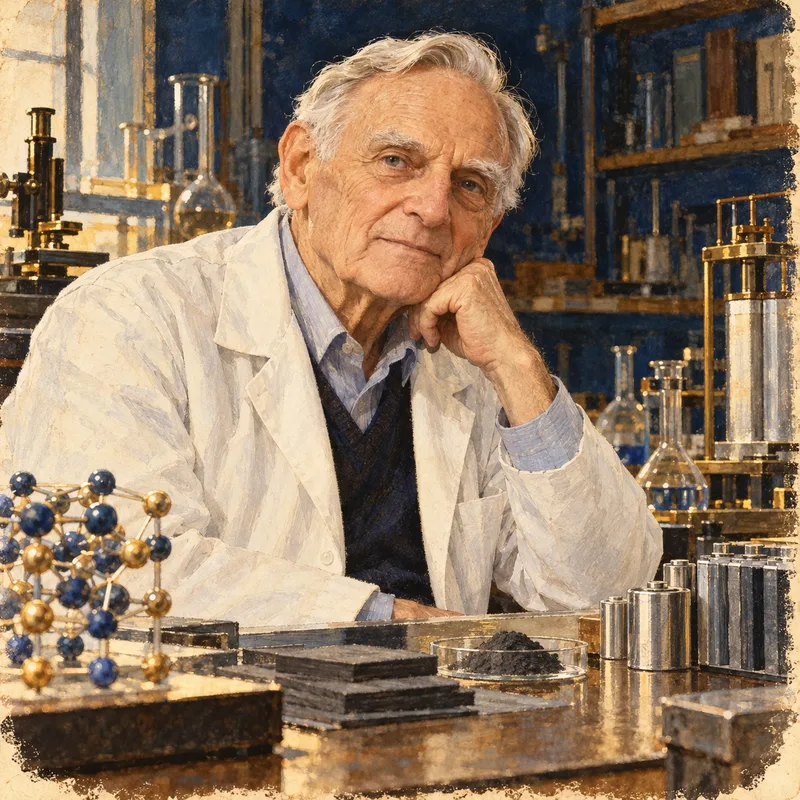
About the chemist
John B. Goodenough
1922-2023 · United States · Nobel Chemistry 2019
Lithium-ion battery cathode materials