The discovery, explained · Chemist no. 214 of 350
John B. Goodenough and the Cathode That Powered the Portable Age
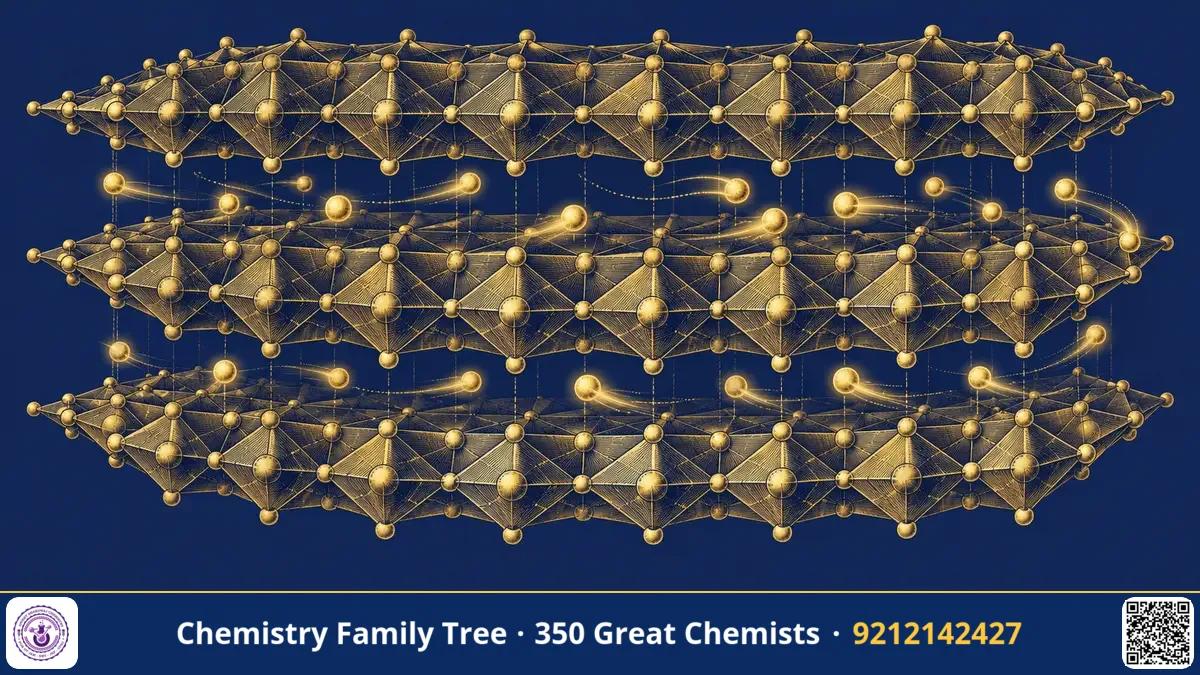
Your phone, laptop, earbuds and the electric scooter in the lane next door all share one invention: the lithium-ion battery. The key to its high voltage was found in 1980 by John B. Goodenough and his team at the University of Oxford: a layered oxide, lithium cobalt oxide (LiCoO₂), that could release and take back lithium ions reversibly at a high voltage of about 4 V against lithium metal. For this work, Goodenough shared the 2019 Nobel Prize in Chemistry with M. Stanley Whittingham and Akira Yoshino, "for the development of lithium-ion batteries". At age 97, he became the oldest Nobel laureate in history at that time.
The Scientific Problem Before the Discovery
Lithium is the lightest metal and has the most negative standard reduction potential (about −3.04 V), so lithium batteries promise high energy per unit mass. In the 1970s, after the oil crisis, Stanley Whittingham at Exxon made a rechargeable lithium battery with a titanium disulfide (TiS₂) cathode and a lithium metal anode. The cathode worked by intercalation: lithium ions slip between the layers of TiS₂ without destroying the structure. But the cell voltage was only around 2 V, and the lithium metal anode formed dendrites on repeated charging, which could short-circuit the cell and cause fires.
Goodenough, then a professor at Oxford, had a solid-state chemistry background. He reasoned that replacing the sulfide with an oxide would give a higher voltage, because the metal-oxygen bonds are more ionic and the redox couple of the transition metal lies at a lower energy (higher potential) in an oxide than in a sulfide. The challenge was to find an oxide that could hold lithium ions reversibly.
The Discovery: Step by Step
- Hypothesis. Use a layered oxide of a transition metal (Co, Ni or Mn) in which lithium sits between sheets of MO₂, like TiS₂ but with higher voltage.
- Synthesis. Goodenough's group (with Koichi Mizushima, Phillip Jones and Philip Wiseman) prepared LiCoO₂ by heating lithium carbonate and cobalt oxide in air at high temperature.
- Structure. LiCoO₂ has an ordered rock-salt-related layered structure (α-NaFeO₂ type): sheets of edge-sharing CoO₆ octahedra, with Li⁺ ions in octahedral sites between sheets.
- Electrochemistry. They showed that about half of the lithium can be removed from LiCoO₂ electrochemically at around 4 V versus Li/Li⁺, and re-inserted on discharge. This is deintercalation and intercalation.
- Result. The 1980 publication reported a cathode of roughly twice the voltage of TiS₂, which means much higher energy density.
The cathode reaction on charge is:
LiCoO₂ → Li₁₋ₓCoO₂ + x Li⁺ + x e⁻ (charging; Co³⁺ → Co⁴⁺)
Because LiCoO₂ already contains lithium, it can be paired with a lithium-free anode. Akira Yoshino later paired it with a carbon-based anode that intercalates lithium. In 1985 he made the first safe, commercially viable prototype, and Sony launched the first commercial Li-ion cell in 1991. Goodenough's cathode was the high-voltage heart of that cell.
The Chemistry Behind It
- Intercalation: Guest ions insert into a layered host without major structural change. Reversibility depends on the host framework staying stable.
- Redox couple position: The Co³⁺/Co⁴⁺ couple in an oxide lies at a low energy relative to lithium, giving about 4 V. In sulfides, the sulfur 3p band overlaps with the metal d band, limiting voltage.
- Cell reaction (graphite anode): LiCoO₂ + C₆ ⇌ Li₁₋ₓCoO₂ + LiₓC₆. During discharge, Li⁺ moves from the anode through the electrolyte to the cathode, and electrons flow in the external circuit.
- Energy and voltage: E°cell = E°cathode − E°anode; the free energy change is ΔG = −nFE.
- Limit of capacity: Removing more than about half of the Li from LiCoO₂ causes structural instability and oxygen loss, so practical capacity is around 140 mAh/g.
Goodenough did not stop at LiCoO₂. In the 1980s and 1990s his group also identified the spinel LiMn₂O₄ and, in 1996-97, the olivine lithium iron phosphate (LiFePO₄). LiFePO₄ uses cheap and abundant iron, is thermally stable and safer, and is now widely used in electric buses, energy storage and many cars. Its reaction is LiFePO₄ ⇌ FePO₄ + Li⁺ + e⁻.
Applications Today
- Consumer electronics: Smartphones, laptops, cameras and wearables.
- Electric vehicles: Cathodes based on layered oxides (NMC, NCA) and LiFePO₄ power cars, e-rickshaws and two-wheelers, including those becoming common in India.
- Grid storage: Batteries that store solar and wind energy.
- Medical devices: Portable and implantable devices.
- India: The country is building cell-manufacturing capacity and recycling industries, so understanding cathode chemistry is increasingly valuable.
Exam Corner
- Cathode material discovered by Goodenough in 1980: LiCoO₂ (layered oxide).
- Oxidation state change on charging: Co³⁺ to Co⁴⁺.
- Why higher voltage than TiS₂? Oxide's redox couple lies lower in energy than the sulfide's.
- Safer, cheaper cathode he introduced later: olivine LiFePO₄.
- 2019 Chemistry Nobel winners: Goodenough, Whittingham, Yoshino.
Common Misconceptions
- "Lithium-ion batteries contain lithium metal." They contain lithium ions in host materials, not metallic lithium.
- "Lithium moves from anode to cathode on charge." On charge, Li⁺ moves from cathode to anode.
- "A battery stores charge like a capacitor." It stores energy chemically, in redox reactions.
Quick Revision Box
- 1980: Goodenough's team reports LiCoO₂ as a 4 V cathode.
- Structure: layered, CoO₂ sheets with Li⁺ between them.
- Charging: LiCoO₂ → Li₁₋ₓCoO₂ + xLi⁺ + xe⁻.
- Later cathodes: LiMn₂O₄ spinel and LiFePO₄ olivine.
- Commercial Li-ion cell: Sony, 1991, with Yoshino's carbon anode design.
- Nobel Prize in Chemistry 2019, shared three ways.
FAQ
Why use cobalt?
Cobalt gives a stable layered structure and high voltage, but it is costly and has supply issues, which pushed research towards nickel, manganese and iron-based cathodes.
What is intercalation?
The reversible insertion of ions or molecules into the spaces between layers of a host solid.
Why is LiFePO₄ considered safe?
Strong P-O bonds in the phosphate group hold oxygen tightly, reducing the risk of oxygen release and fire.
Was this prize in Physics?
No. The 2019 prize for lithium-ion batteries was in Chemistry.
Published by ABC Chemistry — IIT-JAM | CSIR-NET | GATE Chemistry Coaching. Visit abcchemistry.com
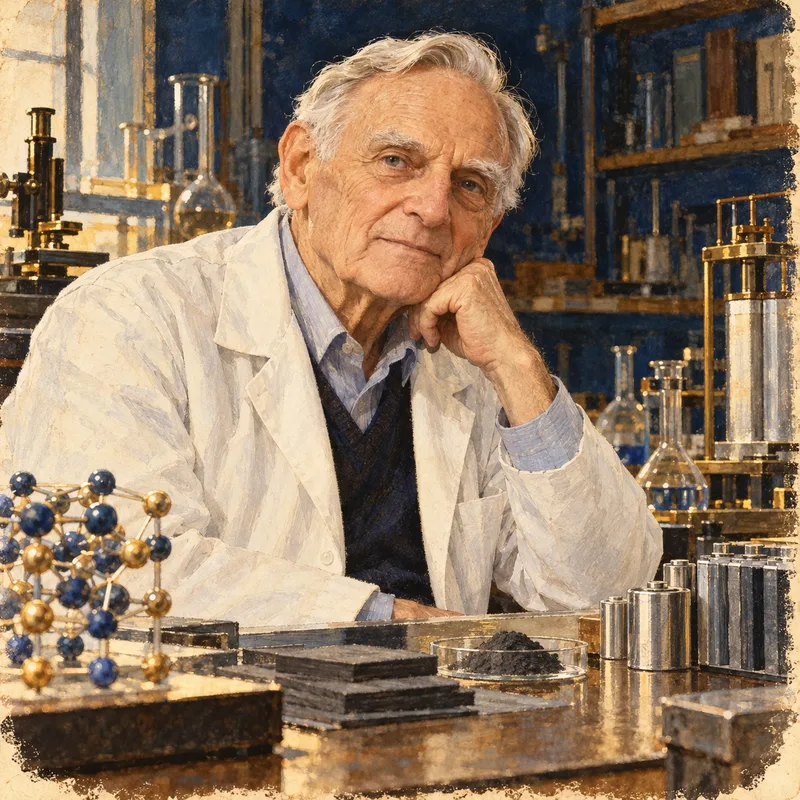
About the chemist
John B. Goodenough
1922-2023 · United States · Nobel Chemistry 2019
Lithium-ion battery cathode materials