Biography · Chemist no. 64 of 350
Sir John Cornforth: The Chemist Who Triumphed over Deafness
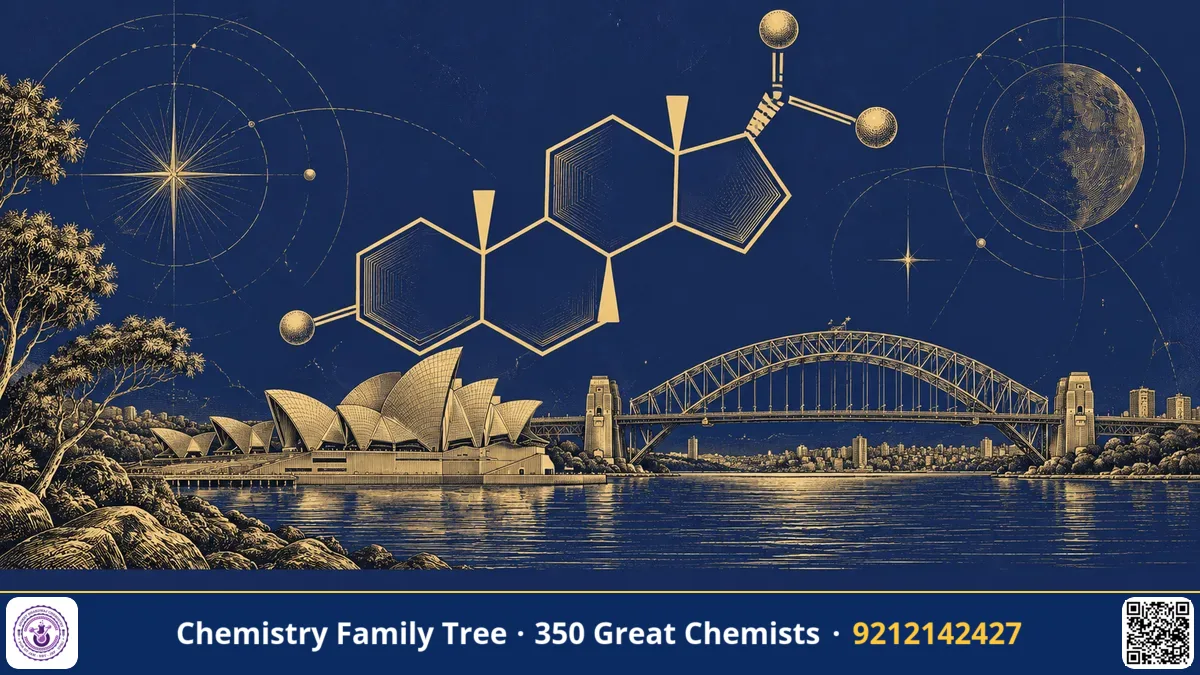
Sir John Warcup Cornforth (1917-2013) was an Australian-British chemist who became almost completely deaf in his teens, and went on to win the 1975 Nobel Prize in Chemistry for his work on the stereochemistry of enzyme-catalysed reactions. With his wife Rita, also a chemist, he worked at Oxford, London and Sussex, and he is remembered for his work on penicillin, the total synthesis of steroids and for tracing the three-dimensional course of cholesterol biosynthesis. His life is a story of determination, teamwork and clear thinking.
Early Life and Family
John Cornforth was born on 7 September 1917 in Sydney, Australia, the second of four children. His father was English-born, and his mother was Australian. He grew up in Sydney and in the Blue Mountains region of New South Wales. As a child he showed an interest in chemistry and carried out experiments at home. From the age of about ten, he began to lose hearing because of otosclerosis, a condition in which the small bones of the ear become fixed. By the time he reached his early twenties he was totally deaf. He never allowed it to stop his scientific career.
Education and Mentors
Cornforth attended Sydney Boys High School, and then went to the University of Sydney, where he studied chemistry and graduated with first-class honours (B.Sc. 1937, M.Sc. 1939). His work at Sydney was under the guidance of J. C. Earl. In 1939 he won an Exhibition of 1851 scholarship and went to Oxford, where he worked with Sir Robert Robinson, one of the great organic chemists. At Oxford he met a fellow Australian chemist, Rita Harradence, whom he married in 1941. Cornforth earned his doctorate (D.Phil.) at Oxford in 1941. During the war, the Oxford group took part in the large British-American penicillin project, working on its structure and synthesis.
Career Timeline
| Year | Event |
|---|---|
| 1917 | Born in Sydney, Australia (7 September) |
| 1937-1939 | B.Sc. and M.Sc., University of Sydney |
| 1939 | Went to Oxford on a scholarship to work with Robert Robinson |
| 1941 | D.Phil., Oxford; married Rita Harradence |
| 1941-1945 | Wartime work on penicillin with the Oxford group |
| 1949 | Described the Cornforth rearrangement of oxazoles |
| 1946-1962 | National Institute for Medical Research, Mill Hill, London |
| 1951 | Total synthesis of cholesterol and related steroids with Robinson and co-workers |
| 1962 | Director, Milstead Laboratory of Chemical Enzymology, Shell Research |
| 1969 | Chiral methyl acetate developed by his group and, independently, by Duilio Arigoni's group |
| 1975 | Nobel Prize in Chemistry (shared with Vladimir Prelog); Professor at University of Sussex |
| 1977 | Knighted |
| 2013 | Died in Sussex, England (8 December) |
Major Scientific Contributions
1. Penicillin
Cornforth and colleagues contributed to establishing the structure of penicillin, which contains a fused β-lactam and thiazolidine ring system. His work helped the war-time effort to mass-produce this life-saving antibiotic.
2. Steroid synthesis
With Robert Robinson and others, Cornforth took part in the total synthesis of cholesterol and other steroids in the early 1950s, a landmark in organic synthesis.
3. Cholesterol biosynthesis
At Mill Hill with George Popják he used deuterium- and tritium-labelled mevalonate to work out the stereochemistry of every step of the conversion of mevalonate into squalene and cholesterol.
acetate → mevalonate → isopentenyl PP → farnesyl PP → squalene → lanosterol → cholesterol
4. Chiral methyl groups
He and his colleagues (and, independently, Duilio Arigoni's group) made chiral acetate CHDT-COOH, which allowed determination of the stereochemical course (inversion or retention) of reactions at a methyl group in enzyme systems.
5. Cornforth rearrangement
The thermal rearrangement of 4-acyloxazoles, in which the acyl group and the C-5 substituent interchange through a nitrile ylide intermediate, is named after him.
Awards, Honours and Nobel Prize
The Nobel Prize in Chemistry 1975 was awarded to Cornforth "for his work on the stereochemistry of enzyme-catalysed reactions" and Prelog "for his research into the stereochemistry of organic molecules and reactions". Cornforth was elected a Fellow of the Royal Society in 1953 and was knighted (Sir John Cornforth) in 1977. In Australia, he was made a Companion of the Order of Australia in 1991, and he received numerous honorary degrees and other awards.
Personality, Struggles and Lesser-Known Facts
- Deafness: Otosclerosis began to affect his hearing in childhood and he became fully deaf in his early twenties. He relied on lip-reading, written notes and the help of his wife and colleagues.
- A scientific partnership: Rita Cornforth was a chemist in her own right and a close collaborator for most of his career. Many of the papers on steroids and biosynthesis have both names on them.
- Deep concentration: Because he could not hear, he spent much of his time in quiet thought, and colleagues said this helped him to focus on difficult problems.
- Thinking in pictures: He is remembered for his clear, logical approach to problems, and for designing elegant experiments in which a simple isotope label provided a decisive answer.
- Industry and academia: He moved from a research institute to an industrial laboratory (Shell's Milstead Laboratory) and then to a university, showing that fundamental research can flourish in any setting.
- Long life: He lived to the age of 96 and stayed interested in science and in the activities of his family and friends in later life.
Legacy and Influence on Modern Chemistry
Cornforth's labelling methods gave a three-dimensional view of enzyme action that is now routine in biochemistry. The pathway he helped to work out is the basis of statin therapy, which has saved millions of lives. His chiral methyl group remains one of the cleverest tools for studying reaction mechanism. He also inspired disabled scientists around the world by proving that deafness need not stop a researcher at the very top of science.
Lessons for Students
- Do not let a disability define your limits: Cornforth became deaf and still won the Nobel Prize.
- Work as a team: His partnership with Rita and with George Popják produced his best results.
- Design simple experiments: A well-chosen isotopic label can answer a complex question.
- Link chemistry with biology: Biochemistry questions in CSIR-NET and GATE Life Sciences-related chemistry sections draw directly from this field.
Quick Facts Box
- Born: 7 September 1917, Sydney, Australia
- Died: 8 December 2013, Sussex, England
- Nationality: Australian-British
- Field: Organic chemistry, biochemistry
- Famous for: Stereochemistry of cholesterol biosynthesis, chiral methyl group, Cornforth rearrangement
- Nobel Prize: Chemistry 1975 (shared with Vladimir Prelog)
FAQ
Why was Cornforth deaf?
He had otosclerosis, a condition in which the bones of the middle ear stiffen, causing progressive hearing loss.
Who was Rita Cornforth?
Rita Cornforth (née Harradence) was an Australian chemist who married John in 1941 and collaborated with him on research.
What is the Cornforth rearrangement?
It is the thermal rearrangement of 4-acyloxazoles in which the acyl group at C-4 and the substituent at C-5 exchange positions.
Where did Cornforth work later in life?
He was Research Professor at the University of Sussex from 1975, after earlier roles at Mill Hill and at Shell's Milstead Laboratory.
Published by ABC Chemistry — IIT-JAM | CSIR-NET | GATE Chemistry Coaching. Visit abcchemistry.com

About the chemist
John Cornforth
1917-2013 · Australia/United Kingdom · Nobel Chemistry 1975
Stereochemistry of enzyme-catalysed reactions