The discovery, explained · Chemist no. 64 of 350
Stereochemistry of Enzyme Reactions: How John Cornforth Traced Every Hydrogen in Cholesterol Synthesis
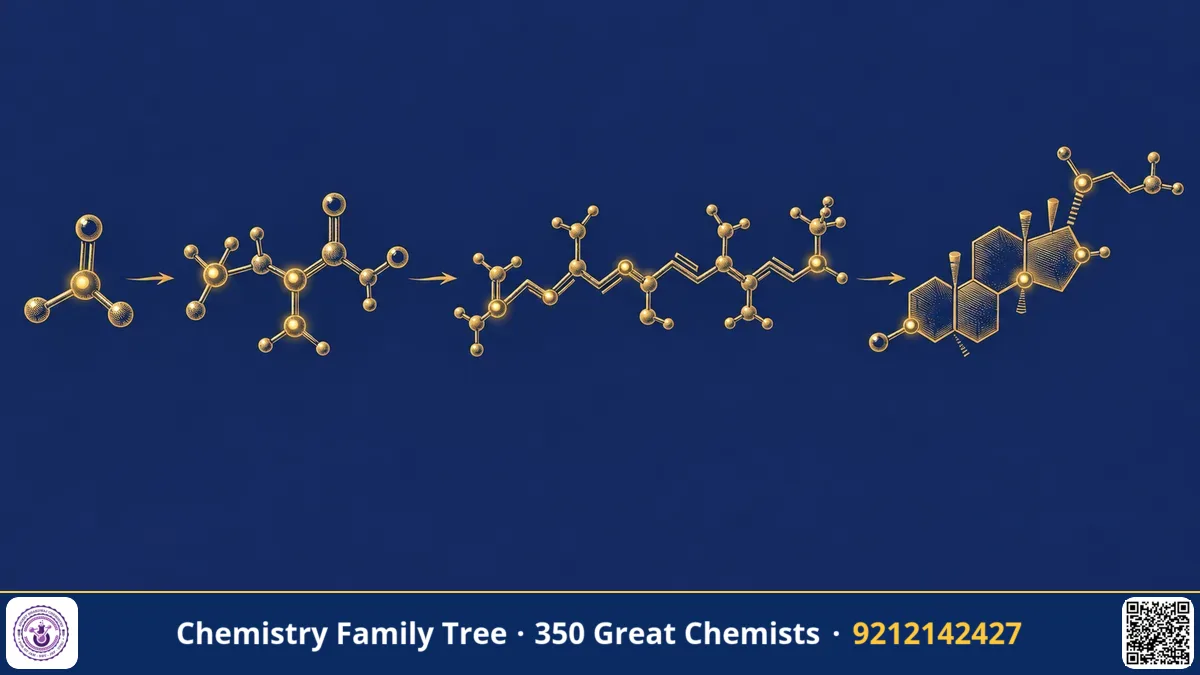
An enzyme is a biological catalyst, but it is also something more: a three-dimensional machine that can tell the difference between two chemically identical-looking groups. Imagine a carbon with two hydrogens, CH2XY. To an ordinary reagent, the two H atoms are the same. To an enzyme, they are different, and the enzyme will remove or modify only one of them. The Australian-born chemist John Warcup Cornforth, working with George Popják, discovered the detailed stereochemistry of these reactions in the biosynthesis of cholesterol. He shared the 1975 Nobel Prize in Chemistry with Vladimir Prelog "for his work on the stereochemistry of enzyme-catalysed reactions". This post explains the central ideas in simple terms.
The Scientific Problem Before the Discovery
In the 1940s and 1950s, Konrad Bloch and others showed with isotope-labelled acetate that all 27 carbon atoms of cholesterol come from acetate. The pathway was found to proceed through mevalonic acid, isopentenyl pyrophosphate and squalene. The big question was how exactly enzymes make cholesterol, a molecule with eight stereocentres. At each step, an enzyme must remove or add hydrogens and form new bonds with a very specific orientation. Chemists had no method to find which hydrogen atom (or which face of a double bond) the enzyme used. If this could be answered, it would show how enzymes work in three dimensions.
Another problem was the concept of prochirality. In 1948, Alexander Ogston explained that an enzyme binding a substrate at three points can distinguish two identical groups on the same carbon. But it was a theory, and it needed experimental proof for each enzyme.
The Discovery: Step by Step
- Synthesis of labelled mevalonate: Cornforth and Popják, at the National Institute for Medical Research in London, prepared samples of mevalonic acid labelled stereospecifically with deuterium (D) and tritium (T) in known positions.
- Feeding enzyme systems: They used liver enzymes and yeast systems to convert labelled mevalonate to squalene and cholesterol, and examined where the isotopes ended up.
- Tracking each hydrogen: By following whether a labelled hydrogen was lost or retained in each step, they could tell which hydrogen the enzyme removed (for example, the pro-R or pro-S hydrogen at a CH2 group) and from which face of a double bond a proton was added.
- The chiral methyl group: In 1969, Cornforth (working with Hermann Eggerer and colleagues) and, independently, a group led by Duilio Arigoni developed an elegant tool: a methyl group made chiral by using all three hydrogen isotopes, CHDT. Such a methyl group is chiral and can be used to find out whether an enzyme reaction occurs with inversion or retention at a methyl carbon.
The Chemistry Behind It
The cholesterol biosynthesis pathway (simplified)
3 Acetyl-CoA  →  HMG-CoA
HMG-CoA + 2 NADPH  →  mevalonate    (HMG-CoA reductase; the target of statins)
mevalonate  →  isopentenyl pyrophosphate (IPP, C5)  ⇌  dimethylallyl pyrophosphate (DMAPP)
IPP + DMAPP → geranyl PP (C10);  + IPP → farnesyl PP (C15)
2 farnesyl PP + NADPH  →  squalene (C30)
squalene + O2  →  squalene epoxide  →  lanosterol (C30)  →  cholesterol (C27)
Prochirality
The two hydrogens of a CH2 group in a molecule like ethanol, CH3CH2OH, are enantiotopic: replacing one by D gives (R)-, the other gives (S)-CH3CHDOH. They are named pro-R and pro-S. An enzyme, being chiral, can distinguish them. Cornforth showed that enzymes in the pathway do so with almost perfect selectivity.
Examples of findings
- The conversion of IPP to DMAPP by isomerase involves loss of a specific proton from C-2 of IPP, and addition of a proton to a specific face of the double bond.
- In the formation of squalene from two farnesyl units, the hydrogens at C-1 are lost or kept in a precise stereochemical way, with one hydrogen being replaced by one from NADPH, delivered to a specific face.
- In the conversion of squalene epoxide to lanosterol, a cascade of cyclisation and rearrangement steps occurs, with 1,2-shifts of hydrogen and methyl groups. Cornforth's labelling revealed which groups migrate.
Chiral methyl group
A methyl group carrying H, D and T is chiral. The two groups prepared samples of (R)- and (S)-acetic acid, CHDT-COOH, and used them to study enzymes such as malate synthase and citrate synthase. By converting the acetate into malate and measuring the tritium retained after fumarase action, one can find whether the enzyme reaction goes with inversion or retention. This showed, for instance, that the condensation catalysed by malate synthase proceeds with inversion of configuration at the methyl carbon.
CHDT-COO- + glyoxylate --malate synthase--> malate (inversion at the methyl carbon)
Cornforth rearrangement
In 1949, during penicillin-related studies, Cornforth also described the thermal rearrangement of 4-acyloxazoles, in which the acyl substituent and the C-5 substituent of the oxazole ring exchange places. It is now known as the Cornforth rearrangement.
Applications Today
- Statin drugs: Knowing the pathway to cholesterol and its key enzyme, HMG-CoA reductase, led to the development of statins such as lovastatin, simvastatin and atorvastatin, widely used in India and worldwide to lower cholesterol.
- Understanding enzyme mechanisms: Stereochemical labelling is a standard tool for studying enzyme mechanisms, including those of drug targets.
- Biosynthesis of natural products: The same approach is used to study the biosynthesis of terpenes, steroids and antibiotics, including the route to isoprenoids in plants.
- Drug design: Knowing which enantiotopic group an enzyme attacks helps in designing inhibitors and prodrugs.
- NMR and mass spectrometry: Modern methods use stable isotopes like 2H and 13C to trace metabolic routes, a descendant of the early labelling experiments.
Exam Corner
- All 27 carbons of cholesterol come from acetate (via acetyl-CoA and mevalonate). The key regulated step is HMG-CoA → mevalonate, catalysed by HMG-CoA reductase, inhibited by statins.
- Squalene (C30) is formed from two molecules of farnesyl pyrophosphate (C15) in a tail-to-tail coupling.
- Prochiral CH2 groups have enantiotopic H atoms (pro-R, pro-S) which enzymes can distinguish.
- A CHDT methyl is chiral. Used to study inversion/retention in enzymatic reactions.
- Cornforth and Prelog shared the 1975 Nobel Prize in Chemistry.
Common Misconceptions
- "Two hydrogens on a CH2 are always identical." To an achiral reagent, yes. To a chiral enzyme, no.
- "A methyl group cannot be chiral." A methyl group with three different isotopes of hydrogen (H, D, T) is chiral.
- "Cornforth discovered cholesterol." Cholesterol was known since the eighteenth century. Cornforth worked out the stereochemistry of how the body makes it.
Quick Revision Box
- Cornforth + Popják: stereochemistry of cholesterol biosynthesis using D and T labelling.
- Pathway: acetyl-CoA → HMG-CoA → mevalonate → IPP → FPP → squalene → lanosterol → cholesterol.
- Chiral methyl (CHDT) acetate, developed in 1969 by Cornforth's group and independently by Arigoni's group, used to study enzyme stereochemistry.
- Enzymes discriminate enantiotopic groups (prochirality, Ogston 1948).
- Nobel Prize in Chemistry 1975 (with Prelog).
FAQ
What is a prochiral centre?
A prochiral centre is an atom that is not chiral itself, but becomes chiral when one of two identical groups on it is replaced by a different group.
What is a chiral methyl group?
It is a methyl group in which the three hydrogen positions are occupied by three different isotopes: protium, deuterium and tritium.
Why is mevalonate important?
It is the product of the key regulated step of the pathway and the precursor of all isoprenoids and steroids; statins block its formation.
What was Cornforth's Nobel Prize for?
For his work on the stereochemistry of enzyme-catalysed reactions.
Published by ABC Chemistry — IIT-JAM | CSIR-NET | GATE Chemistry Coaching. Visit abcchemistry.com
About the chemist
John Cornforth
1917-2013 · Australia/United Kingdom · Nobel Chemistry 1975
Stereochemistry of enzyme-catalysed reactions