The discovery, explained · Chemist no. 227 of 350
AlphaFold2: How John Jumper Led the Neural Network That Predicts Protein Structures
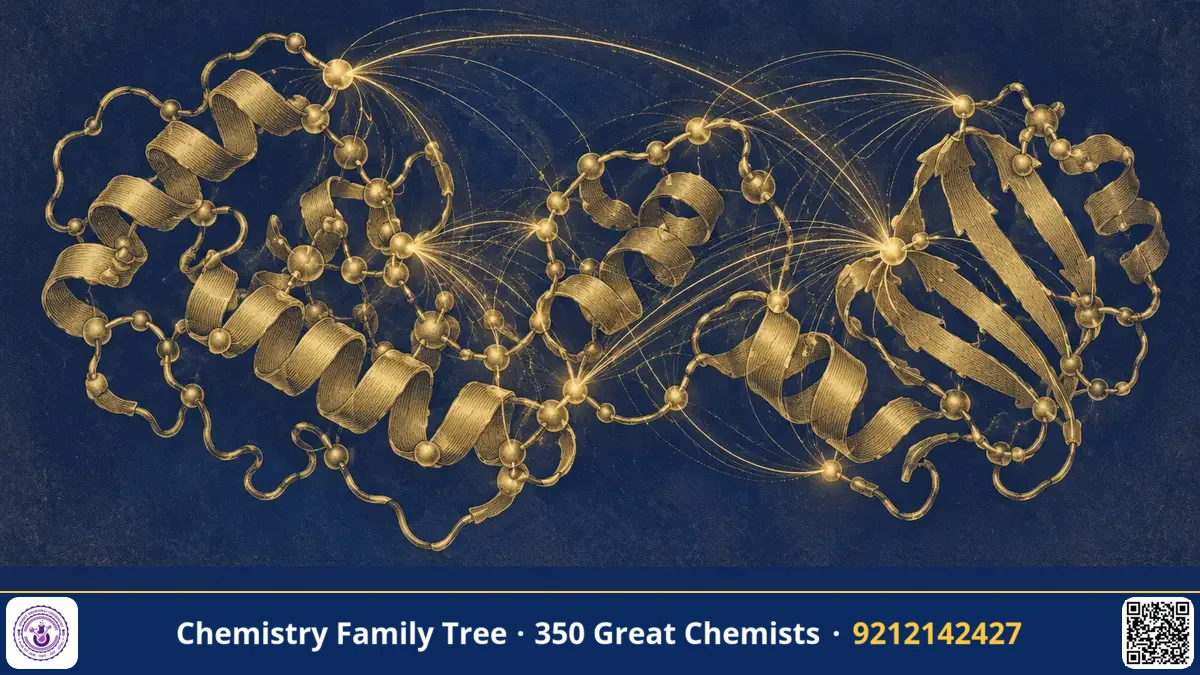
Before 2020, if you wanted to know the shape of a protein you usually had to grow crystals, run an NMR experiment or freeze the sample for cryo-electron microscopy. In July 2021 the journal Nature published a paper by John Jumper and colleagues at DeepMind describing a program that could predict the 3D structure of a protein from its amino acid sequence, with accuracy often comparable to experiments. The system, AlphaFold2, had won the 14th round of the CASP competition in late 2020. In 2024, Jumper and Demis Hassabis shared half of the Nobel Prize in Chemistry "for protein structure prediction", while David Baker received the other half for protein design.
This post focuses on what Jumper's team actually did: how the AlphaFold2 network works, why the chemistry of proteins made it possible, and what to remember for exams.
The Scientific Problem Before the Discovery
The protein folding problem has three related parts: (1) predicting the final folded structure from the sequence, (2) understanding the pathway by which the chain folds, and (3) designing a sequence that folds into a chosen shape. AlphaFold addresses the first.
Physical approaches try to simulate atoms using force fields and molecular dynamics. They are accurate in principle, but the computing cost is huge because proteins have thousands of atoms, a vast conformational space, and fold on timescales of microseconds to seconds. Jumper himself had worked in this area: he worked at D. E. Shaw Research, where specialised computers (Anton) were built for long molecular dynamics simulations, and did his PhD at the University of Chicago on protein physics and simulation. He understood both the beauty and the limits of physics-based methods.
The other approach was knowledge-based: use the thousands of known structures and the huge number of known sequences to learn patterns. By 2018, DeepMind's first AlphaFold had shown that machine learning could predict inter-residue distances. But for most proteins, predictions were still far from atomic accuracy.
The Discovery / Experiment
When Jumper joined DeepMind in 2017, the protein folding team was small. He became the lead researcher on AlphaFold2, and the main new idea was to design a neural network that thinks about the geometry of the protein and the evolutionary data together, and that is trained end-to-end to produce atomic coordinates.
- Input. The target sequence is searched against large databases to build a multiple sequence alignment (MSA) of related sequences from evolution, and optionally a set of similar known structures (templates).
- Evoformer. This block of the network has two linked representations: the MSA (a table of sequences by residues) and a pair representation (a table of every residue pair). Attention layers update one using the other, repeatedly (48 blocks), so that evolutionary correlations are turned into a consistent picture of which residues are close and how they are oriented.
- Structure module. It converts the pair representation into 3D positions. It treats each residue as a rigid frame (a triangle of the backbone atoms N, C-alpha and C), and applies rotations and translations to place them, using "invariant point attention" so that the result does not depend on the arbitrary orientation of the coordinate system.
- Recycling. The output is fed back into the network several times to refine it.
- Training. The network was trained on the structures in the Protein Data Bank, with a loss function that rewards accurate local geometry (FAPE, frame aligned point error), plus extra self-distillation using its own high-confidence predictions on unlabelled sequences.
At CASP14 (2020), AlphaFold2 gave a median backbone accuracy of about 0.96 angstrom RMSD (roughly the width of a carbon atom) for many targets, far above any other group, and about 90 on the GDT scale for most targets. Organisers described the problem as largely solved for single protein chains.
The Chemistry Behind It
Why co-evolution works. Residues that touch each other in a folded protein are under joint evolutionary pressure. If a positively charged lysine is replaced by a negatively charged glutamate in one position, its partner might change to the opposite charge to preserve a salt bridge. Correlated mutations in the MSA therefore point to contacts in 3D.
Geometry of the backbone. The peptide bond (C-N) has partial double-bond character because of resonance, so the amide plane is rigid and planar (omega angle close to 180 degrees for trans). Only the phi (N-C-alpha) and psi (C-alpha-C) angles vary freely, subject to steric limits shown in the Ramachandran plot. AlphaFold2's frame-based approach uses this chemistry: rigid blocks connected by flexible hinges.
| Structural level | Description | Example |
|---|---|---|
| Primary | Amino acid sequence | Input to AlphaFold |
| Secondary | Alpha-helix, beta-sheet | Hydrogen bonds in the backbone |
| Tertiary | Overall 3D fold | Output of AlphaFold |
| Quaternary | Subunit assembly | AlphaFold-Multimer, AlphaFold3 |
Confidence and limitations. The model gives a per-residue confidence score (pLDDT) and a predicted aligned error that shows which domains are positioned reliably relative to each other. It predicts mainly one structure, not the full ensemble of motions; it is weaker for intrinsically disordered regions, for the effect of single point mutations, and for cases with few related sequences.
In 2024 DeepMind and Isomorphic Labs released AlphaFold3, which extends the approach to complexes of proteins with DNA, RNA, small-molecule ligands and ions, using a diffusion-based architecture.
Applications Today
- Drug discovery. Models of drug targets help design ligands, and are used in docking and virtual screening.
- Understanding disease mutations. Researchers map mutations onto predicted structures to see their possible impact.
- Experimental structure solving. Predicted models are used as starting models for crystallography (molecular replacement) and cryo-EM interpretation.
- Agriculture and environment. Studying enzymes in crops, bees' immune proteins and plastic-degrading enzymes.
- Teaching. The AlphaFold database lets Indian students explore protein structures on a laptop.
Exam Corner
- The peptide bond is planar due to resonance, with partial double-bond character (about 40%).
- Ramachandran plot shows allowed phi-psi combinations.
- AlphaFold2 won CASP14 in 2020, using attention and MSA-based evolutionary information.
- pLDDT above 90 indicates very high confidence; below 50 suggests disorder.
- 2024 Nobel Prize in Chemistry: Baker, Hassabis, Jumper.
Common Misconceptions
- "AlphaFold simulates folding step by step." It predicts the end structure directly; it is not a molecular dynamics simulation.
- "A high-confidence prediction is always correct for function." A good fold does not tell you binding, dynamics or the effect of modifications.
- "Jumper built AlphaFold alone." It was a large team effort; he led the scientific work on AlphaFold2.
Quick Revision Box
- Input: sequence plus MSA plus templates.
- Core: Evoformer (MSA and pair attention), then a structure module with rigid frames.
- Accuracy at CASP14: around 0.96 angstrom median backbone RMSD.
- Paper: Jumper et al., Nature, 2021.
- Confidence: pLDDT and predicted aligned error.
- Nobel Prize in Chemistry 2024 (shared with Hassabis).
FAQ
What does MSA mean?
Multiple sequence alignment: an alignment of related protein sequences from different organisms, used to find conserved and co-varying positions.
What is attention in a neural network?
It is a mechanism in which each element of the input can weigh the importance of every other element when computing its new representation.
Is AlphaFold2 open source?
Yes, the AlphaFold2 code and parameters were released in 2021 and the predicted structures are available in a public database.
Why is this a chemistry prize?
Because it solves a central question of molecular structure: how the sequence of a chemical polymer determines its 3D shape.
Published by ABC Chemistry — IIT-JAM | CSIR-NET | GATE Chemistry Coaching. Visit abcchemistry.com

About the chemist
John Jumper
1985- · United States · Nobel Chemistry 2024
AlphaFold protein structure prediction