Biography · Chemist no. 227 of 350
John Jumper: The Young Scientist Who Led AlphaFold2 to a Nobel Prize
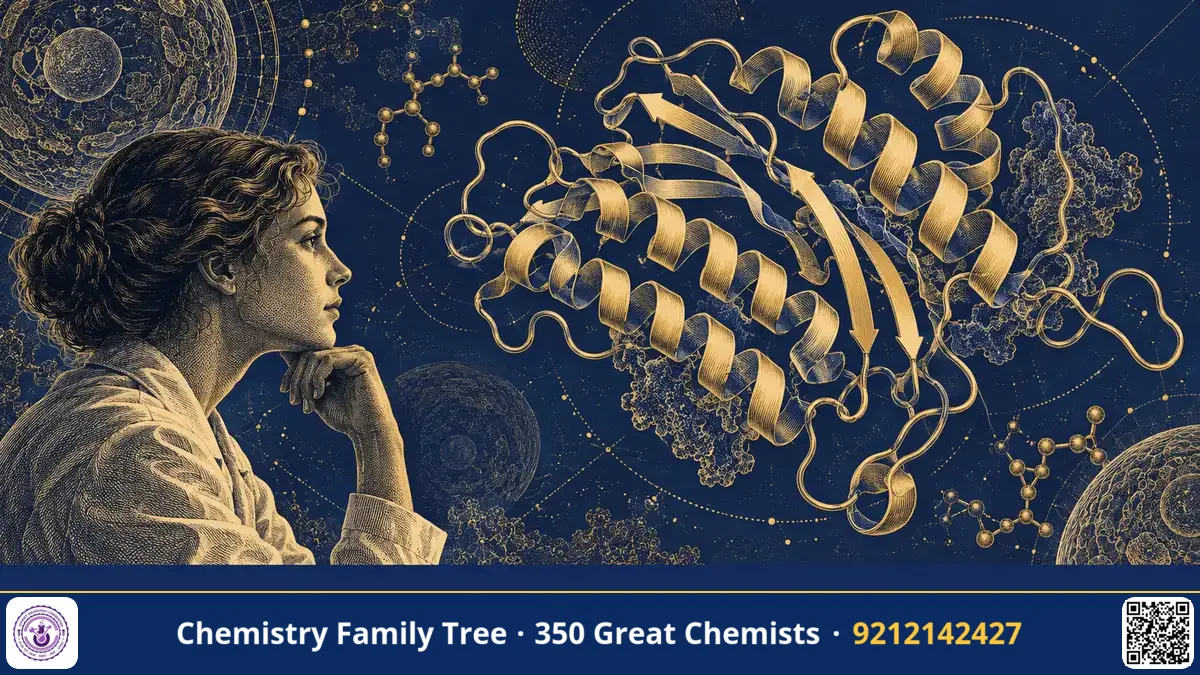
John Michael Jumper, born in 1985 in the United States, is a senior research scientist and director at Google DeepMind. He led the research team that built AlphaFold2, the AI system that predicts protein structures from sequences. In 2024, at the age of 39, he shared half of the Nobel Prize in Chemistry with Demis Hassabis; the other half went to David Baker. His legacy in one line: a physicist who became a computational chemist and then an AI scientist, he helped solve a 50-year-old grand challenge.
Early Life and Family
Jumper was born on 23 February 1985 and grew up in Little Rock, Arkansas, in the southern United States. He has said in interviews that he was a student who enjoyed mathematics and science from a young age. Further details of his family life are not widely documented, and this post does not go beyond what is publicly known.
Education and Mentors
Jumper studied physics and mathematics at Vanderbilt University in Tennessee, graduating in 2007. He then went to the University of Cambridge in the United Kingdom for a master's degree in theoretical condensed matter physics. After that, he worked at D. E. Shaw Research in New York, a company that built specialised supercomputers (Anton) to run long molecular dynamics simulations of proteins. There he worked on methods to simulate and understand protein behaviour.
He later went to the University of Chicago for a PhD in chemistry, completed in 2017, in the field of theoretical chemistry and biophysics. His doctoral work, with advisers who included Tobin Sosnick and Karl Freed, was on developing methods for protein structure and dynamics, in part using machine learning approaches. In the same year he finished his PhD, he joined DeepMind in London.
Career Timeline
| Year | Event |
|---|---|
| 1985 | Born; later grows up in Little Rock, Arkansas |
| 2007 | Graduates from Vanderbilt University (physics and mathematics) |
| Late 2000s | Master's study at the University of Cambridge |
| Before 2012 | Works at D. E. Shaw Research on protein simulation |
| 2017 | Completes PhD in chemistry at the University of Chicago; joins DeepMind |
| 2018 | Contributes to AlphaFold, which wins CASP13 |
| 2020 | Leads AlphaFold2, which achieves near-experimental accuracy at CASP14 |
| 2021 | Paper in Nature; AlphaFold code and database released |
| 2024 | Nobel Prize in Chemistry (shared) |
Major Scientific Contributions
AlphaFold2 (2020-2021). Jumper led the research on the AlphaFold2 architecture, with its Evoformer and structure module, and with the team trained the network that solved the protein structure prediction problem for most single-chain proteins. See our discovery post for the technical details.
Open access to predictions. He was one of the lead authors of the 2021 Nature paper and of the team that made the code open and, with the European Bioinformatics Institute, helped release structures of hundreds of millions of proteins.
AlphaFold3 (2024). The team extended the approach to predict the joint structure of proteins with DNA, RNA, ligands and ions, which is highly important for drug discovery.
Earlier work. Before DeepMind, his research on molecular simulation and on protein structure with machine learning prepared him for this project.
Awards, Honours and Nobel Prize
John Jumper received half of the Nobel Prize in Chemistry 2024 together with Demis Hassabis "for protein structure prediction". He was among the youngest Nobel laureates in chemistry in recent decades. In 2023 he and Hassabis also shared the Albert Lasker Basic Medical Research Award and the Breakthrough Prize in Life Sciences. These are the awards that can be stated with confidence.
Personality, Struggles and Lesser-Known Facts
- Simulation to learning. He moved from physics-based simulation of proteins to machine learning, combining the two ways of thinking.
- Competition as a test. AlphaFold2 was judged blind in CASP14 in 2020, so the result could not be tuned in advance.
- Crediting the team. He regularly emphasises that AlphaFold was built by a large team of scientists and engineers, and by decades of work by the structural biology community, who created the Protein Data Bank that was needed to train it.
- A link between two prizes. Karl Freed, one of his Chicago advisers, was also the PhD adviser of 2023 laureate Moungi Bawendi.
- A bridge between disciplines. His path moves from physics to chemistry to AI, showing that one can be flexible in the early career.
Legacy and Influence on Modern Chemistry
AlphaFold2 has been used in a vast number of research projects around the world. Biologists and chemists now often start a project by looking at the predicted structure of the target protein. It made structure available for proteins that could not be crystallised, and speeds up hypothesis generation. It also inspired a new generation of AI models for chemistry and biology: those that predict molecular interactions, design proteins and model chemical reactions. For students in India, it reduces the barrier of expensive equipment and shows the value of learning programming alongside chemistry.
Lessons for Students
- Build a broad base. Physics, mathematics, chemistry and programming all mattered.
- Stay with a hard problem. Protein folding resisted attempts for fifty years.
- Respect earlier work. AlphaFold stood on the shoulders of the experimental structures in the PDB.
- Test honestly. Blind competitions like CASP keep science honest.
- Work in teams. Big problems need many skills.
Quick Facts Box
- Born: 23 February 1985, United States (grew up in Little Rock, Arkansas)
- Died: Living
- Nationality: American
- Field: Computational chemistry, machine learning
- Famous for: Leading the development of AlphaFold2
- Nobel: Chemistry 2024 (half, with Demis Hassabis)
FAQ
Where does John Jumper work?
He works at Google DeepMind, based in London.
What is his educational background?
He studied physics and mathematics at Vanderbilt, did a master's at Cambridge and a PhD in chemistry at the University of Chicago.
How did he and Hassabis share the Nobel Prize?
Hassabis led DeepMind and set the strategy, while Jumper led the scientific development of AlphaFold2; both received half of the prize.
Which skills should a chemistry student learn from his story?
Basic programming, statistics and machine learning along with the fundamentals of structure and thermodynamics.
Published by ABC Chemistry — IIT-JAM | CSIR-NET | GATE Chemistry Coaching. Visit abcchemistry.com
About the chemist
John Jumper
1985- · United States · Nobel Chemistry 2024
AlphaFold protein structure prediction