Biography · Chemist no. 135 of 350
Sir John Cowdery Kendrew (1917-1997): The Scientist Who First Saw a Protein
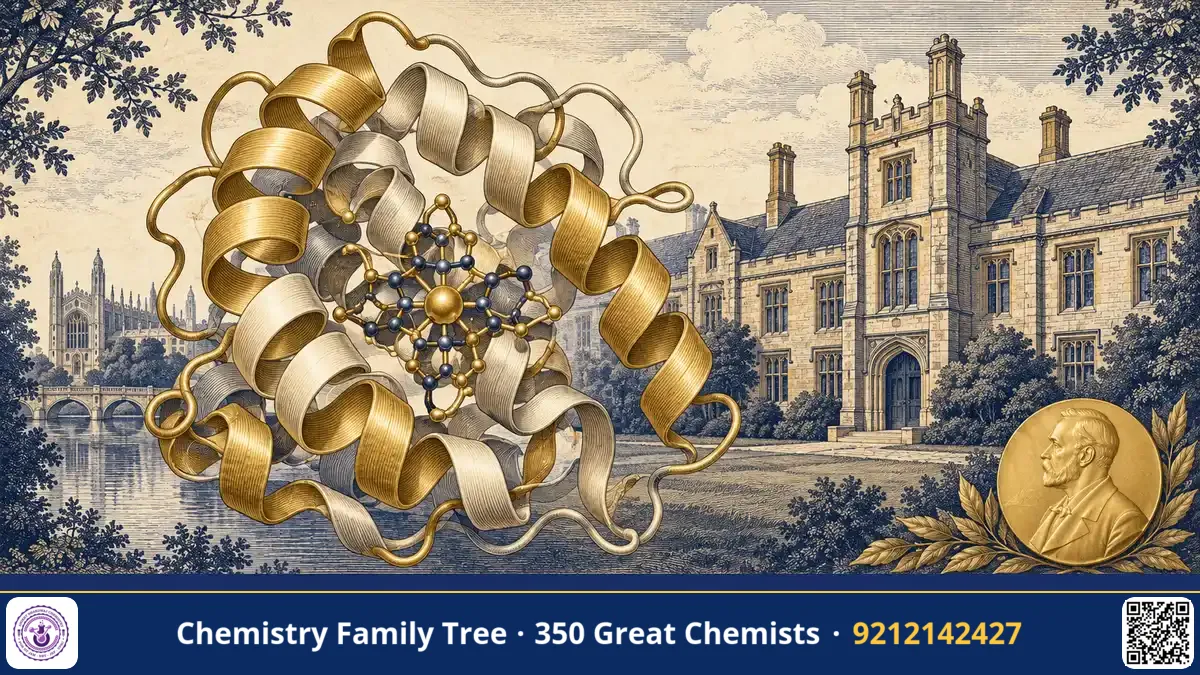
Sir John Kendrew was a British biochemist and structural biologist who determined the first three-dimensional structure of a protein, sperm whale myoglobin, using X-ray crystallography. He shared the 1962 Nobel Prize in Chemistry with Max Perutz. Beyond the laboratory he helped to create the European Molecular Biology Organization (EMBO) and the European Molecular Biology Laboratory (EMBL), and he founded the Journal of Molecular Biology. His legacy in one line: he turned the protein from an abstract chain into a real object that chemists could see, and he helped build European science around it.
Early Life and Family
Kendrew was born on 24 March 1917 in Oxford, England. His father, Wilfrid Kendrew, was a climatologist, and his mother, Evelyn Sandberg, was an art historian. He grew up in a family that valued scholarship and the arts, and he kept a lifelong interest in music and art alongside science. He was educated at Clifton College in Bristol, where his interest in science developed.
Education and Mentors
In 1936 Kendrew entered Trinity College, Cambridge, and studied chemistry, graduating in 1939. Just as his research career was beginning, the Second World War started, and he went into scientific war service. He worked in operational research on radar and on the effectiveness of bombing for the Air Ministry and the Royal Air Force, rising to the rank of Wing Commander, and served in North Africa, Italy and South-East Asia. After the war he returned to Cambridge, where he joined Max Perutz in the Cavendish Laboratory under Sir Lawrence Bragg. He completed his PhD in 1949 and soon began to concentrate on myoglobin. Bragg, the pioneer of X-ray crystallography, was a major influence.
Career Timeline
| Year | Event |
|---|---|
| 1917 | Born in Oxford |
| 1936-1939 | Studies chemistry at Trinity College, Cambridge |
| 1940-1945 | War service in scientific and operational research |
| 1946 | Returns to Cambridge, joins the group of Max Perutz |
| 1947 | Becomes a Fellow of Peterhouse, Cambridge |
| 1957 | First low-resolution (6 Å) model of myoglobin |
| 1959 | Founds the Journal of Molecular Biology |
| 1960 | 2 Å resolution structure of myoglobin |
| 1962 | Nobel Prize in Chemistry with Max Perutz |
| 1960s | Helps to found EMBO |
| 1974 | Knighted |
| 1975-1982 | First Director-General of EMBL |
| 1997 | Dies in Cambridge |
Major Scientific Contributions
Myoglobin structure. In 1957 Kendrew and his team produced a 6 Å map of sperm whale myoglobin that showed a compact molecule with rod-like helical segments. In 1960 a 2 Å map allowed most of the chain to be traced: 153 amino acids, eight α-helices, and a heme group with Fe²⁺ bound to a histidine. The phase problem was solved by isomorphous replacement with heavy atoms, with crucial support from the use of electronic computers.
Principles of protein folding. His structure showed that non-polar side chains are packed in the interior while polar groups face the aqueous surroundings, establishing the hydrophobic core as a basic principle.
Haemoglobin comparison. Comparison with Perutz's haemoglobin structure showed that both share a similar globin fold, a milestone for evolutionary biochemistry.
Scientific organisation. He founded the Journal of Molecular Biology (1959) with Max Perutz's support and served as an editor, and he led the creation of EMBO and EMBL, which now provide training and research facilities for European molecular biology.
Details of the method are discussed in the companion discovery article.
Awards, Honours and Nobel Prize
Kendrew shared the 1962 Nobel Prize in Chemistry with Max Perutz "for their studies of the structures of globular proteins". In the same year, James Watson, Francis Crick and Maurice Wilkins received the Nobel Prize in Physiology or Medicine for the structure of DNA, so 1962 was a landmark year for molecular biology. Kendrew was elected a Fellow of the Royal Society in 1960 and was knighted in 1974. He received numerous honorary degrees and served as President of St John's College, Oxford, from 1981 to 1987.
Personality, Struggles and Lesser-Known Facts
- The first 3D models of myoglobin were built physically from rods and clips on a frame, and the "forest of rods" model of the 2 Å map at the Cavendish became famous.
- Kendrew chose myoglobin partly because it is small. The sperm whale supply came from the muscle of the whale, which stores plenty of oxygen for deep dives.
- When the first map appeared, he and his colleagues were disappointed to see an irregular, asymmetric object, because they had hoped for a neat symmetric architecture. The later analysis showed that the irregularity serves function.
- He wrote the popular book The Thread of Life (1966), explaining molecular biology to non-specialists, and edited a wide-ranging encyclopaedia of science.
- He was a person of many interests: music, art, and the politics of science. He advised the British government on defence science in the 1960s.
Legacy and Influence on Modern Chemistry
Kendrew's myoglobin was the first of a vast library of protein structures. The Protein Data Bank started in 1971 with a handful of entries, including myoglobin, and now holds hundreds of thousands. Structure-based drug design, enzymology, molecular medicine and AI protein prediction (such as AlphaFold, which was trained on PDB data) all rest on this tradition. EMBL, which he created, remains a leading research centre with outstations in several European countries. Indian researchers are connected to this community through many collaborations. For examinations, Kendrew is remembered for myoglobin (the first protein structure), Perutz for haemoglobin, and both for the 1962 Nobel Prize in Chemistry.
Lessons for Students
- Choose a model system you can manage. Myoglobin was small enough to solve.
- Keep going through long, dull computations; the result may be a first in science.
- Build institutions: journals, laboratories and training programmes help the whole community.
- Stay curious beyond your field, in music, art and public affairs.
Quick Facts Box
- Born: 24 March 1917, Oxford, England
- Died: 23 August 1997, Cambridge, England
- Nationality: British
- Field: Molecular biology, protein crystallography
- Famous for: First 3D structure of a protein (myoglobin); founding EMBL
- Nobel Prize: Chemistry, 1962 (shared with Max Perutz)
FAQ
Is Kendrew's Nobel Prize in Chemistry or Medicine?
It is in Chemistry. The Medicine prize of 1962 went to Watson, Crick and Wilkins for DNA structure.
What was the role of Max Perutz?
Perutz was Kendrew's colleague and mentor, who solved the haemoglobin structure and developed the isomorphous replacement approach to the phase problem.
What is EMBL?
The European Molecular Biology Laboratory, an intergovernmental research organisation founded in 1974 with Kendrew as its first Director-General.
Which protein did he solve?
Sperm whale myoglobin, an oxygen-storing muscle protein.
Published by ABC Chemistry — IIT-JAM | CSIR-NET | GATE Chemistry Coaching. Visit abcchemistry.com
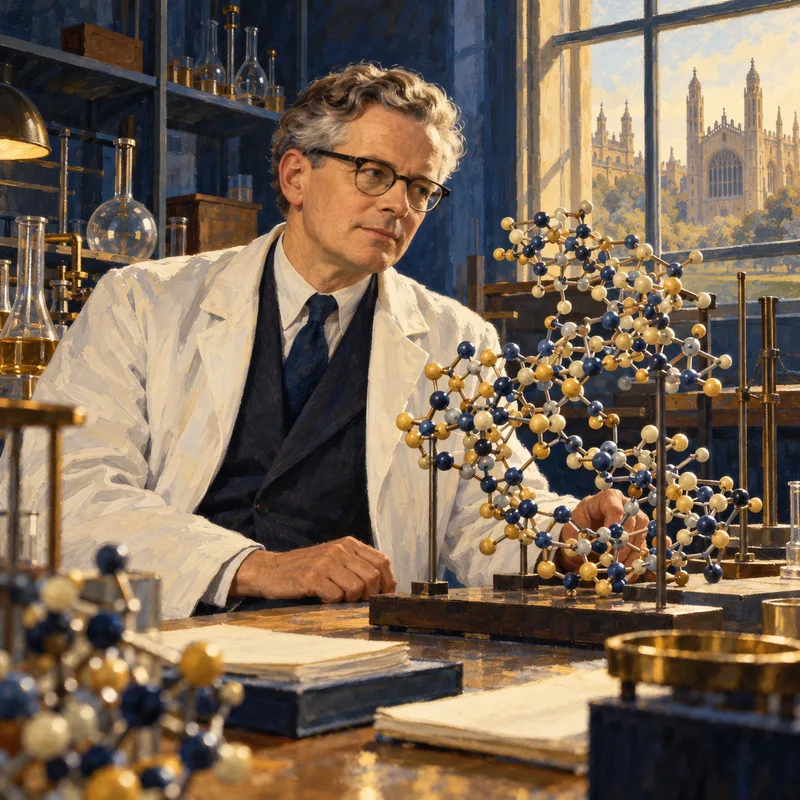
About the chemist
John Kendrew
1917-1997 · United Kingdom · Nobel Chemistry 1962
Structure of myoglobin