Biography · Chemist no. 156 of 350
John Polanyi: Complete Life and Legacy of a Reaction Dynamics Pioneer
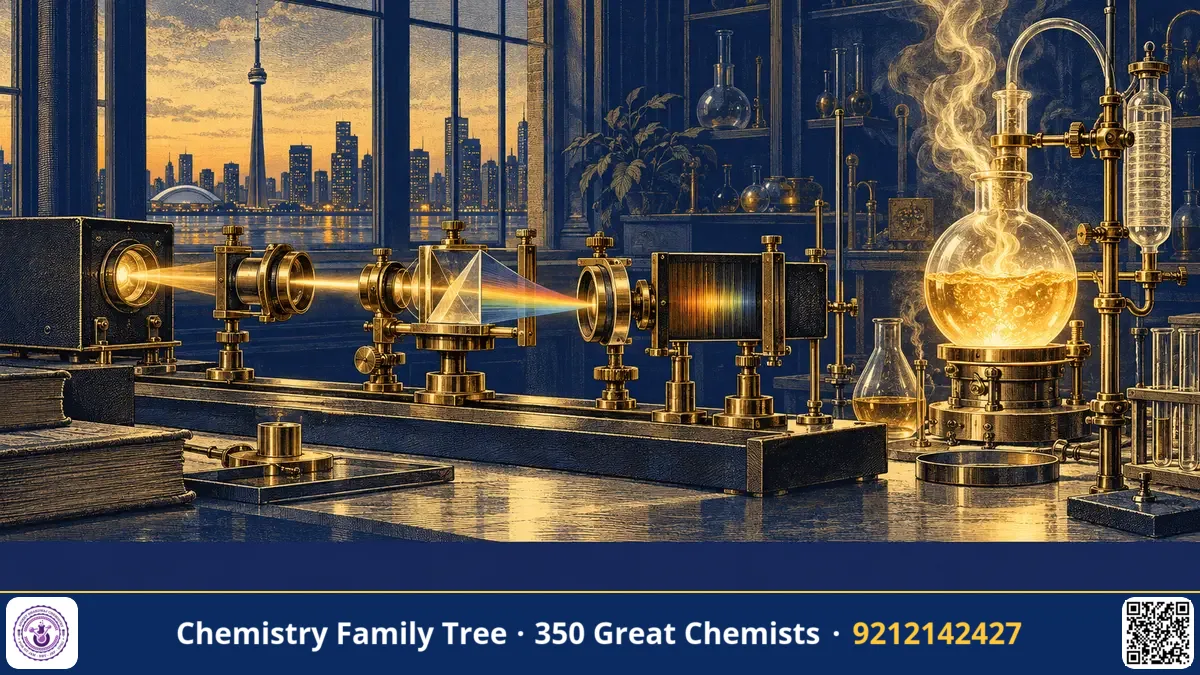
John Charles Polanyi, born in 1929, is a Canadian chemist whose studies of infrared emission from newly formed molecules revealed how chemical reactions distribute their energy. He shared the 1986 Nobel Prize in Chemistry with Dudley Herschbach and Yuan T. Lee. Spending most of his career at the University of Toronto, he also became a well-known voice on science, public policy and nuclear arms control. His legacy: he showed that the energy of a reaction can be traced to specific motions of the product, and this idea underlies chemical lasers.
Early Life and Family
John Polanyi was born on 23 January 1929 in Berlin, Germany. His father, Michael Polanyi, was a physical chemist and later a philosopher of science, and his family was of Hungarian background. As political conditions worsened in Germany in the early 1930s, the family moved to England; Michael Polanyi took a professorship at the University of Manchester. John grew up in Manchester in an intellectually lively household where science, philosophy and economics were discussed at the table. His uncle, Karl Polanyi, was a well-known economic historian. The family environment encouraged curiosity from the beginning.
Education and Mentors
Polanyi studied chemistry at the University of Manchester, earning a BSc in 1949 and a PhD in 1952. His doctoral work was on the kinetics of reactions of alkali metal atoms, studied by a diffusion flame method that his father's group had used. He then went to Canada for a postdoctoral fellowship at the National Research Council in Ottawa, working with Edgar W. R. Steacie, a leading chemical kineticist. Later he spent time at Princeton University working with Hugh Taylor. In 1956 he joined the University of Toronto, where he stayed for the rest of his career.
Career Timeline
| Year | Event |
|---|---|
| 1929 | Born in Berlin, Germany |
| 1949 | BSc in chemistry, University of Manchester |
| 1952 | PhD, University of Manchester |
| 1952–1954 | Postdoctoral research at the National Research Council of Canada, Ottawa |
| 1956 | Joined the University of Toronto |
| 1960s | Developed infrared chemiluminescence to study nascent product energy |
| 1986 | Shared the Nobel Prize in Chemistry |
Major Scientific Contributions
Polanyi's major contribution was the technique of infrared chemiluminescence. In low-pressure experiments, such as the reaction H + Cl₂ → HCl* + Cl, he recorded the infrared glow from vibrationally excited HCl. The intensities of the emission lines showed how many molecules were formed in each vibrational level, giving the first direct view of how reaction energy is partitioned.
Related contributions include:
- Polanyi's rules: relating the position of the energy barrier along the reaction path to whether translational or vibrational energy is more effective in promoting a reaction.
- Chemical laser concept: his recognition that reactions producing a population inversion of vibrational levels could be used to build lasers.
- Surface reaction dynamics: later studies of molecules reacting on surfaces, using the idea of "reaction at a surface" with directed motion.
- Theory: work on computer calculations of reaction trajectories on model potential energy surfaces.
Awards, Honours and Nobel Prize
In 1986, Polanyi shared the Nobel Prize in Chemistry with Dudley Herschbach and Yuan T. Lee "for their contributions concerning the dynamics of chemical elementary processes." He is a Companion of the Order of Canada and a Fellow of the Royal Society of London and of the Royal Society of Canada, among numerous honours. He is regarded as one of Canada's most distinguished scientists.
Personality, Struggles and Lesser-Known Facts
- Son of a scientist-philosopher: His father, Michael Polanyi, moved from physical chemistry to philosophy, and John often spoke about the influence of this unusual family.
- Refugee background: Born in Berlin and moved as a child because of political upheaval, he understood the human cost of conflict.
- Public voice: He was a co-founder of the Canadian Pugwash Group and a well-known advocate for the control of nuclear weapons, and he often wrote on science policy and academic freedom.
- Poetry of science: He wrote and spoke about the aesthetics of science and was fond of language and the arts.
- Simple apparatus, deep idea: The first experiments used a cooled vessel and an infrared spectrometer; the insight was in what to look for.
Legacy and Influence on Modern Chemistry
Polanyi's rules are standard material in advanced physical chemistry courses. The notion of controlling a reaction by choosing which energy form to supply, either speed (translation) or bond vibration, now guides studies of laser-controlled chemistry. Chemical lasers, such as HF and DF types, grew out of the discovery of population inversion in reaction products. In surface chemistry, his work encouraged scientists to look at the motion of single molecules on a surface. Indian students meet these ideas through the study of the potential energy surface, the Eyring equation and spectroscopy.
Lessons for Students
- Observe the intermediate steps. Final heat tells less than the first moment of a new molecule.
- Link theory and experiment. His rules came from combining potential energy surfaces and measurement.
- Take part in society. Scientists have a responsibility to speak about the use of knowledge.
- Value family and culture. Wide reading enriches scientific thinking.
Quick Facts Box
- Born: 23 January 1929, Berlin, Germany
- Died: Not covered here
- Nationality: Canadian (born in Germany, raised in England)
- Field: Physical chemistry, chemical dynamics
- Famous for: Infrared chemiluminescence and Polanyi's rules
- Nobel: 1986, Chemistry (shared with Herschbach and Lee)
FAQ
Is John Polanyi related to Michael Polanyi?
Yes. Michael Polanyi, a physical chemist and philosopher, was his father.
Where did he spend his career?
Mainly at the University of Toronto, which he joined in 1956.
What is infrared chemiluminescence?
It is the emission of infrared light by vibrationally excited product molecules just after a reaction, used to find how the reaction energy is distributed.
What did the 1986 Nobel Prize recognise?
The dynamics of chemical elementary processes, shared by Herschbach, Lee and Polanyi in Chemistry.
Published by ABC Chemistry — IIT-JAM | CSIR-NET | GATE Chemistry Coaching. Visit abcchemistry.com
About the chemist
John Polanyi
1929- · Canada · Nobel Chemistry 1986
Infrared chemiluminescence, reaction dynamics