The discovery, explained · Chemist no. 156 of 350
John Polanyi and Infrared Chemiluminescence: Where Does the Energy of a Reaction Go?
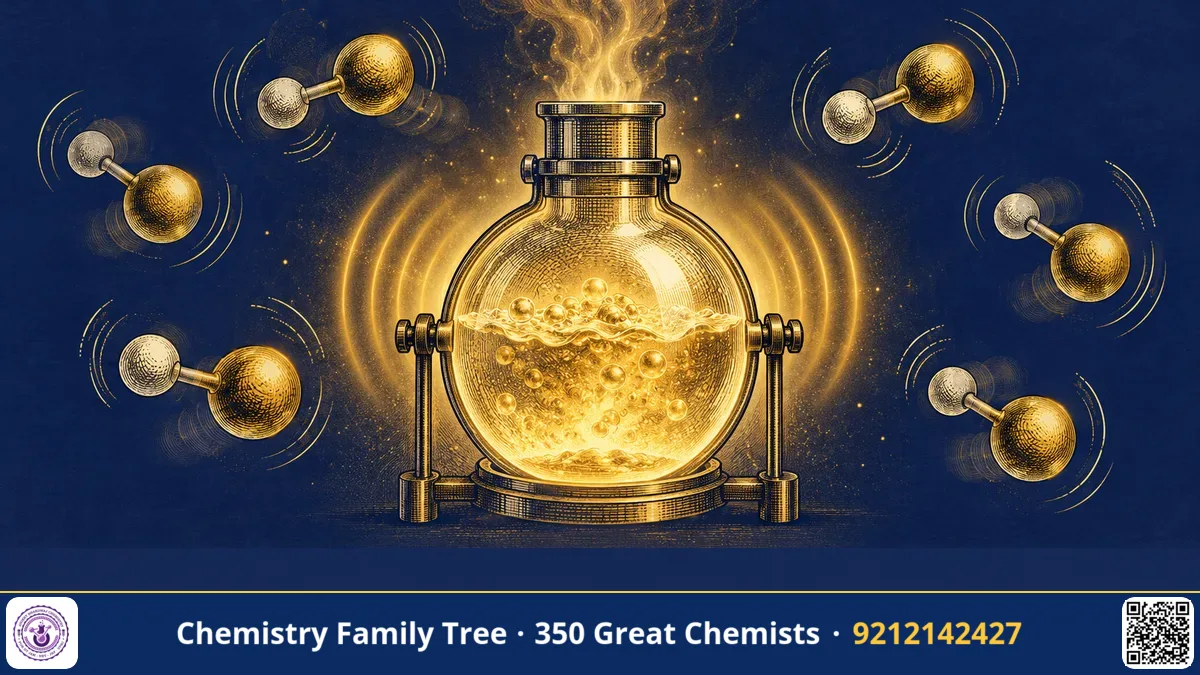
When hydrogen and chlorine react to give hydrogen chloride, energy is released. But where does it go? Does it simply heat the surroundings, or does it first reside in the new H–Cl bond as vibration? John Polanyi answered this question by looking at the faint infrared glow emitted by newly formed molecules. This technique, called infrared chemiluminescence, showed that reaction energy is often deposited in specific modes of the product, and that the way it is shared depends on the shape of the potential energy surface. His work, along with that of Dudley Herschbach and Yuan T. Lee, was recognised by the 1986 Nobel Prize in Chemistry. It also pointed the way to chemical lasers.
The Scientific Problem Before the Discovery
In textbooks, an exothermic reaction releases heat, ΔH < 0. This heat appears as an increase in the temperature of the surroundings, after countless collisions have shared the energy among all molecules. But that is the end of the story. Right after a bond is formed, the new molecule can be vibrating strongly, rotating rapidly, or flying apart at high speed. The statistical, equilibrium view cannot describe this. Chemists needed experiments that look at the products before collisions have scrambled the energy.
There was also a theoretical question: given the potential energy surface of a reaction, how will the energy be released? Is it important whether the barrier lies early in the reaction path (reactant-like) or late (product-like)? To answer this, one needed detailed data for a number of reactions.
The Discovery: Reading the Infrared Glow
Polanyi, working at the University of Toronto from the late 1950s, developed the idea that if a reaction creates a vibrationally excited molecule, then that molecule will emit infrared radiation as it relaxes to lower vibrational levels. By recording the infrared emission spectrum, one can count how many molecules are in each vibrational level at birth. The method required very low pressures so that molecules do not collide and lose their energy before they radiate.
The experimental logic runs as follows.
- Produce reactants at low pressure. Hydrogen atoms are generated, for example, by an electric discharge in H₂, and flow into a vessel containing a halogen molecule such as Cl₂.
- Allow reaction. The reaction is H + Cl₂ → HCl* + Cl, where the star shows vibrational excitation.
- Prevent collisions. The walls of the vessel are cooled (for example with liquid nitrogen) so that the molecules are removed quickly and quenching is minimised.
- Record emission. An infrared spectrometer records the light emitted as HCl* goes from vibrational level v to v−1 and so on.
- Analyse intensities. The intensity of each line is related to the population of that level, giving the energy distribution of the nascent products.
The results showed that, for reactions like H + Cl₂, a large fraction of the energy released appears as vibration of the HCl product, not as random heat. The distribution was non-Boltzmann, with higher levels populated more than expected from thermal equilibrium. This was direct proof that the reaction is not a statistical process in the simple sense.
Polanyi also formulated what are known as Polanyi's rules for how reaction energy and barrier position interact:
- If the barrier is early (on the reactant side), translational energy of the reactants is more effective than vibrational energy at promoting reaction.
- If the barrier is late (on the product side), vibrational energy of the reactant is more effective in promoting the reaction.
- For exothermic reactions, the location of the barrier also determines whether the products come out vibrationally hot or translationally hot.
The Chemistry Behind It
A molecule such as HCl has quantised vibrational energy levels, approximately Ev = (v + ½)hν. When HCl is formed in level v = 3, say, it can emit a photon of infrared light as it drops to v = 2. The frequency of the photon corresponds to the energy gap. Detecting the lines and their relative intensities tells you the vibrational population.
| Concept | Meaning |
|---|---|
| Chemiluminescence | Light emission produced by a chemical reaction |
| Nascent product | Product observed immediately after formation, before collisional relaxation |
| Population inversion | More molecules in a higher level than in a lower level |
| Early barrier | Transition state resembles reactants |
| Late barrier | Transition state resembles products |
When a reaction creates more molecules in a higher vibrational level than in a lower level, we have a population inversion. This is the condition required for laser action. Polanyi pointed out that such reactions can be used to build chemical lasers, in which the energy of a chemical reaction is converted directly into coherent infrared light, for example in the hydrogen fluoride laser based on H + F₂ → HF* + F.
Applications Today
- Chemical lasers: HF and DF lasers are examples of lasers driven by chemical reactions.
- Atmospheric chemistry: Emission from excited species gives information about the upper atmosphere and the airglow.
- Surface science: Polanyi later studied reactions of molecules on surfaces, which links to catalysis and semiconductor processing.
- Theory and computing: Potential energy surfaces calculated by quantum chemistry are tested against measured energy distributions.
- Education: Polanyi's rules are used to explain why some reactions respond to heating and others to vibrational excitation.
Exam Corner
- 1986 Nobel Prize in Chemistry (Herschbach, Lee, Polanyi): dynamics of chemical elementary processes.
- Infrared chemiluminescence: infrared emission from vibrationally excited nascent products.
- Vibrational energy levels of a diatomic: Ev = (v + ½)hν for a harmonic oscillator.
- Population inversion is needed for laser action; some exothermic reactions produce it.
- Polanyi's rules: early barrier favours translational energy; late barrier favours vibrational energy.
Common Misconceptions
- "All reaction energy ends up as heat immediately." It first appears in specific degrees of freedom of the products and only later becomes heat.
- "Chemiluminescence is only visible light." It can be in the infrared or ultraviolet as well.
- "Lasers need electricity." Chemical lasers get their energy from a reaction.
Quick Revision Box
- Method: infrared emission from nascent products at very low pressure.
- H + Cl₂ → HCl* + Cl produces vibrationally excited HCl.
- Distribution is non-Boltzmann; shows dynamics are not purely statistical.
- Polanyi's rules link barrier position to the best form of reactant energy.
- Population inversion leads to chemical lasers.
- Shared the 1986 Nobel Prize in Chemistry.
FAQ
What is a nascent product?
It is a product molecule observed right after formation, before collisions change its energy distribution.
Why was low pressure needed?
At low pressure, molecules travel long distances between collisions, so they can emit radiation before losing energy by collision.
How is Polanyi's work different from Herschbach's?
Herschbach used crossed beams to measure scattering angles; Polanyi used infrared emission to measure how product energy is distributed among vibrational levels. Both give detailed pictures of reaction dynamics.
Is this topic useful for GATE or NET?
Yes. It ties together kinetics, spectroscopy and potential energy surfaces, which appear in physical chemistry sections.
Published by ABC Chemistry — IIT-JAM | CSIR-NET | GATE Chemistry Coaching. Visit abcchemistry.com
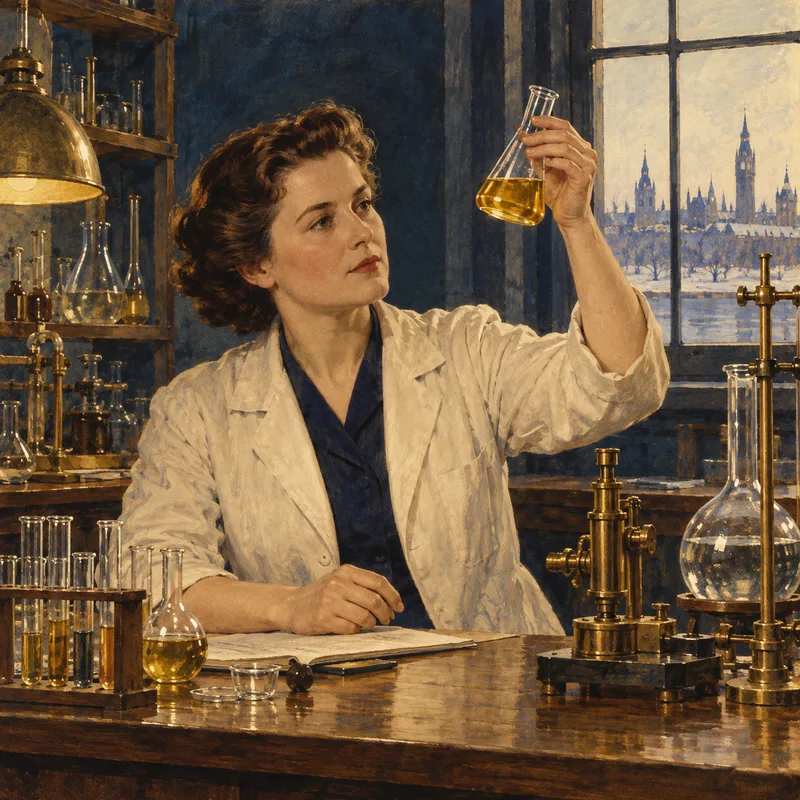
About the chemist
John Polanyi
1929- · Canada · Nobel Chemistry 1986
Infrared chemiluminescence, reaction dynamics