Biography · Chemist no. 171 of 350
Sir John Pople: The Mathematician Who Put Quantum Chemistry on the Computer
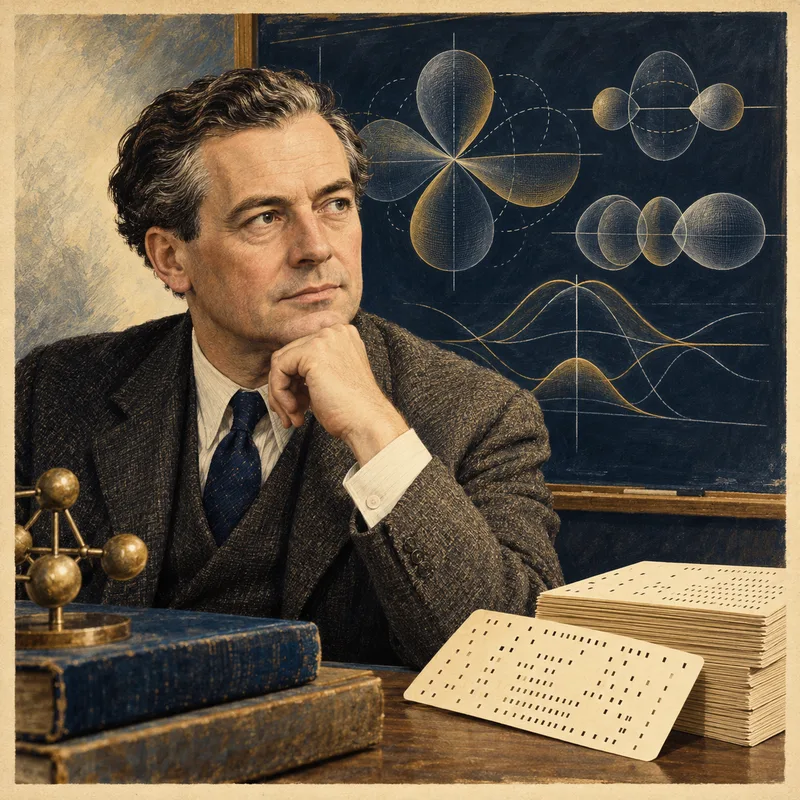
Sir John Anthony Pople (1925–2004) was a British theoretical chemist who trained as a mathematician. He built a systematic set of computational methods and the Gaussian computer program, which allowed chemists to calculate molecular structures and energies without doing experiments first. He shared the 1998 Nobel Prize in Chemistry with Walter Kohn. His legacy lives in every research laboratory where a chemist runs a quantum chemical calculation.
Early Life and Family
John Pople was born on 31 October 1925 in Burnham-on-Sea, a seaside town in Somerset, England. His father ran a clothing shop, and the family was of modest means. Pople was a bright child, and he attended Bristol Grammar School, where he developed a strong talent for mathematics. He later said that he was more interested in mathematics than in chemistry in his early years. His scientific career began in a country that was recovering from war, and his education was supported by scholarship opportunities.
Education and Mentors
Pople won a place at Trinity College, Cambridge, and studied mathematics, graduating in 1946. He then continued with research at Cambridge, where he studied the structure of water and ice and then theoretical chemistry under Sir John Lennard-Jones, a leading theoretical chemist who worked on the quantum theory of molecules. Pople received his PhD from Cambridge in 1951. Lennard-Jones gave him a strong grounding in the theory of molecular orbitals. He stayed at Cambridge as a research fellow and lecturer, and was a Fellow of Trinity College.
Career Timeline
| Year | Event |
|---|---|
| 1925 | Born in Burnham-on-Sea, Somerset, on 31 October |
| 1946 | Graduated in mathematics, Trinity College, Cambridge |
| 1951 | PhD in theoretical chemistry, Cambridge, under Lennard-Jones |
| 1953 | Published work on π-electron theory (the PPP method, in parallel with Pariser and Parr) |
| 1958–1964 | Head of the Basic Physics Division at the National Physical Laboratory, Teddington |
| 1964 | Moved to Carnegie Institute of Technology (later Carnegie Mellon University), Pittsburgh |
| 1965 | Introduced CNDO semi-empirical methods |
| 1970 | Released the Gaussian 70 program |
| 1993 | Moved to Northwestern University, Illinois |
| 1998 | Nobel Prize in Chemistry, shared with Walter Kohn; knighted in the same year |
| 2004 | Died on 15 March in Chicago |
Major Scientific Contributions
- Early theory. His early work includes the theory of nuclear magnetic resonance chemical shifts and the PPP π-electron method.
- Semi-empirical methods. CNDO, INDO and NDDO allowed approximate calculation of larger molecules in the 1960s, when computers were slow.
- Ab initio methods and basis sets. Pople's family of Gaussian basis sets, including STO-3G and 6-31G, became a standard language of quantum chemistry.
- The Gaussian program. Gaussian 70 and its successors turned theory into a tool that experimental chemists could use.
- Accuracy benchmarks. He created composite methods (Gaussian-1, Gaussian-2 and Gaussian-3) to predict heats of formation to near chemical accuracy.
- Support for DFT. His group helped to establish DFT methods in chemistry by testing and implementing them.
The method details, basis set naming and exam points appear in our discovery post on computational quantum chemistry.
Awards, Honours and the Nobel Prize
Pople shared the Nobel Prize in Chemistry in 1998. He received one half "for his development of computational methods in quantum chemistry", and Walter Kohn received the other half for density functional theory. He was elected a Fellow of the Royal Society and a member of the US National Academy of Sciences. He was knighted by Queen Elizabeth II in 2003, and he received other prizes, such as the Wolf Prize in Chemistry (1992) and the Davy Medal of the Royal Society.
Personality, Struggles and Lesser-Known Facts
- A mathematician in chemistry. He moved into chemistry after studying mathematics, and he believed that theory should be useful to practising chemists, not only elegant.
- Software and business. The Gaussian program later became a commercial product through the company Gaussian, Inc. It is an interesting case of academic research turning into widely used software.
- Late Nobel. The Nobel Prize came at the age of 72, many years after his most important methods had been adopted.
- Move to Northwestern. After many years at Carnegie Mellon, he moved to Northwestern University in 1993 and remained active in research.
- Transatlantic career. He began in England, spent his major research years in the United States, and kept strong links with Britain.
Legacy and Influence on Modern Chemistry
Before Pople, most quantum chemistry was a specialist activity. After him, a bench chemist could model a reaction mechanism, predict a spectrum or check an unusual structure with software. The language of "method/basis set" is used everywhere. The work also opened the path for modern computational drug design, materials design and catalysis modelling. In India, computational chemistry is a growing area in research institutes, and many CSIR-NET and GATE questions on molecular orbital theory and Hartree–Fock ideas have their roots in the framework that Pople built.
Lessons for Students
- Learn mathematics. A strong mathematical base can take you into any science.
- Make tools for others. Pople's greatest impact was making methods usable by everyone.
- Be systematic. A standard set of basis sets and tests made results comparable.
- Test theory against experiment. Pople's group compared calculated heats of formation and geometries with measured values.
Quick Facts Box
- Born: 31 October 1925, Burnham-on-Sea, Somerset, England
- Died: 15 March 2004, Chicago, Illinois, USA
- Nationality: British (worked in the USA)
- Field: Theoretical and computational chemistry
- Famous for: Gaussian program, Pople basis sets, semi-empirical and ab initio methods
- Nobel: Chemistry, 1998 (shared with Walter Kohn)
FAQ
Did Pople study chemistry first?
No. He studied mathematics at Cambridge, and moved into theoretical chemistry for his PhD.
What is the Gaussian program?
It is a computational chemistry software package, first released in 1970, that calculates molecular energies, structures and properties.
Who was Pople's PhD supervisor?
Sir John Lennard-Jones at Cambridge.
Which universities did he work at in the USA?
Carnegie Mellon University in Pittsburgh from 1964, and Northwestern University from 1993.
Published by ABC Chemistry — IIT-JAM | CSIR-NET | GATE Chemistry Coaching. Visit abcchemistry.com
About the chemist
John Pople
1925-2004 · United Kingdom · Nobel Chemistry 1998
Computational quantum chemistry methods