The discovery, explained · Chemist no. 171 of 350
John Pople: Making Quantum Chemistry a Tool for Every Chemist
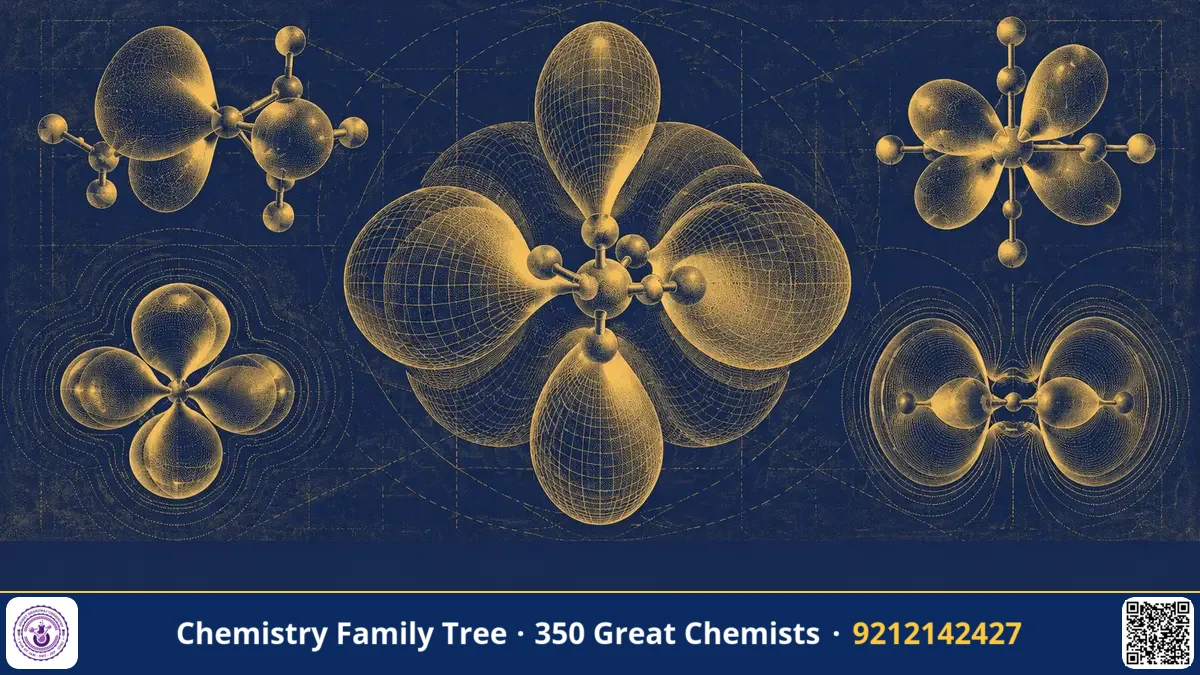
In the 1950s, quantum mechanics could describe the hydrogen atom beautifully, but for real molecules the equations were too hard to solve. Sir John Anthony Pople spent his career turning those equations into a practical tool. He developed systematic computational methods, including the Pople basis sets and the Gaussian computer program, so that a chemist could calculate the structure, energy and properties of a molecule on a computer. In 1998, he shared the Nobel Prize in Chemistry with Walter Kohn; Pople received half "for his development of computational methods in quantum chemistry", while Kohn received half for density functional theory.
The Scientific Problem Before the Discovery
The time-independent Schrödinger equation is:
Ĥ Ψ = E Ψ
For a molecule, the Hamiltonian Ĥ includes the kinetic energy of the electrons and nuclei, attractions between electrons and nuclei, and repulsions between electrons and between nuclei. Using the Born–Oppenheimer approximation, nuclei are fixed and the electronic problem is solved. Even so, the electron–electron repulsion makes the equation impossible to solve exactly for more than one electron.
The Hartree–Fock method gives a practical approximate route. Each electron occupies a molecular orbital, written as a combination of atomic-type functions (LCAO). The orbitals are found by solving the Roothaan equations:
F C = S C ε
where F is the Fock matrix, S the overlap matrix, C the orbital coefficients and ε the orbital energies. In the early days, calculations were slow, done on desk calculators or early computers, and there were no standard procedures. Different groups used different approximations and results could not be compared. The challenge was to create a systematic, well-tested, reproducible approach.
The Discovery: What Pople Did, Step by Step
- Semi-empirical methods (1950s–60s). In 1953, Pople independently of Pariser and Parr developed the PPP method for π-electron systems. In 1965 he introduced the CNDO (complete neglect of differential overlap) method and then INDO and NDDO. These methods ignore many difficult integrals to make calculation faster for large molecules.
- Ab initio methods. Pople and his group at Carnegie Mellon University moved toward ab initio ("from first principles") calculations, which use no experimental parameters other than fundamental constants.
- Gaussian-type basis sets. Computing integrals over Slater-type orbitals is difficult. Gaussian functions, of the form exp(−αr²), are mathematically convenient because the product of two Gaussians is another Gaussian. Pople's group built systematic families of basis sets from contracted Gaussians, such as STO-3G, 3-21G, 6-31G and 6-311G.
- The Gaussian program. In 1970 Pople and co-workers released Gaussian 70, a computer program that implemented Hartree–Fock calculations. It has been updated over the years (Gaussian 76, 80, 82 …) and is still one of the most used computational chemistry packages.
- Post-Hartree–Fock methods. He developed practical implementations of Møller–Plesset perturbation theory (MP2, MP3, MP4), configuration interaction, and coupled cluster methods. He also developed the Gaussian-n (G1, G2, G3) composite procedures to obtain accurate thermochemical data such as heats of formation.
- Later work. After DFT appeared, Pople's group tested and implemented it in the Gaussian programs, and this helped DFT to become popular in chemistry.
The Chemistry Behind It
How to read Pople basis set names
| Name | Meaning |
|---|---|
| STO-3G | Minimal basis; each Slater-type orbital is approximated by 3 Gaussians |
| 3-21G | Split valence: core orbitals use 3 Gaussians; valence is split into inner (2 Gaussians) and outer (1 Gaussian) parts |
| 6-31G | Core uses 6 Gaussians; valence is split into 3 + 1 |
| 6-31G(d,p) | Adds d polarisation functions on heavy atoms and p functions on hydrogens |
| 6-31+G(d) | The plus sign adds diffuse functions, important for anions and weak interactions |
Polarisation functions allow orbitals to distort, so that, for example, bonds can be bent and lone pairs can be described properly. Diffuse functions allow electron density far from the nucleus.
Method versus basis set
The quality of a calculation depends on two choices: the method (HF, MP2, DFT, CCSD(T)) and the basis set (STO-3G … large). A larger basis set and a better method give more accurate answers but cost more computer time. In notation, a calculation is written "method/basis set", for example B3LYP/6-31G(d) or MP2/6-311+G(d,p). Calculations at one level can be done at the geometry of another, written as "single point // optimisation".
What can be calculated
- Equilibrium geometries by minimising energy: bond lengths and angles.
- Transition states and reaction pathways to find activation energies.
- Vibrational frequencies to compare with IR and Raman spectra and calculate zero-point energies.
- Dipole moments, charges, ionisation energies and electron affinities.
- NMR chemical shifts, with the GIAO method.
Applications Today
- Drug discovery: Calculating molecular shapes, charges and binding energies.
- Reaction mechanisms: Computational chemistry can show a reaction pathway that experiments cannot see, such as short-lived transition states.
- Atmospheric chemistry: Studying ozone-depleting reactions and greenhouse gases.
- Materials and catalysis: Predicting the properties of new molecules before they are synthesised.
- Education and India: Indian universities and IITs use Gaussian and free alternatives such as ORCA, GAMESS and Psi4 in research and in M.Sc. computational chemistry labs.
Exam Corner
- Pople basis sets: in "6-31G", 6 = number of Gaussians for core orbitals; 3 and 1 = valence split. (d,p) are polarisation functions; "+" is diffuse functions.
- Hartree–Fock neglects electron correlation; MP2, CI and CC include it. Correlation energy = E(exact) − E(HF).
- Ab initio means no empirical parameters; semi-empirical methods (CNDO, INDO) use parameters and neglect integrals.
- Gaussian functions are used because the product of two Gaussians is a Gaussian, which makes integrals fast.
- Pople shared the 1998 Nobel Prize in Chemistry with Walter Kohn.
Common Misconceptions
- "Gaussian is the name of a method." Gaussian is a software package; the underlying functions are Gaussian-type orbitals. Methods are HF, MP2, DFT and so on.
- "Larger basis set always means a better answer." A large basis improves a method only up to the limit of that method; HF with a huge basis still misses correlation.
- "Gaussian orbitals are physically more correct than Slater orbitals." Slater functions have the correct cusp and decay but Gaussians are much cheaper, so several Gaussians are combined to mimic a Slater function.
Quick Revision Box
- Pople: semi-empirical (PPP, CNDO, INDO) then ab initio methods.
- Gaussian program first released in 1970.
- Basis sets: STO-3G, 3-21G, 6-31G, 6-31G(d,p), 6-311+G(d,p).
- Electron correlation methods: MPn, CI, CC; composite G-n methods for thermochemistry.
- Roothaan equations FC = SCε are the heart of HF.
- Nobel Prize in Chemistry 1998 with Walter Kohn.
FAQ
What does 6-31G mean?
It is a split-valence basis. Each core orbital is described by 6 contracted Gaussians. Each valence orbital is split into an inner part (3 Gaussians) and an outer part (1 Gaussian).
Why do chemists use Gaussian functions?
The product of two Gaussians centred on different atoms is a single Gaussian at another point, so the many-centre integrals can be evaluated quickly by computers.
What is the difference between ab initio and semi-empirical?
Ab initio methods compute all integrals from first principles. Semi-empirical methods neglect some integrals and fit others to experimental data, making them faster but less general.
How is Pople's work different from Kohn's?
Kohn gave the theory of DFT based on electron density. Pople created general tools and programs that made quantum chemical calculations routine, including the use of DFT.
Published by ABC Chemistry — IIT-JAM | CSIR-NET | GATE Chemistry Coaching. Visit abcchemistry.com
About the chemist
John Pople
1925-2004 · United Kingdom · Nobel Chemistry 1998
Computational quantum chemistry methods