Biography · Chemist no. 237 of 350
Joseph Black: The Gentle Professor Who Taught Chemistry to Count
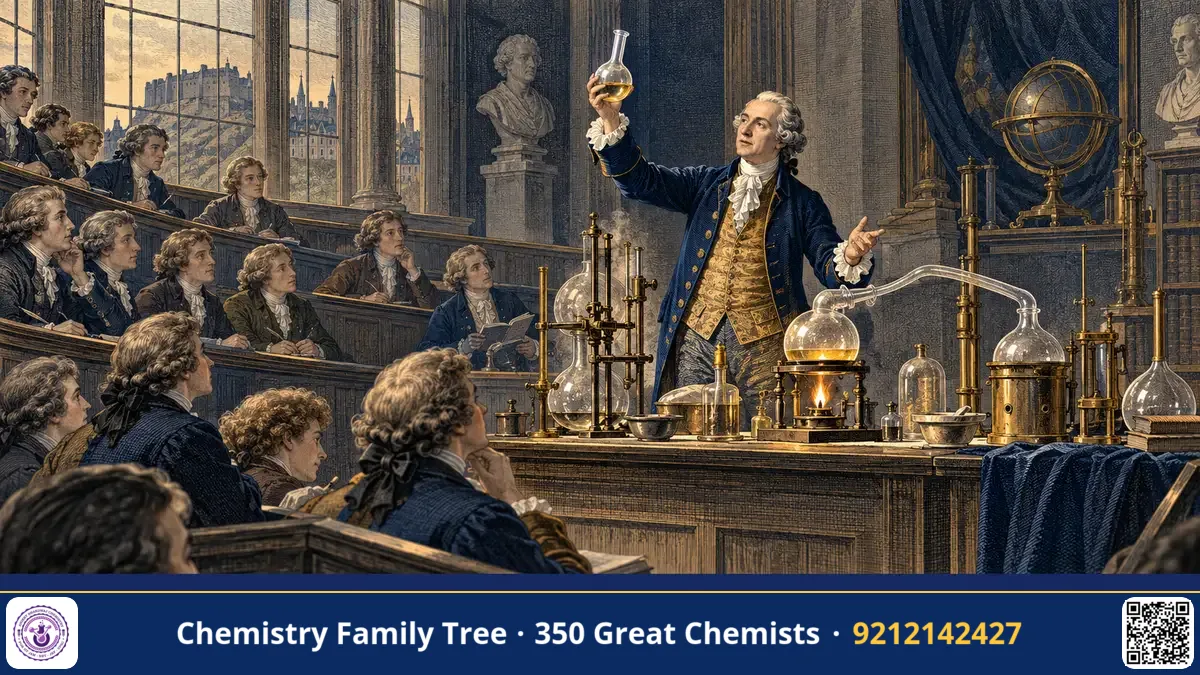
Joseph Black (1728–1799) was a Scottish physician and chemist whose work on carbon dioxide, magnesium and lime and on heat helped to make chemistry a quantitative science. He was a calm and widely loved teacher in Glasgow and Edinburgh, a friend of James Watt and Adam Smith, and a leading figure in the Scottish Enlightenment. His one-line legacy: he showed that gases are distinct substances that can be weighed, and that heat has quantity as well as temperature.
Early Life and Family
Black was born in Bordeaux, France, in 1728 (the date usually given is 16 April). His father, John Black, was a wine merchant from Belfast of Scottish descent, and his mother, Margaret Gordon, was the daughter of a Scottish family of Aberdeenshire. He was one of a large family. Bordeaux was a centre of the wine trade, and the Black family moved in educated circles. At the age of twelve, Joseph was sent to school in Belfast, and he later went on to university in Scotland. His warm family background gave him an even temper which friends remarked on throughout his life.
Education and Mentors
Black entered the University of Glasgow in 1746 to study arts and then medicine. There he met William Cullen, the lecturer in chemistry and medicine, who became his mentor and encouraged him to do experiments. Cullen's chemistry class gave Black a taste for exact laboratory work. In 1751 he moved to Edinburgh to complete his medical studies, and in 1754 he submitted his doctoral thesis on magnesia alba, quicklime and other alkaline substances, which contained the discovery of fixed air. The thesis is now regarded as a model of early quantitative chemical research.
Career Timeline
| Year | Event |
|---|---|
| 1728 | Born in Bordeaux. |
| 1746 | Enters the University of Glasgow. |
| 1751 | Moves to Edinburgh for medical studies. |
| 1754 | Receives his M.D. with a thesis on magnesia alba and fixed air. |
| 1756 | Succeeds Cullen as professor of chemistry at Glasgow, also as lecturer in medicine. |
| c. 1761–1764 | Develops the theory of latent heat; supports James Watt. |
| 1766 | Moves to Edinburgh as professor of chemistry and succeeds Cullen again. |
| 1783 | Elected to the Royal Society of Edinburgh as a founding member (the Society received its royal charter in 1783). |
| 1790s | Becomes ill and reduces his teaching; his lectures are taken over by an assistant. |
| 1799 | Dies in Edinburgh on 6 December. |
Major Scientific Contributions
- Fixed air (CO₂): shown by weighing that heating MgCO₃ gives MgO and a distinct gas; see our discovery blog for the full set of equations.
- Causticity of lime: quicklime is caustic because it has lost CO₂, not because it has gained fire matter.
- Distinction between magnesia and lime: he showed that magnesia is a different substance from lime, which was a significant step in the chemical identification of the alkaline earths.
- Latent heat: the heat absorbed or released during phase change without temperature change, q = mL.
- Specific heat: different substances have different heat capacities. q = mcΔT.
- Teaching: his lecture courses were demonstration-based and attracted students from Britain, Ireland and America.
Awards, Honours and Nobel Prize
There was no Nobel Prize in Black's lifetime. His honours were academic: professorships at Glasgow and Edinburgh, and membership of learned societies including the Royal Society of Edinburgh, of which he was an early member, and the Paris Academy of Sciences as a foreign associate. The Joseph Black Building at the University of Glasgow, which houses chemistry, carries his name.
Personality, Struggles and Lesser-Known Facts
- A shy publisher. Black published very little, and his famous discoveries on latent heat were mostly spread through his lectures and by his students. Much of what we know of his heat theory comes from lecture notes edited by John Robison after his death.
- Friend of Watt. He lent Watt money for his experiments with the steam engine, and encouraged him in his work. This friendship is one of the best-known partnerships in the history of technology.
- Moderate habits. Friends described him as courteous, with a gentle and calm manner. He lived simply and never married.
- Poor health. He suffered from poor health through much of his life, including a lung weakness, and he reduced his lecturing in the 1790s.
- A calm death. According to the account by Robison, he died quietly, sitting with a cup of milk on his knees, and the cup was still unspilled when he was found. The story is told in several biographies, though it may be embellished.
Legacy and Influence on Modern Chemistry
Black's discovery that gas can combine with solids and be released again opened the field of pneumatic chemistry. Cavendish, Priestley, Scheele and Lavoisier all built on the idea that "airs" are different substances, which led to the discovery of hydrogen, oxygen and nitrogen. His use of the balance anticipated Lavoisier's law of conservation of mass. He also embraced the new chemistry of Lavoisier, and taught it in Edinburgh; his students included many who spread chemistry in Britain and America. Modern calorimetry, thermodynamics and the study of phase transitions rest on the concepts of specific and latent heat.
Lessons for Students
- Use the balance. Weighing reactants and products turns a qualitative observation into a proof.
- Be open to a better theory. Black gave up older views when stronger evidence appeared.
- Teach clearly. Demonstrations make abstract ideas stick.
- Support others. His help to Watt shows that science thrives on friendship and encouragement.
Quick Facts Box
- Born: 1728, Bordeaux, France
- Died: 6 December 1799, Edinburgh
- Nationality: Scottish (born in France)
- Field: Chemistry, medicine, physics of heat
- Famous for: Fixed air (CO₂), latent heat, specific heat
- Nobel Prize: None (pre-dates the prize)
FAQ
Where was Joseph Black born?
He was born in Bordeaux, France, to a Scottish-Irish wine merchant family, and educated in Belfast, Glasgow and Edinburgh.
Why is his thesis important?
It used the balance to prove that a gas is released and absorbed in reactions of carbonates, making it a model of quantitative chemistry.
Did Black discover latent heat before Watt?
Yes. Black developed the concept, and Watt used it in his steam engine studies while collaborating with Black.
Was he interested in the new chemistry of Lavoisier?
Yes. He is generally regarded as one of the first British chemists to adopt Lavoisier's system in his teaching.
Published by ABC Chemistry — IIT-JAM | CSIR-NET | GATE Chemistry Coaching. Visit abcchemistry.com
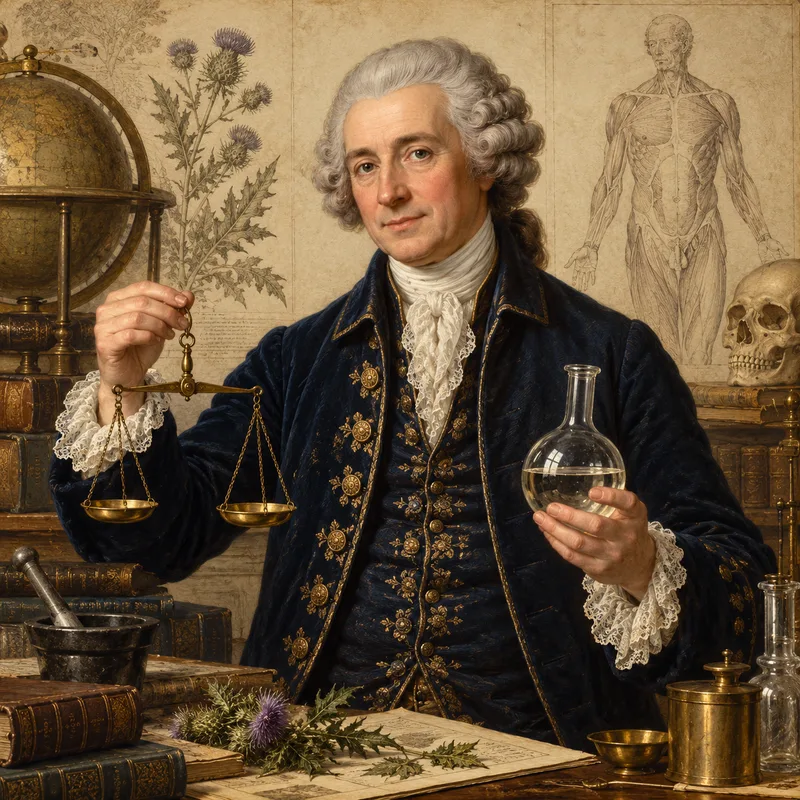
About the chemist
Joseph Black
1728-1799 · United Kingdom
Latent heat; discovery of carbon dioxide