The discovery, explained · Chemist no. 237 of 350
Joseph Black: Fixed Air, Latent Heat and the Quantitative Turn in Chemistry
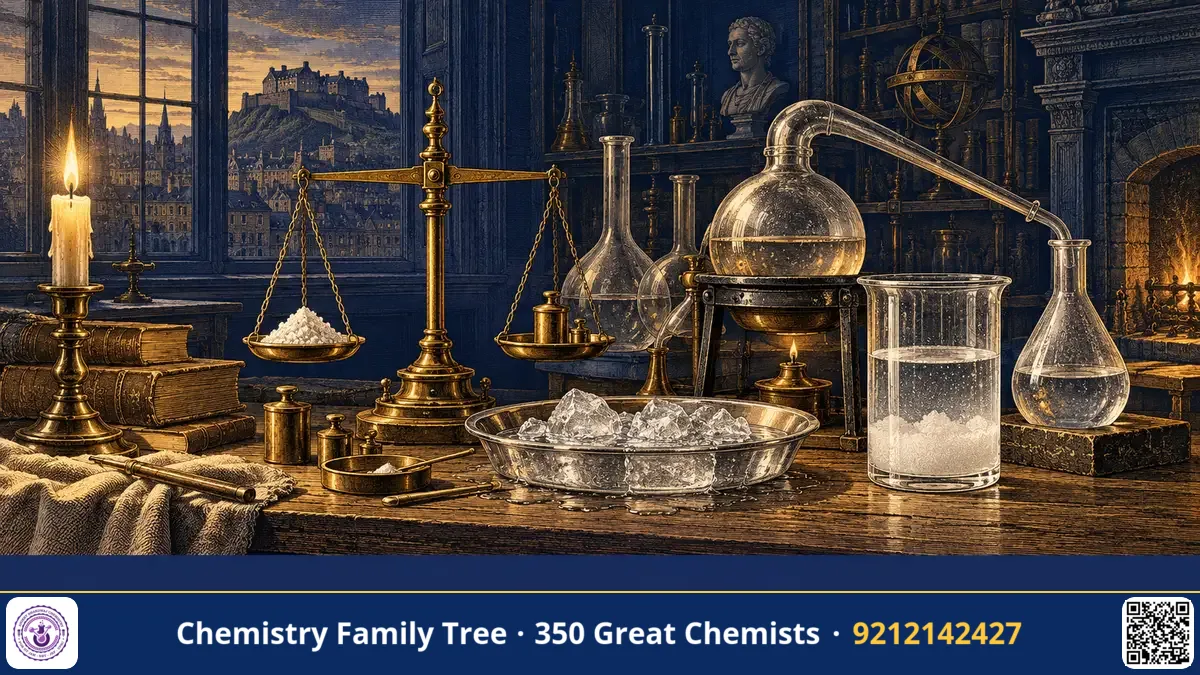
When you bubble carbon dioxide through limewater and watch it turn milky, you repeat an experiment that Joseph Black helped to make famous in the 1750s. Black, a Scottish physician and chemist, proved by careful weighing that a solid can lose weight by giving off a gas, and that this gas, which he called "fixed air", is a distinct substance, not ordinary air. A few years later, he introduced the ideas of latent heat and specific heat. These two contributions, one in chemistry and one in heat, made him a founder of quantitative experimental science. In this post, we follow his experiments and explain the chemistry in the way you will need it for exams.
The Scientific Problem Before the Discovery
In the early 18th century, air was considered a single element that merely acted as a container or carrier of other substances. Gases that appeared during reactions were often regarded as impure air. Alkalis such as quicklime and the mild alkalis (carbonates) were not well understood. The accepted view was that quicklime (CaO) acquired its caustic nature by absorbing "fire matter" during burning, a view related to the phlogiston ideas of Stahl. The medical need was concrete: Black was looking for a better remedy for kidney and bladder stones, and for a safer alternative to the harsh lime-water then used. In heat science, thermometers measured temperature, but nobody separated the idea of "heat quantity" from "temperature".
The Discovery: Step by Step
Step 1: Studying magnesia alba (1754)
In his medical thesis at Edinburgh, Black studied magnesia alba, a white powder (basic magnesium carbonate) that was a mild antacid. When he heated it strongly, it lost weight and became magnesia usta, which no longer effervesced with acids.
MgCO₃ → MgO + CO₂↑
Step 2: Weighing
The key innovation was the use of the balance. Black weighed the magnesia alba before and after heating, and found that it lost about 7/12 of its weight. He then showed that the lost weight corresponds to a gas, which he collected, that does not support flame or animal life, and that turns limewater cloudy.
Step 3: Recovering the gas
He added acid to the original powder and observed bubbles of the same gas. He also showed that magnesia usta, when treated with acid, dissolved without effervescence, so the gas was gone. The same gas is produced by chalk with acid, by fermenting liquors and by human breath.
MgCO₃ + 2HCl → MgCl₂ + H₂O + CO₂↑
CaCO₃ + 2HCl → CaCl₂ + H₂O + CO₂↑
Step 4: Causticity and the limewater test
Black explained that quicklime is caustic not because it picks up fire matter but because it has lost fixed air. When fixed air is returned to limewater, calcium carbonate precipitates:
Ca(OH)₂ + CO₂ → CaCO₃↓ + H₂O
This showed a cycle: limestone → quicklime → slaked lime → limestone again, with the weight changes accounted for by one specific gas.
Step 5: Latent heat (about 1761–1764)
Black noticed that ice melts slowly and absorbs a lot of heat without any rise in temperature, and that boiling water continues absorbing heat while the temperature stays at 100 °C. He called this hidden heat latent heat. He also demonstrated that equal masses of different substances need different amounts of heat to raise their temperature by the same amount, which is the idea of specific heat capacity. These ideas were further developed by his students and associates, including James Watt, who used them in improving the steam engine.
The Chemistry Behind It
- Thermal decomposition of carbonates: MgCO₃ → MgO + CO₂ and CaCO₃ → CaO + CO₂ (at about 900 °C). Thermal stability of Group 2 carbonates increases down the group, which is a favourite exam topic.
- Conservation of mass: the mass lost by the solid equals the mass of the gas released. MgCO₃ has molar mass 84.3 g/mol, and CO₂ is 44 g/mol, so the loss is 44/84.3 which is about 52% for pure magnesium carbonate. Basic magnesium carbonate, the real magnesia alba, has a different composition, so the observed fraction differs.
- Limewater test: Ca(OH)₂ + CO₂ → CaCO₃ + H₂O. Excess CO₂ redissolves the precipitate: CaCO₃ + CO₂ + H₂O → Ca(HCO₃)₂.
- Heat calculations: q = m c ΔT for temperature changes, and q = m L for phase changes. For water, the latent heat of fusion is about 334 J/g (80 cal/g) and the latent heat of vaporisation is about 2260 J/g (540 cal/g).
Applications Today
The decomposition of limestone is the first step in cement and lime production, a major industry in India. Carbon dioxide is used in fire extinguishers, soft drinks, dry ice cooling and photosynthesis research, and its greenhouse role is central to climate science. Magnesium hydroxide (milk of magnesia) and magnesium carbonate are used as antacids, directly continuing Black's medical interest. Latent heat is the principle behind refrigerators, steam engines, air-conditioners, sweating as cooling and heat storage materials. The calorimeter, which measures heat changes in reactions, owes its theoretical basis to his work on specific heat and latent heat.
Exam Corner
- Joseph Black discovered "fixed air" (CO₂) in 1754 by heating magnesia alba (MgCO₃) and weighing the products.
- Limewater test for CO₂: it turns milky due to CaCO₃; excess CO₂ turns it clear again as Ca(HCO₃)₂ forms.
- Latent heat is the heat absorbed or released during a phase change at constant temperature (q = mL).
- Specific heat capacity: q = mcΔT. Water has an unusually high value of 4.18 J g⁻¹ K⁻¹.
- Thermal stability of carbonates of Group 2: BeCO₃ < MgCO₃ < CaCO₃ < SrCO₃ < BaCO₃, explained by the polarising power of the cation.
Common Misconceptions
- "Black discovered carbon dioxide first of all." Van Helmont had described "gas sylvestre" earlier. Black showed by quantitative experiments that it is a distinct, chemically specific gas.
- "Latent heat means no heat is flowing." Heat is flowing, but it goes into changing the state, not the temperature.
- "Heat and temperature are the same." Black's work separated heat (quantity) from temperature (intensity).
Quick Revision Box
- Joseph Black (1728–1799), Scottish physician-chemist.
- 1754: fixed air (CO₂) from MgCO₃ and CaCO₃, proved by weighing.
- Quicklime is caustic because it lacks fixed air, not because it gained fire matter.
- Latent heat of fusion of ice about 334 J/g; vaporisation of water about 2260 J/g.
- Specific heat distinguishes heat quantity from temperature.
- Mentor to James Watt's era of steam engine improvement.
FAQ
Why is it called fixed air?
Because the gas was "fixed" in solid substances such as chalk and could be released by heat or acids.
Did Black believe in phlogiston?
He was cautious and later accepted Lavoisier's new chemistry, becoming one of the first British professors to teach it.
How did he help James Watt?
Black supported Watt in Glasgow, including financial help, and his ideas on latent heat helped Watt to understand the steam engine's heat losses.
What is magnesia alba?
It is a white powder of basic magnesium carbonate, formerly used as a medicine for indigestion.
Published by ABC Chemistry — IIT-JAM | CSIR-NET | GATE Chemistry Coaching. Visit abcchemistry.com
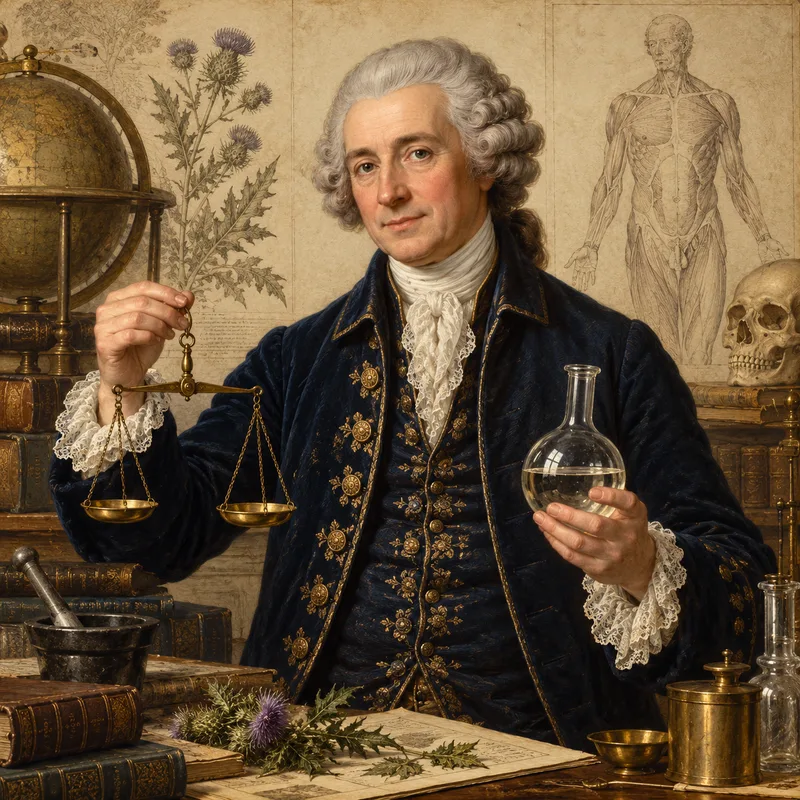
About the chemist
Joseph Black
1728-1799 · United Kingdom
Latent heat; discovery of carbon dioxide