Biography · Chemist no. 45 of 350
Joseph Louis Proust: The Patient Analyst Who Proved That Compounds Have Fixed Composition
Introduction
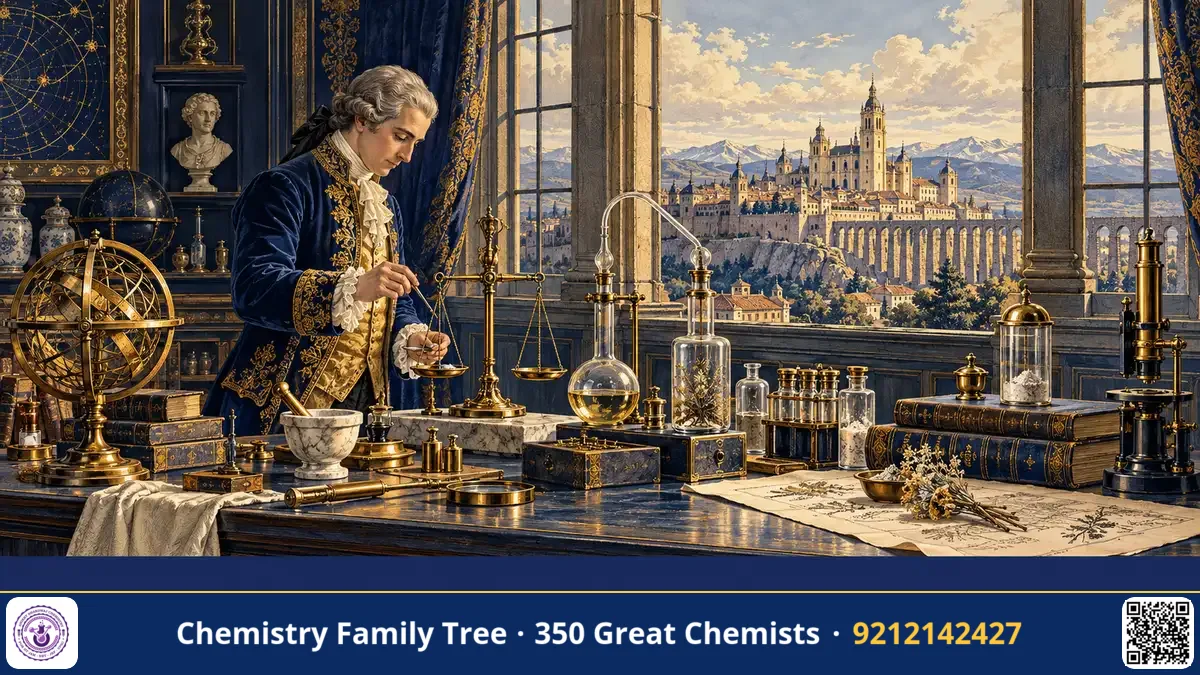
Joseph Louis Proust (1754-1826) was a French apothecary and chemist who spent nearly three decades working in Spain. He is remembered for the law of definite proportions, which says that a pure chemical compound always contains the same elements in the same mass ratio. He won a long scientific debate against the famous Claude-Louis Berthollet by careful, patient analysis rather than by argument. Legacy in one line: he showed that compounds are not arbitrary mixtures, but substances with fixed composition, a cornerstone for atomic theory.
Early Life & Family
Proust was born on 26 September 1754 in Angers, in the Loire valley of France. His father was an apothecary, and young Joseph grew up in a house where drugs, balances and bottles were part of daily life. This family setting gave him early training in practical chemistry. Angers had a respected school and botanical interests, and the boy developed a taste for natural history alongside chemistry.
Education & Mentors
Proust learned the basics of pharmacy in his father's shop and then went to Paris to continue his studies. In Paris he worked as an apothecary and studied chemistry with Guillaume-François Rouelle, a famous lecturer whose public courses attracted many young chemists, including Lavoisier. Proust became an assistant and quickly gained a reputation as a careful analyst. He later held a post as an apothecary at the Salpêtrière hospital in Paris. His training in pharmacy gave him the habits of exact weighing and purification which marked his later work.
Career Timeline
| Year | Event |
|---|---|
| 1754 | Born in Angers, France |
| 1770s | Studies and works as an apothecary in Paris; learns from Rouelle |
| 1778 | Moves to Spain to teach chemistry at the Royal Artillery College, Segovia |
| 1780s | Works in Spain on minerals, metals and analytical chemistry |
| 1789 | Becomes professor at Salamanca |
| 1791 | Moves to Madrid, where the Spanish crown supports a well-equipped laboratory for him |
| 1799 | Publishes his arguments for definite proportions; the debate with Berthollet begins |
| 1802 | Studies the sugar of grapes (glucose) and shows it differs from cane sugar |
| 1806 | Returns to France |
| 1808 | Berthollet and the French scientific community largely accept his law; his Madrid laboratory is lost in the Napoleonic invasion of Spain |
| 1816 | Elected to the Académie des Sciences |
| 1826 | Dies in Angers on 5 July |
Major Scientific Contributions
- Law of definite proportions (constant composition): based on analyses of copper carbonate, oxides of tin and iron, and many sulphides. See our companion article on Proust's law for the numerical examples.
- Distinguishing mixtures from compounds: he insisted that a few real compounds exist, and that variable results come from mixtures or impure samples.
- Sugar chemistry: he showed that the solid sugar obtained from grapes is a distinct substance from cane sugar, and recognised it as a sweet sugar that crystallises in granules. This is today known as glucose.
- Analytical methods: he developed careful procedures for analysing minerals, metallic oxides and sulphides, and set a high standard for purity of samples.
- Teaching: in Spain he trained students in modern, Lavoisier-style chemistry at the Segovia artillery college and at Salamanca and Madrid.
Awards, Honours & Nobel Prize
There was no Nobel Prize in his lifetime. Proust received support from the Spanish crown, which provided him with a fine laboratory in Madrid, and in 1816 he was elected to the Académie des Sciences in Paris. King Louis XVIII granted him a pension in his old age. His best honour is the law that carries his name.
Personality, Struggles & Lesser-Known Facts
- A courteous opponent. His debate with Berthollet lasted years, but the tone remained largely polite and based on evidence, and the exchange pushed Proust to improve his methods.
- Years abroad. For nearly 28 years Proust lived and worked in Spain, far from the great Paris laboratories, and wrote mainly in French for French journals.
- Loss of the laboratory. During the Napoleonic invasion of Spain in 1808, his laboratory and equipment in Madrid were damaged or lost, and he returned to France with little. Much of his later life was spent in modest circumstances.
- Quiet in later life. He retired to Angers in his final years, living on a royal pension, far from the centre of Paris science.
- Berthollet's generosity. After the debate, Berthollet publicly accepted that Proust had been correct for most compounds, a rare act of scientific honesty.
Legacy & Influence on Modern Chemistry
Proust's law supported formulas such as H₂O and NaCl, and through Dalton's atomic theory gave the basis for atomic weights and stoichiometry. Chemistry teachers in India still begin the chapter "Some Basic Concepts of Chemistry" with the law of definite proportions. In the 20th century, the discovery of non-stoichiometric compounds showed that there are limits. Solid-state chemists call fixed-composition compounds daltonides and variable ones berthollides, an acknowledgement that both sides of the debate contributed. Today, modern analytical chemistry and materials science, from pharmaceutical purity tests to defects in semiconductors, still reflect the Proust-Berthollet discussion.
Lessons for Students
- Precision wins debates. Better data settled the argument.
- Test unusual claims with simple examples. Natural and artificial copper carbonate was a clear test.
- Be ready for exceptions. Every law has limits, and learning them is part of science.
- Work with what you have. Proust produced great science far from the main centres.
Quick Facts Box
- Born: 26 September 1754, Angers, France
- Died: 5 July 1826, Angers, France
- Nationality: French
- Field: Analytical and inorganic chemistry
- Famous for: Law of definite proportions (1799)
- Nobel: None (lived before the prizes began)
FAQ
Why did Proust work in Spain?
The Spanish crown offered good posts and well-equipped laboratories for chemists, and he taught at Segovia, Salamanca and Madrid.
Who was Proust's opponent?
Claude-Louis Berthollet, who believed that compounds could vary in composition.
Is Proust related to the novelist Marcel Proust?
No. The two are not known to be related; the shared surname is a coincidence for most students.
What did he discover about sugar?
He identified the crystalline sugar from grapes as a distinct substance, later known as glucose.
Published by ABC Chemistry — IIT-JAM | CSIR-NET | GATE Chemistry Coaching. Visit abcchemistry.com
About the chemist
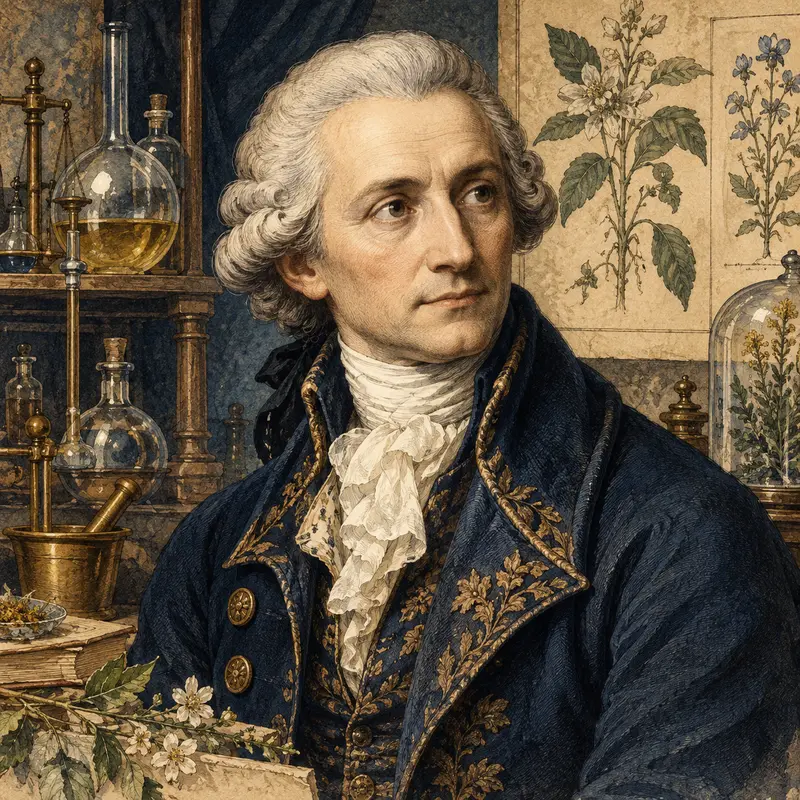
Joseph Louis Proust
1754-1826 · France
Law of definite proportions