The discovery, explained · Chemist no. 45 of 350
Proust's Law: Why a Compound Always Has the Same Composition
Whether you take water from the Ganga, from a Himalayan glacier or from a laboratory distillation unit, pure water always contains hydrogen and oxygen in the same mass ratio, about 1 : 8. Common salt always has sodium and chlorine in the ratio 23 : 35.5 by mass. This so-called law of definite proportions (or law of constant composition) is one of the basic laws of chemical combination. It was established through years of careful analysis by the French chemist Joseph Louis Proust between about 1794 and 1808, mostly while he worked in Spain. His success in a long scientific debate with Claude-Louis Berthollet helped make chemistry a quantitative science and prepared the ground for Dalton's atomic theory.
The Scientific Problem Before the Discovery
At the end of the 18th century, Lavoisier had shown that mass is conserved in a chemical reaction (law of conservation of mass). But a second question remained: does a given compound always have the same composition, or can it vary?
- Chemists were used to mixtures and alloys, which can have any proportions. Many thought compounds could behave similarly.
- Berthollet, an eminent professor who had worked with Lavoisier, argued that composition depends on the conditions and on the relative amounts of reactants. In his view, the products of a reaction vary continuously in composition, depending on mass action and conditions such as temperature and solubility.
- Without a firm rule on composition, there was no basis for assigning fixed formulas or atomic weights.
The Discovery: Step by Step
Proust set out to settle the question by analysing the same substance from different sources, with the best balances and methods he could obtain.
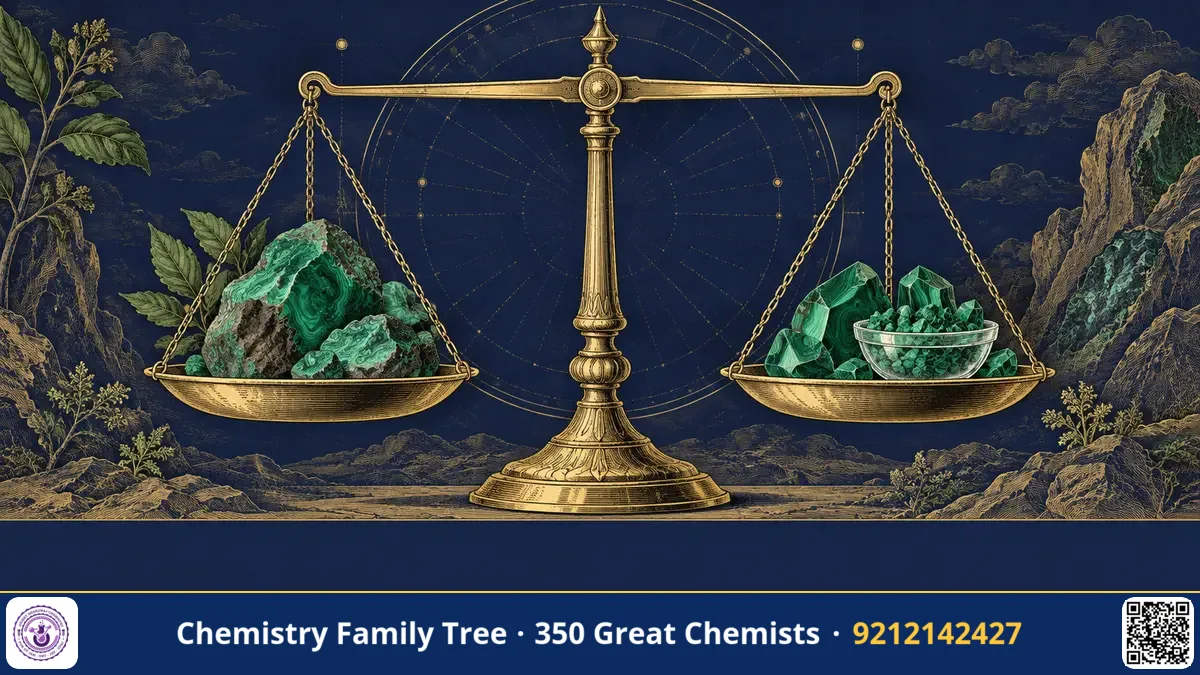
- Copper carbonate. He took natural green malachite and compared it with copper carbonate prepared in the laboratory from copper salts and alkali carbonate. Both, on heating or on treatment with acid, gave the same proportions of copper oxide, carbon dioxide and water. His conclusion was that the compound has the same composition whether it is made by nature or in the laboratory.
- Oxides of tin and iron. He showed that tin forms two oxides and iron forms two oxides, each with its own fixed composition. There were no oxides of intermediate composition. Berthollet's continuous variation would have predicted a smooth range.
- Sulphides. He found that iron forms two sulphides with definite compositions, and he analysed many other metal sulphides and oxides.
- Explaining apparent variations. Where other chemists found differences, Proust showed that their samples were impure, or contained water, or were actually a mixture of two distinct compounds.
He stated the conclusion in a form we still use:
A chemical compound always contains the same elements combined in the same fixed proportion by mass, irrespective of its source or method of preparation.
The dispute with Berthollet, carried on in the journals between about 1799 and 1808, ended with most chemists accepting Proust's view. Berthollet himself accepted it for most compounds, while Proust accepted that solutions and alloys are not fixed compounds.
The Chemistry Behind It
Numerical illustration
For water, H₂O: mass of H = 2 × 1.008 = 2.016; mass of O = 16.00. Percent H = 2.016/18.016 = 11.19%; percent O = 88.81%. The ratio H : O = 1 : 7.94, nearly 1 : 8.
| Sample | Mass of compound | Mass of oxygen | Ratio |
|---|---|---|---|
| Water from river | 9.00 g | 8.00 g | H:O = 1:8 |
| Water from rain | 18.0 g | 16.0 g | H:O = 2:16 = 1:8 |
| Water from combustion of H₂ | 4.5 g | 4.0 g | H:O = 0.5:4 = 1:8 |
Why does the law hold?
Dalton's atomic theory, proposed in 1803-1808, gave the explanation: a compound is formed by combination of atoms in a fixed whole-number ratio, and each atom of an element has a fixed mass. Hence the mass ratio of the elements in a compound is also fixed. Proust's experiments supplied the evidence, and Dalton's atoms supplied the theory. The law of multiple proportions (Dalton) extends the idea to elements that form more than one compound: CO and CO₂ have oxygen masses combining with 12 g of carbon in the ratio 16 : 32 = 1 : 2.
Limits of the law (important for GATE and NET)
- Isotopic composition: a compound made from different isotopes has a different mass ratio. Heavy water D₂O has H : O mass ratio of about 1 : 4 (2 × 2.014 : 16.00). So the law holds for a fixed isotopic composition.
- Non-stoichiometric (Berthollide) compounds: some solids show variable composition. Wüstite is written Fe₀.₉₅O; it never has the ideal 1 : 1 ratio because of vacancies in the lattice. Similar compounds include TiO, VO and some sulphides. Chemists call fixed-composition compounds daltonides and the variable ones berthollides, which fairly honours both sides of the old debate.
- Mixtures and solutions are not compounds and do not follow the law.
Applications Today
- Quality control: pharmaceutical and food industries check the composition of purity by elemental analysis, relying on constant composition.
- Empirical and molecular formulas: percent composition from combustion analysis gives empirical formulas, which works only because composition is fixed.
- Stoichiometry: all mole-based calculations assume constant composition of reagents.
- Materials science: the study of non-stoichiometric oxides gives us superconductors such as YBa₂Cu₃O₇₋δ, solid oxide fuel cells and oxide catalysts used in India's growing energy industry.
- Forensics and geology: a mineral is identified partly by its characteristic composition.
Exam Corner
- Law of definite proportions: a pure compound has the same elements in the same mass ratio, whatever its source (Proust, 1799).
- Example: CO₂ from limestone, from burning carbon, or from respiration is always 27.3% C and 72.7% O by mass.
- Law of multiple proportions (Dalton) is different: it compares masses of one element combining with a fixed mass of another in two or more compounds.
- Non-stoichiometric compounds such as FeO (Fe₀.₉₅O) and TiOₓ apparently violate the law; they are called berthollide compounds.
- Law of definite proportions does not hold when isotopic composition changes.
Common Misconceptions
- "Proust and Dalton discovered the same law." Proust: fixed composition of one compound. Dalton: multiple proportions across different compounds of the same elements.
- "The law means all compounds have exact whole-number atom ratios." Non-stoichiometric solids are real exceptions.
- "Berthollet was simply wrong." In many solids and alloys, Berthollet's intuition of variable composition turned out to be right; he was wrong about typical molecular compounds.
Quick Revision Box
- Proust, ~1794-1808: law of definite proportions (constant composition).
- Evidence: natural and artificial copper carbonate have identical composition.
- Opponent: Claude-Louis Berthollet, who believed in variable composition.
- Water: H : O = 1 : 8 by mass; CO₂: C : O = 3 : 8.
- Exceptions: isotopic variation and non-stoichiometric compounds (Fe₀.₉₅O).
- Explained by Dalton's atomic theory.
FAQ
Who proposed the law of definite proportions?
Joseph Louis Proust, a French chemist who worked mostly in Spain.
Is the law of definite proportions the same as the law of constant composition?
Yes. Both names describe the same law.
Why was the Proust-Berthollet debate important?
Its outcome supported fixed formulas and made it possible to assign atomic weights, which was needed for Dalton's atomic theory.
Does this law apply to mixtures like air?
No. Air is a mixture, and its composition varies with place and altitude.
Published by ABC Chemistry — IIT-JAM | CSIR-NET | GATE Chemistry Coaching. Visit abcchemistry.com
About the chemist
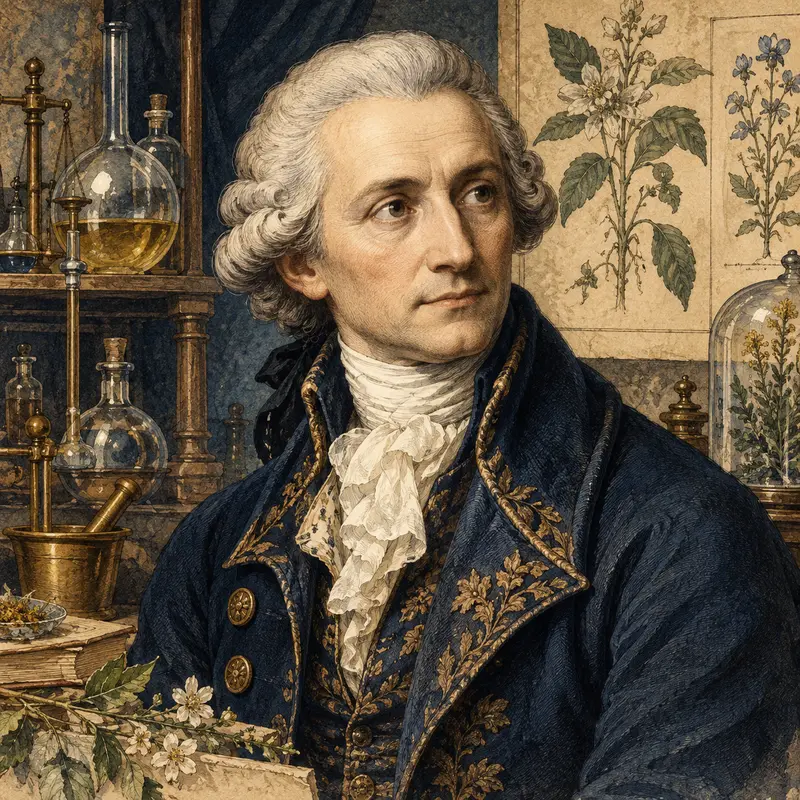
Joseph Louis Proust
1754-1826 · France
Law of definite proportions