Biography · Chemist no. 7 of 350
Joseph Priestley: Minister, Teacher and Discoverer of Oxygen
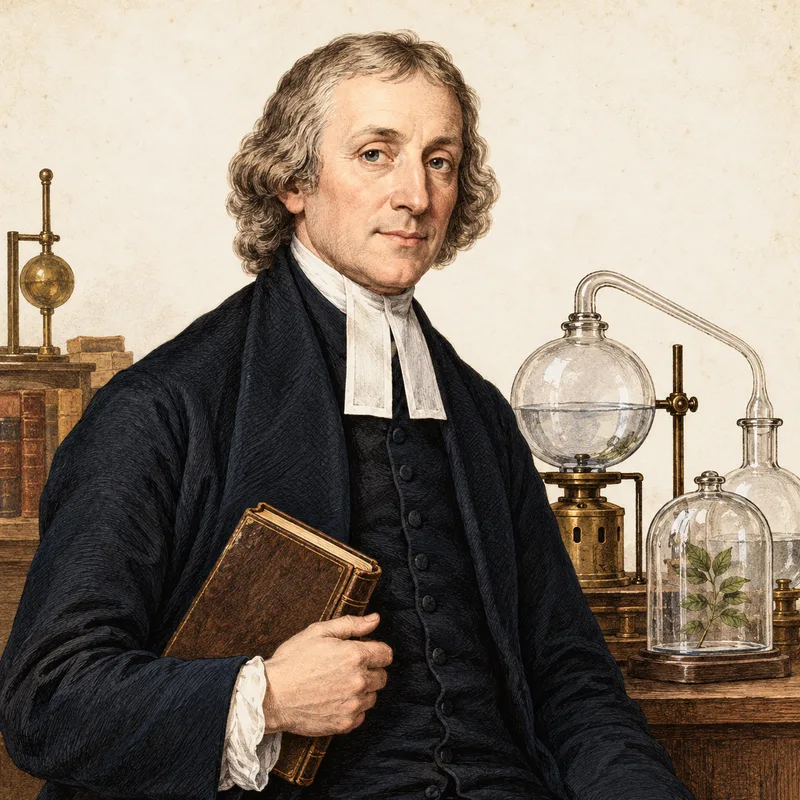
Joseph Priestley (1733-1804) was an English clergyman, teacher, political thinker and chemist. He is famous for preparing oxygen in 1774, for making soda water and for his many studies of gases. He was also a defender of religious freedom and of the French Revolution's early ideals, which brought him great trouble. His legacy in one line: a curious and courageous teacher who opened the field of gas chemistry and paid a heavy price for his beliefs.
Early Life and Family
Joseph Priestley was born on 13 March 1733 at Birstall Fieldhead, near Leeds in Yorkshire, England. He was the eldest of six children in a family of cloth finishers. His mother, Mary Swift, died when he was young, and he was sent to live with his aunt, Sarah Keighley, a wealthy and devout woman who supported his education. Her home was a gathering place for Dissenting ministers, people who did not follow the Church of England. Priestley grew up in this atmosphere of study and religious debate. In 1762 he married Mary Wilkinson, the daughter of an ironmaster, and they had children together. Mary was a strong support to him through many difficult years.
Education and Mentors
- He studied at local schools, where he learnt Latin, Greek and Hebrew, and he also taught himself several other languages. He later said that he learnt much on his own.
- As the Dissenters were barred from Oxford and Cambridge, he attended the Daventry Academy, a Dissenting academy, where he studied from 1752 to 1755 and prepared for the ministry.
- In 1766, in London, he met Benjamin Franklin, who encouraged him to write a history of electricity. Franklin remained his friend.
- He was also influenced by the work of Joseph Black on carbon dioxide and by Henry Cavendish on gases.
Career Timeline
| Year | Event |
|---|---|
| 1733 | Born near Leeds, England on 13 March |
| 1752-1755 | Studies at Daventry Academy |
| 1761 | Becomes a teacher at Warrington Academy |
| 1767 | Becomes minister at Mill Hill Chapel, Leeds; publishes History and Present State of Electricity |
| 1767-1772 | Experiments on fixed air (carbon dioxide); first carbonated water |
| 1772 | Joins the Earl of Shelburne as librarian and literary companion |
| 1773 | Awarded the Copley Medal of the Royal Society |
| 1774 | Prepares oxygen on 1 August; visits Paris and meets Lavoisier |
| 1780 | Moves to Birmingham as a minister; joins the Lunar Society |
| 1791 | His house, laboratory and chapel are destroyed in the Birmingham riots |
| 1794 | Emigrates to the United States |
| 1804 | Dies at Northumberland, Pennsylvania on 6 February |
Major Scientific Contributions
Gases. Priestley discovered or isolated oxygen, nitrous oxide, nitric oxide, ammonia, hydrogen chloride and sulphur dioxide. He introduced the idea of collecting gases over mercury. See our discovery post on Priestley for equations.
2HgO → 2Hg + O₂
Carbonated water. His method of dissolving carbon dioxide in water was a simple apparatus to carry out an experiment, but it led to the soft drink industry. In 1772 he published a pamphlet on the process, and he is often credited with inventing soda water.
Plants and air. He showed that green plants can restore air in which a candle has burned or an animal has breathed, a basic step towards the discovery of photosynthesis.
Electricity. His 1767 book on electricity summarised the field, and he observed that charcoal conducts electricity, and he stated that the force between electric charges probably follows an inverse-square law, similar to gravity.
Rubber. He noted that a piece of the new material from South America could rub out pencil marks, and the word "rubber" is attributed to this use.
Awards, Honours and Nobel Prize
- Fellow of the Royal Society (1766).
- Copley Medal of the Royal Society (1773) for his work on different kinds of air.
- Foreign associate of the French Academy of Sciences (1772).
- No Nobel Prize, since the prizes began long after his death in 1901. In his memory, the American Chemical Society awards the Priestley Medal, its highest honour, since 1923.
Personality, Struggles and Lesser-Known Facts
- A man of many interests. Priestley wrote on history, grammar, theology, education, politics and science. He wrote dozens of books, and he is often cited as one of the most productive writers of his century.
- A stubborn believer in phlogiston. Even after Lavoisier's oxygen theory became widely accepted, Priestley defended phlogiston to the end of his life. This shows that great experimenters may not interpret their results correctly.
- The Lunar Society. In Birmingham he joined the Lunar Society, a group of industrialists and thinkers, including Matthew Boulton, James Watt, Erasmus Darwin and Josiah Wedgwood, who met on evenings near the full moon.
- The Birmingham riots. In July 1791, a mob angered by Priestley's support for the French Revolution and for religious freedom attacked and burned his home, laboratory and library, along with chapels and houses of other Dissenters. He and his family escaped, but much of his equipment and papers were lost.
- Exile. After the riots he moved to Hackney, near London, and then in 1794 emigrated to Pennsylvania, USA. He continued his experiments there, and he helped to establish Unitarian churches.
- Friendship with the founding fathers. He knew Benjamin Franklin and later Thomas Jefferson, and Jefferson valued his writings on religion.
Legacy and Influence on Modern Chemistry
Priestley demonstrated that "air" is a mixture of different gases, and his techniques for collecting and testing gases built the foundation of pneumatic chemistry. His preparation of oxygen directly led Lavoisier to the oxygen theory of combustion. Medical and industrial uses of oxygen, from hospitals to steel plants, grew from this beginning. His soda water began an entire industry. His work on plants helped Ingenhousz and later scientists to understand photosynthesis. The Priestley Medal and his house in Pennsylvania, now a museum, preserve his memory.
Lessons for Students
- Experiment widely. He tested many gases with simple equipment.
- Share your findings. He told Lavoisier about his experiment openly, and this helped science move forward.
- Be ready to update your theory. His refusal to give up phlogiston is a reminder to follow the evidence.
- Stand for what is right, but understand the risk. He suffered for his beliefs, yet he never stopped working.
- Science and society are linked. A scientist is also a citizen.
Quick Facts Box
- Born: 13 March 1733, Birstall Fieldhead, near Leeds, England
- Died: 6 February 1804, Northumberland, Pennsylvania, USA
- Nationality: English (later lived in the USA)
- Field: Chemistry (pneumatic chemistry), theology, education
- Famous for: Preparing oxygen (1774), soda water, plants restoring air
- Nobel Prize: None (lived before 1901); the Priestley Medal is named for him
FAQ
Was Joseph Priestley a scientist or a priest?
Both. He was a Dissenting minister and teacher by profession, and he did science as a passion. He is remembered for both his chemistry and his religious writings.
Why did Priestley leave England?
After a mob burned his house and laboratory in Birmingham in 1791 and continuing hostility because of his views, he emigrated to the United States in 1794.
What is the Priestley Medal?
It is the highest award of the American Chemical Society, named in honour of Joseph Priestley.
Did Priestley accept Lavoisier's oxygen theory?
No. He continued to support the phlogiston theory all his life, even though his own experiments helped Lavoisier to overthrow it.
Published by ABC Chemistry — IIT-JAM | CSIR-NET | GATE Chemistry Coaching. Visit abcchemistry.com
About the chemist
Joseph Priestley
1733-1804 · United Kingdom
Isolated oxygen and other gases