The discovery, explained · Chemist no. 7 of 350
Joseph Priestley and the Discovery of Oxygen: From "Fixed Air" to Soda Water
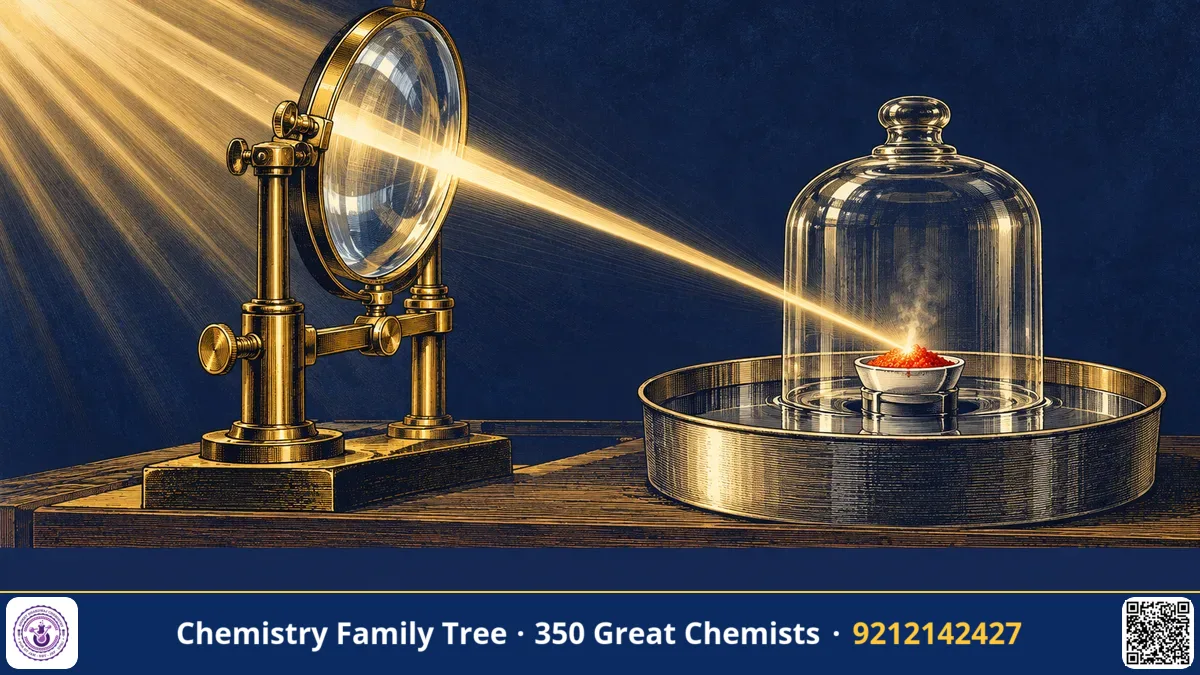
On 1 August 1774, an English minister and teacher named Joseph Priestley focused sunlight with a large lens on a red powder in a glass jar and collected a colourless gas in which a candle burned with a startlingly bright flame. That gas was oxygen. Priestley called it "dephlogisticated air" because he believed in the phlogiston theory, and he never gave up that belief. Even so, his careful experiments with gases gave chemistry some of its most important materials, including oxygen, ammonia, hydrogen chloride, sulphur dioxide and nitrous oxide, and also a method to make soda water. In this post, we will see how he worked, what the chemistry is, and what you need for your exams.
The Scientific Problem Before the Discovery
In the mid-1700s, "air" was thought to be a single substance. Joseph Black in Scotland had shown in 1750s that there is a gas, "fixed air" (carbon dioxide), released from limestone and magnesia alba, which is different from ordinary air. Henry Cavendish identified "inflammable air" (hydrogen) in 1766. These findings suggested that there are several kinds of air, but chemists had few methods to collect and study gases, especially gases that dissolve in water. The questions were: How can we collect gases without losing them? What other airs exist? Why does a mouse die in a closed jar, and why does burning stop? And can air that has been "spoiled" by burning or breathing be restored?
The Discovery: Experiments Step by Step
- Fixed air from a brewery (1767-1772). When Priestley lived next to a brewery in Leeds, he observed the gas that rises above fermenting liquor. He found that it was carbon dioxide, which is heavier than air and extinguishes a flame. He dissolved the gas in water by shaking and by passing it under pressure, and made the first artificial carbonated water. In 1772 he published a pamphlet on impregnating water with fixed air. This is the origin of soda water.
- The pneumatic trough with mercury. Many gases are soluble in water. Priestley collected such gases over mercury instead of water, which allowed him to isolate gases such as hydrogen chloride ("marine acid air"), ammonia ("alkaline air") and sulphur dioxide ("vitriolic acid air").
- Plants restore air (1771). He placed a sprig of mint in a closed jar of air in which a candle had burned out, and after some days, found that a candle could burn again in the jar. This showed that plants can restore air "spoiled" by burning. Jan Ingenhousz later showed that light is necessary for this action.
- Oxygen (1774). Using a large burning lens, Priestley heated mercuric oxide (red calx of mercury) in a closed vessel. A gas was released, and he collected it over mercury. A candle burned in the gas with a remarkable brightness, and a mouse lived longer in it than in ordinary air. He tried breathing the gas himself and felt that his chest was "light and easy" for some time.
- Visit to Paris (October 1774). He told Antoine Lavoisier about this experiment. Lavoisier understood its meaning better than Priestley and later named the gas oxygen. Carl Wilhelm Scheele had also prepared the gas a few years before, although his work was published later.
2HgO(s) → 2Hg(l) + O₂(g)        (heating mercuric oxide)
CaCO₃ + 2HCl → CaCl₂ + H₂O + CO₂   (laboratory carbon dioxide)
CO₂ + H₂O ⇌ H₂CO₃            (soda water)
The Chemistry Behind It
Oxygen: properties
Oxygen (O₂) is a colourless, odourless gas, slightly soluble in water. It makes up about 21% of dry air by volume. It supports combustion, but does not itself burn. It is paramagnetic, because its molecule has two unpaired electrons in antibonding π* orbitals, a fact explained by molecular orbital theory but not by simple Lewis structures. It condenses to a pale blue liquid at about −183 °C.
Laboratory and industrial preparation
2KClO₃ → 2KCl + 3O₂   (heat, MnO₂ catalyst)
2H₂O₂ → 2H₂O + O₂    (MnO₂ catalyst)
2H₂O → 2H₂ + O₂      (electrolysis)
Industrially, oxygen is obtained by fractional distillation of liquid air, in which nitrogen (b.p. −196 °C) boils off before oxygen (b.p. −183 °C).
Phlogiston versus oxygen
Priestley explained his results with phlogiston. A candle burns strongly in "dephlogisticated air" because the gas is eager to absorb phlogiston from the burning body. Lavoisier explained the same results through combination with oxygen, and the experimental evidence favoured his explanation. This is a good example of how different theories can explain the same observation, and why quantitative tests, such as weighing, are needed.
Photosynthesis link
6CO₂ + 6H₂O → C₆H₁₂O₆ + 6O₂ (light, chlorophyll)
Priestley's mint experiment was an early clue to this process.
Carbonated water and Henry's law
The solubility of a gas in a liquid is directly proportional to its partial pressure above the liquid (Henry's law: C = kP). A soda bottle is filled with CO₂ at high pressure, so more gas dissolves. When you open the bottle, the pressure drops and the gas bubbles out.
Applications Today
- Medical oxygen. Oxygen cylinders and concentrators are essential in hospitals. The oxygen supply was a critical issue in India during the second wave of COVID-19 in 2021.
- Steelmaking. Pure oxygen is blown through molten iron to remove carbon and other impurities in the basic oxygen process, which is used in Indian steel plants.
- Welding and cutting. Oxyacetylene torches reach temperatures of around 3000 °C.
- Rocket fuel. Liquid oxygen is the oxidiser in many launch vehicles.
- Soft drinks and fire extinguishers. Carbonated drinks use dissolved CO₂, and CO₂ extinguishers use its property of not supporting combustion.
- Water treatment. Oxygen and ozone are used for aeration and disinfection.
Exam Corner
- Oxygen was discovered independently by Scheele (about 1771-72, published 1777) and Priestley (1774), and named by Lavoisier.
- Priestley's method: heating HgO. Product: Hg and O₂. Collected over mercury.
- Oxygen is paramagnetic (two unpaired electrons in MO theory); bond order of O₂ is 2, of O₂⁺ is 2.5, of O₂⁻ is 1.5 and of O₂²⁻ is 1.
- Henry's law: S = kH × P; solubility of gases decreases with an increase in temperature.
- Priestley also discovered nitrous oxide (N₂O, "laughing gas"), nitric oxide (NO), HCl, NH₃ and SO₂ as gases.
Common Misconceptions
- "Priestley alone discovered oxygen." Scheele prepared oxygen earlier, but published later. Lavoisier explained its role. Credit is often shared among the three.
- "Oxygen burns." Oxygen supports burning; it is the oxidiser, not the fuel.
- "Plants only give out oxygen." Plants also respire and take in oxygen, but in daylight photosynthesis produces more oxygen than respiration uses.
Quick Revision Box
- Priestley prepared oxygen on 1 August 1774 by heating HgO with a burning lens.
- He called it "dephlogisticated air"; Lavoisier named it oxygen.
- He made soda water (CO₂ dissolved under pressure) in the early 1770s.
- Collected water-soluble gases over mercury: HCl, NH₃, SO₂.
- Mint experiment (1771) showed plants restore air.
- O₂ is paramagnetic; bond order 2.
FAQ
How did Priestley discover oxygen?
He heated red mercuric oxide with sunlight focused by a lens and collected the gas that came off over mercury. The gas made a candle burn very brightly.
Why did Priestley call oxygen dephlogisticated air?
He believed in phlogiston theory, and thought that this gas was air with no phlogiston, so it could take up a lot of phlogiston from burning materials.
What is Priestley's connection to soda water?
He found a way to dissolve carbon dioxide in water in 1767-1772, producing the first artificial carbonated water, which led to the soft drink industry.
Which gases did Priestley discover?
He isolated oxygen, nitrous oxide, nitric oxide, ammonia, hydrogen chloride and sulphur dioxide, among others.
Published by ABC Chemistry — IIT-JAM | CSIR-NET | GATE Chemistry Coaching. Visit abcchemistry.com
About the chemist
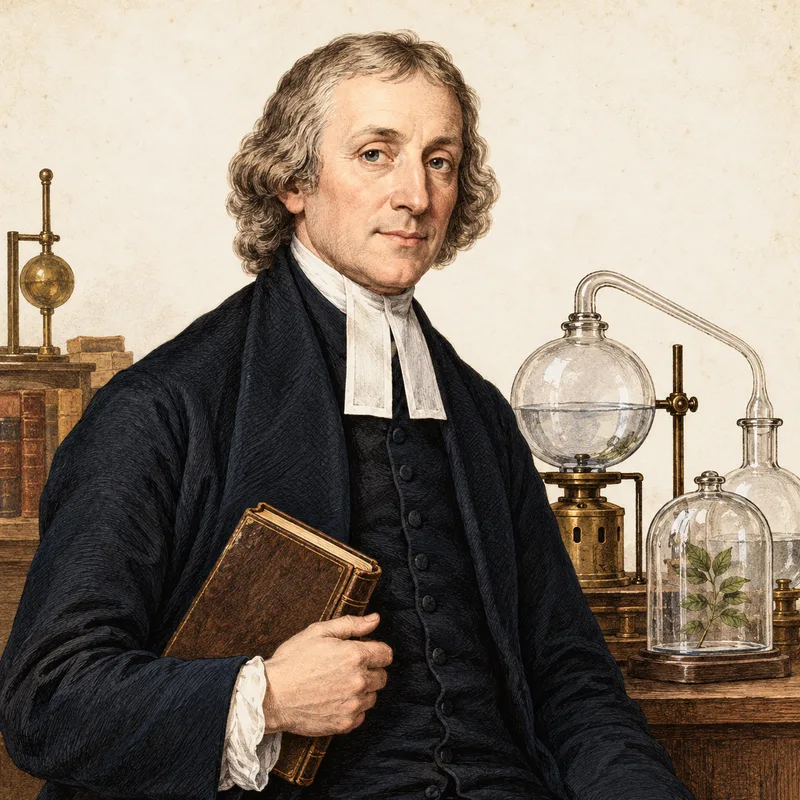
Joseph Priestley
1733-1804 · United Kingdom
Isolated oxygen and other gases