Biography · Chemist no. 21 of 350
J. Willard Gibbs: The Quiet Genius of New Haven
Josiah Willard Gibbs (1839–1903) spent almost his whole life in one city, New Haven, Connecticut, and almost his whole career at one university, Yale. Yet he became one of the most important theoretical scientists of the nineteenth century. He built chemical thermodynamics, introduced free energy and the phase rule, created modern vector analysis and laid the foundation of statistical mechanics. Many historians rank him among the greatest American scientists. His legacy is the Gibbs free energy ΔG that every chemistry student learns.
Early Life and Family
Gibbs was born on 11 February 1839 in New Haven, the fourth of five children. His father, Josiah Willard Gibbs Sr., was a professor of sacred literature at Yale and a respected linguist. He is remembered for helping the captured Africans of the Amistad case in 1839–1841, by finding an interpreter who could speak their language. His mother was Mary Anna Van Cleve.
Gibbs never married. He lived all his life in the family house on High Street with his sister Julia and her husband, Addison Van Name, who was the librarian of Yale. He was described as polite, modest and kind, and was well liked by his students, though few of them could follow his advanced teaching.
Education and Mentors
Gibbs entered Yale College and graduated in 1858, winning prizes in Latin and mathematics. He continued with engineering studies and in 1863 received one of the first doctorates in engineering awarded in the United States, with a thesis on the form of gear teeth. He worked as a tutor at Yale, teaching Latin and then natural philosophy. Between 1866 and 1869 he travelled to Europe with his sisters and studied in Paris, Berlin and Heidelberg. He attended lectures by leading physicists and mathematicians, including Gustav Kirchhoff and Hermann von Helmholtz at Heidelberg and Berlin. These years gave him the mathematical background he needed.
Career Timeline
| Year | Event |
|---|---|
| 1839 | Born in New Haven, Connecticut, 11 February |
| 1858 | Graduates from Yale College |
| 1863 | PhD in engineering from Yale |
| 1866–1869 | Studies in Paris, Berlin and Heidelberg |
| 1871 | Appointed professor of mathematical physics at Yale (initially without salary) |
| 1873 | Publishes two papers on graphical methods in thermodynamics |
| 1876–1878 | Publishes "On the Equilibrium of Heterogeneous Substances" |
| 1880s | Develops vector analysis and works on the electromagnetic theory of light |
| 1901 | Receives the Copley Medal of the Royal Society |
| 1902 | Publishes Elementary Principles in Statistical Mechanics |
| 1903 | Dies in New Haven, 28 April |
Major Scientific Contributions
- Chemical thermodynamics. Gibbs free energy, chemical potential, equilibrium conditions of heterogeneous systems, and the phase rule F = C − P + 2. See our discovery post for the details.
- Vector analysis. He wrote a short book for his students that formed the basis of the vector notation now used in physics and engineering, including dot and cross products. It was developed independently of Oliver Heaviside, and became standard.
- Statistical mechanics. His 1902 book defined the ensemble approach, linking the properties of matter to the statistics of molecules. The term "statistical mechanics" was his. Partition functions and ensembles, used in modern physical chemistry, follow his ideas.
- Gibbs adsorption equation. It links surface tension with the surface excess of a solute at an interface.
- Optics. He worked on the electromagnetic theory of light and on crystal optics.
Awards, Honours and Nobel Prize
Gibbs did not receive a Nobel Prize, and the prizes had only just been started when he died in 1903. During his life he gained several honours, including the Rumford Prize of the American Academy of Arts and Sciences (1880) and the Copley Medal of the Royal Society (1901), which was one of the highest scientific honours of the time. He became a Foreign Member of the Royal Society and a member of many academies in Europe. The American Chemical Society's Chicago Section awards the Willard Gibbs Award in his honour, and the Gibbs free energy and Gibbs phase rule carry his name across all textbooks. A crater on the Moon is also named for him.
Personality, Struggles and Lesser-Known Facts
- An unpaid professor. When Yale made him professor in 1871, he received no salary for his first nine years. When Johns Hopkins University tried to hire him in 1880, Yale gave him a salary to stay.
- Maxwell's model. James Clerk Maxwell made a clay (later plaster) model of the thermodynamic surface from Gibbs's 1873 paper. He sent one to Gibbs, as a mark of his admiration.
- Few words, great depth. Gibbs's writing is short and dense, with few explanations. This made it difficult to read, and probably delayed its recognition. Ostwald, who translated it into German, wrote that it contained a large part of what later became physical chemistry.
- Mathematics is a language. According to Yale accounts, during a faculty debate on the school curriculum, the usually silent Gibbs spoke only briefly, saying that "mathematics is a language".
- A modest life. He lived with his family in the house where he grew up, and he is remembered as a man of very regular habits who rarely sought public attention.
Legacy and Influence on Modern Chemistry
Gibbs's work was first appreciated in Europe, by Ostwald, Le Chatelier, van 't Hoff and Roozeboom, who used the phase rule in studies of alloys and salts. In America, G. N. Lewis and Merle Randall revived his methods in their 1923 textbook, which taught free energy and activity to chemists. Today, ΔG is the standard tool to decide the direction of chemical change; the phase rule is basic to metallurgy and geology; and statistical mechanics connects molecular properties to measurable quantities. Gibbs is often described as the first great theoretical scientist of the United States.
Lessons for Students
- Deep ideas can come from patient, quiet work. Gibbs published relatively little, but each paper was complete.
- Mathematics is a tool for chemists. Learn calculus and partial derivatives well.
- Explain your ideas clearly. Gibbs's work might have been recognised sooner if it had been easier to read.
- Stay curious even without recognition. Gibbs did not receive a salary for years, and yet he continued.
Quick Facts Box
- Born: 11 February 1839, New Haven, Connecticut, USA
- Died: 28 April 1903, New Haven, Connecticut, USA
- Nationality: American
- Field: Thermodynamics, physical chemistry, mathematical physics
- Famous for: Gibbs free energy, chemical potential, phase rule, vector analysis, statistical mechanics
- Nobel: None
FAQ
Did Gibbs ever leave the United States?
Yes, but only once for a long period: he studied in Europe from 1866 to 1869. After that he stayed in New Haven.
What is Gibbs's most important paper?
"On the Equilibrium of Heterogeneous Substances" (1876–1878), which established chemical thermodynamics.
Was Gibbs a chemist?
He was a mathematical physicist by title, but his work made him one of the founders of physical chemistry.
Who made his work known in Europe?
Wilhelm Ostwald translated it into German in 1892, and Henry Le Chatelier translated it into French in 1899.
Published by ABC Chemistry — IIT-JAM | CSIR-NET | GATE Chemistry Coaching. Visit abcchemistry.com
About the chemist
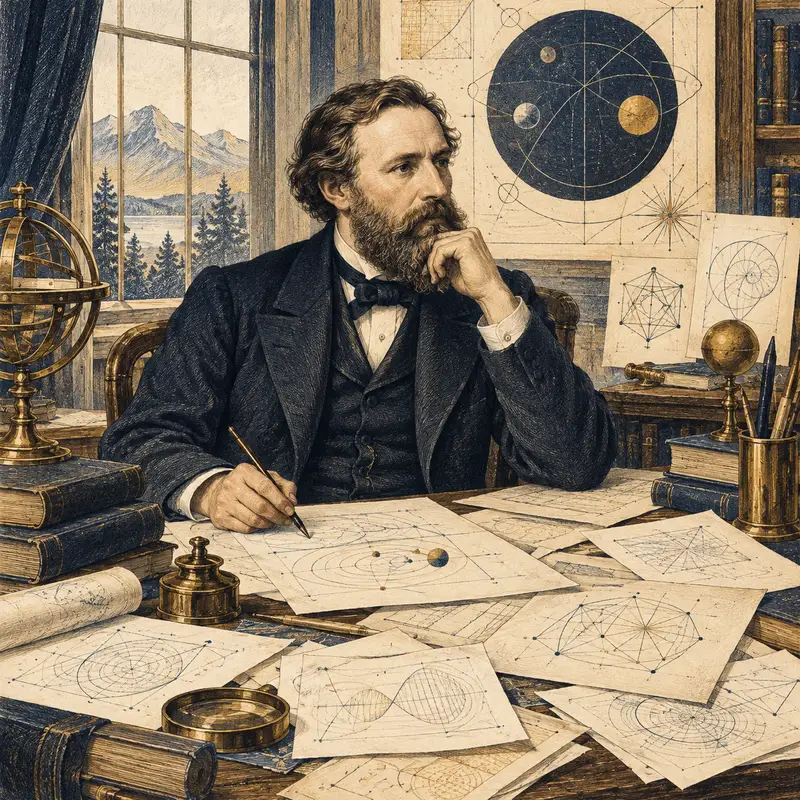
Josiah Willard Gibbs
1839-1903 · United States
Chemical thermodynamics; Gibbs free energy