The discovery, explained · Chemist no. 21 of 350
J. Willard Gibbs: Free Energy, Chemical Potential and the Phase Rule
Will a reaction happen by itself? How many phases can coexist in a mixture, and how many variables can we change freely? The answers to these basic questions come from the work of Josiah Willard Gibbs, an American scientist working quietly at Yale University. In a long paper published in 1876–1878, "On the Equilibrium of Heterogeneous Substances", Gibbs created the foundation of chemical thermodynamics. He gave us the free energy G, the idea of chemical potential, and the phase rule. Every JAM, NET and GATE paper tests these concepts, and they are central to metallurgy, biochemistry and materials science.
The Scientific Problem Before the Discovery
By the 1870s, thermodynamics had been developed for heat engines by Carnot, Clausius and Kelvin. The first law (energy conservation) and second law (entropy increases in an isolated system) were known. But chemists had no simple way to apply them to reactions. Berthelot and others claimed that the reaction which gives out the most heat always happens, and this is not true; ice melts at room temperature while absorbing heat.
Several questions were open:
- What single quantity decides the direction of a chemical change at constant temperature and pressure?
- How can the behaviour of mixtures, with many components and several phases, be described in a unified way?
- Why do some combinations of phases coexist only at one fixed temperature and pressure, such as ice, water and vapour?
The Discovery: A Mathematical Framework
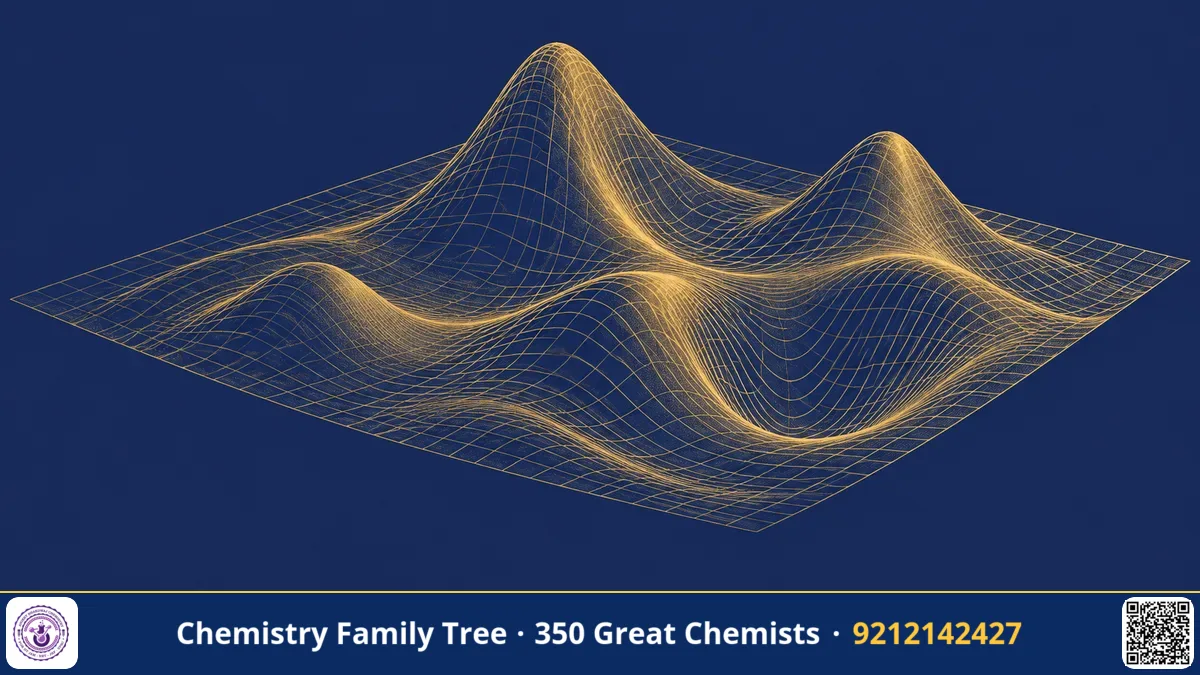
Gibbs first published two papers in 1873 on graphical methods in thermodynamics, using diagrams of entropy, volume and energy. James Clerk Maxwell in Cambridge admired these papers so much that he made a plaster model of Gibbs's thermodynamic surface for water and sent a copy to Gibbs. Then Gibbs wrote his great paper of 1876–1878 in the Transactions of the Connecticut Academy of Arts and Sciences, a journal of limited circulation. The main steps were:
- He defined a function now called the Gibbs free energy:
G = H − TS, where H is enthalpy, T is temperature and S is entropy. - He showed that at constant temperature and pressure, a process is spontaneous if ΔG < 0, is at equilibrium if ΔG = 0, and cannot occur spontaneously if ΔG > 0.
- He extended thermodynamics to open systems by defining the chemical potential:
μᵢ = (∂G/∂nᵢ)T,P,nⱼ. At equilibrium, the chemical potential of each component is equal in all phases. - From this he derived the phase rule.
The paper was mathematical and difficult. It was recognised mainly after Wilhelm Ostwald translated it into German in 1892 and Henry Le Chatelier translated it into French in 1899.
The Chemistry Behind It
Free energy and spontaneity. From G = H − TS at constant T:
ΔG = ΔH − TΔS
| ΔH | ΔS | Spontaneity |
|---|---|---|
| Negative | Positive | Spontaneous at all temperatures |
| Positive | Negative | Non-spontaneous at all temperatures |
| Negative | Negative | Spontaneous at low temperature |
| Positive | Positive | Spontaneous at high temperature |
Link to equilibrium and cells. The standard free energy change is related to the equilibrium constant and to the cell EMF:
ΔG° = −RT ln K = −nFE°
Also the fundamental differential is dG = V dP − S dT, and the Gibbs–Helmholtz equation is [∂(G/T)/∂T]P = −H/T².
The phase rule. For a system at equilibrium with C components and P phases, the number of degrees of freedom F (independent intensive variables such as T and P that can be changed without changing the number of phases) is:
F = C − P + 2
For water (C = 1):
- One phase (only liquid): F = 1 − 1 + 2 = 2 (bivariant: both T and P can vary).
- Two phases (ice and water): F = 1 (univariant: choose T, and P is fixed).
- Three phases (ice, water, vapour) at the triple point: F = 0 (invariant: 273.16 K and 611 Pa).
For condensed systems at constant pressure, the rule becomes F = C − P + 1.
Applications Today
- Biochemistry: the hydrolysis of ATP has a standard free energy change of about −30 kJ/mol, and this drives many biological reactions. Metabolic pathways are analysed through ΔG.
- Metallurgy: Ellingham diagrams, a plot of ΔG° against T for oxide formation, decide which reducing agent can extract a metal from its ore, as in blast furnaces used in Indian steel plants.
- Materials science: phase diagrams of alloys such as the iron–carbon system rely on the phase rule and equal chemical potentials.
- Batteries and fuel cells: the maximum electrical work from a cell is −ΔG.
- Chemical industry: choosing the temperature and pressure of an industrial process, such as ammonia synthesis, relies on ΔG and K.
- Computer modelling: modern software for materials and geochemistry minimises the Gibbs energy of a mixture to predict stable phases.
Exam Corner
- G = H − TS; spontaneous if ΔG < 0 at constant T and P; equilibrium at ΔG = 0.
- ΔG° = −RT ln K = −nFE°; ΔG = ΔG° + RT ln Q.
- Phase rule: F = C − P + 2; at the triple point of water F = 0.
- Chemical potential is the partial molar Gibbs energy; in equilibrium it is equal in all phases for each component.
- Gibbs–Duhem equation: Σ nᵢ dμᵢ = 0 at constant T and P.
Common Misconceptions
- "ΔG < 0 means the reaction is fast." It only says the reaction is thermodynamically possible. The rate depends on kinetics.
- "ΔG° = 0 at equilibrium." At equilibrium ΔG = 0. ΔG° is zero only when K = 1.
- "Gibbs energy is the same as total energy." It is the maximum non-expansion work available at constant T and P.
Quick Revision Box
- Gibbs's main paper: "On the Equilibrium of Heterogeneous Substances" (1876–1878).
- G = H − TS; dG = V dP − S dT.
- Chemical potential μ = (∂G/∂n) at constant T, P.
- Phase rule: F = C − P + 2.
- Triple point of water: 273.16 K, F = 0.
- Gibbs also founded vector analysis in physics and the term "statistical mechanics".
FAQ
Why is Gibbs energy more useful than entropy for chemists?
Most reactions take place at constant temperature and pressure. Under those conditions the sign of ΔG alone tells us the direction of spontaneous change, without having to calculate entropy changes of the surroundings.
What is a component in the phase rule?
It is the smallest number of independent chemical species needed to describe the composition of every phase.
Is Gibbs energy the same as Helmholtz energy?
No. Helmholtz energy A = U − TS applies at constant volume, and Gibbs energy G = H − TS at constant pressure.
Why did few people know Gibbs's work at first?
It was published in a small regional journal, and the mathematics was demanding. European translations brought it wide attention.
Published by ABC Chemistry — IIT-JAM | CSIR-NET | GATE Chemistry Coaching. Visit abcchemistry.com

About the chemist
Josiah Willard Gibbs
1839-1903 · United States
Chemical thermodynamics; Gibbs free energy