Biography · Chemist no. 13 of 350
Justus von Liebig: The Life of the Teacher Who Built Modern Chemistry Education
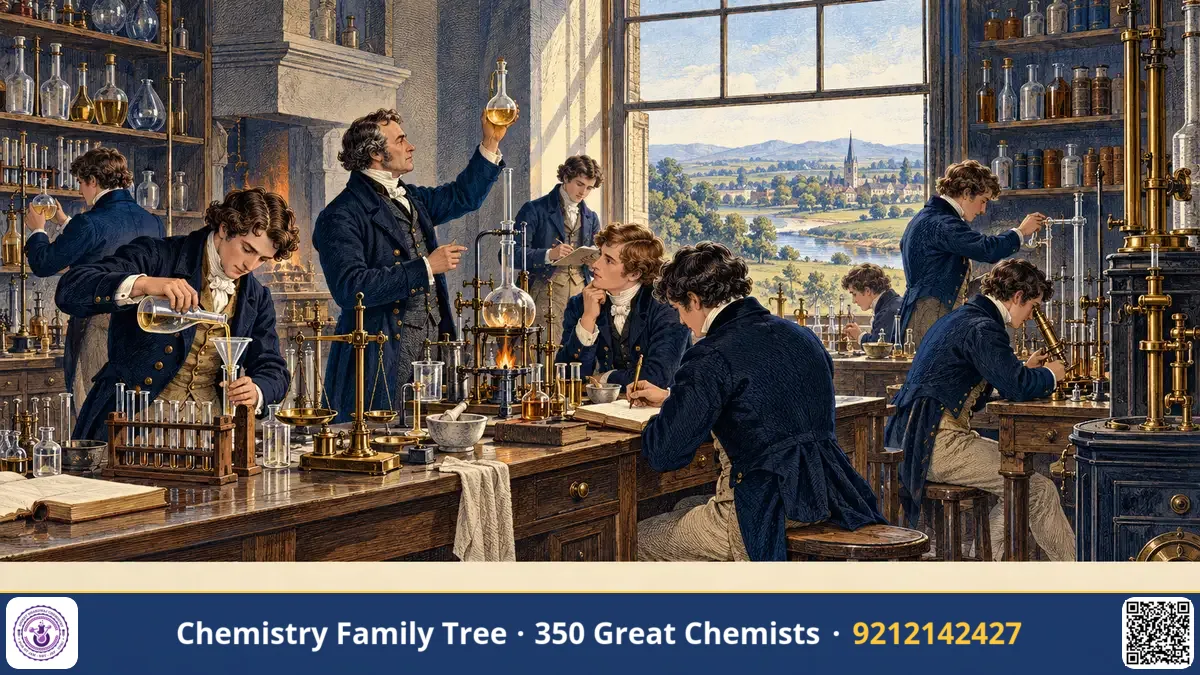
Justus von Liebig (1803-1873) was a German chemist who transformed organic chemistry with accurate methods of analysis, founded agricultural chemistry, and created the model of the university research and teaching laboratory that is now standard everywhere. His students became leaders of chemistry across Europe and America. His legacy in one line: he taught the world to learn chemistry by doing chemistry, and he taught farmers that plants need minerals.
Early Life and Family
Liebig was born on 12 May 1803 in Darmstadt, in the Grand Duchy of Hesse, Germany. His father, Johann Georg Liebig, was a dealer in drugs, dyes and chemicals, and made some of these products in a small workshop at home. Young Justus watched, helped and experimented with these materials. He grew up in the difficult years after the Napoleonic wars and the famine of 1816-1817, when poor harvests affected the whole of Europe. This experience of hunger may have shaped his later interest in agriculture. He did not enjoy school much, as it focused on classics and memory, and he left the gymnasium early. For a short time, he was apprenticed to an apothecary, but his master dismissed him after an explosion during his experiments. In 1826 he married Henriette Moldenhauer, and they had several children.
Education and Mentors
- He studied chemistry at the University of Bonn under Karl Wilhelm Gottlob Kastner and then followed him to Erlangen, where he received his doctorate in 1822. Kastner was a good scientist, but Liebig felt that Germany lacked proper laboratory training.
- With a grant from the Grand Duke of Hesse, he moved to Paris in 1822. There, with help from the explorer and naturalist Alexander von Humboldt, he was accepted into the laboratory of Joseph Louis Gay-Lussac, where he learned precise analytical methods, and found the culture of research that he later introduced to Germany.
- In Paris, he also came across the work on fulminates, which he had started to study earlier, and he met leading French chemists.
Career Timeline
| Year | Event |
|---|---|
| 1803 | Born in Darmstadt on 12 May |
| 1822 | Receives a doctorate at Erlangen; goes to Paris |
| 1824 | Becomes professor extraordinary at the University of Giessen at age 21 |
| 1826 | Opens a teaching laboratory at Giessen |
| 1831 | Develops combustion analysis with the five-bulb potash apparatus; prepares chloroform |
| 1832 | Founds the journal Annalen der Pharmacie (later Liebigs Annalen); works with Wöhler on the benzoyl radical |
| 1840 | Publishes his book on organic chemistry in its application to agriculture and physiology |
| 1845 | Made a baron (Freiherr) by the Grand Duke of Hesse |
| 1847 | Devises a concentrated meat extract |
| 1852 | Moves to the University of Munich |
| 1860 | Becomes president of the Bavarian Academy of Sciences |
| 1873 | Dies in Munich on 18 April |
Major Scientific Contributions
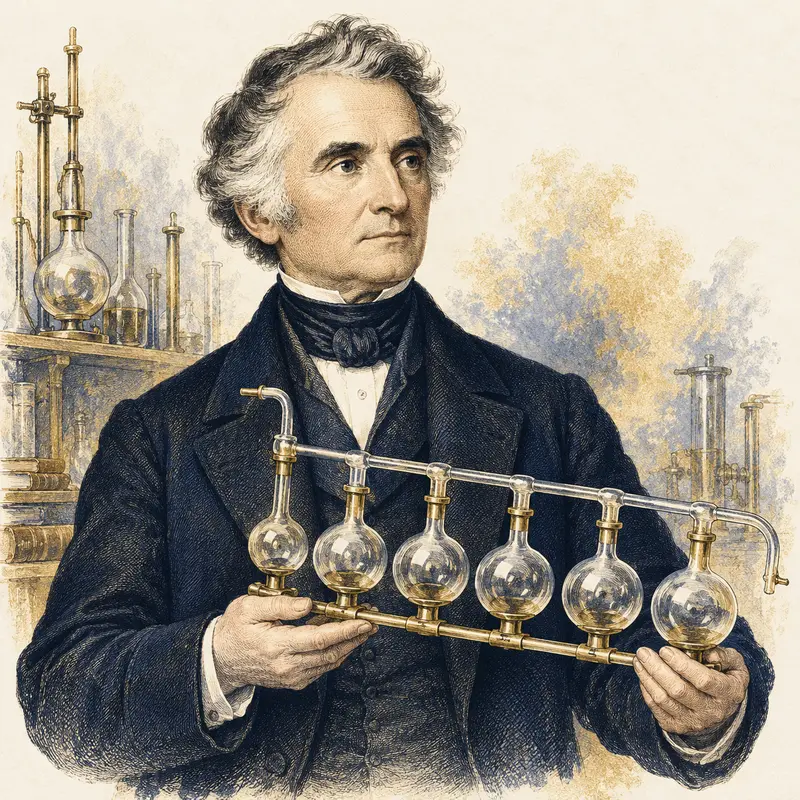
Organic analysis. His combustion method with the five-bulb potash apparatus made it possible to determine the formula of organic compounds quickly and accurately. See our discovery post on Liebig for the method and worked numericals.
% C = (12/44) × (mass of CO₂ / mass of sample) × 100
% H = (2/18) × (mass of H₂O / mass of sample) × 100
Radicals and compounds. With Wöhler, he showed that the benzoyl group passes unchanged through many reactions, supporting the idea of radicals. He studied uric acid and its derivatives, discovered chloroform and chloral, and prepared many other compounds. He also described amino acids such as tyrosine, and the compound hippuric acid.
Agricultural chemistry. He promoted the mineral theory of plant nutrition and popularised the law of the minimum. His book on agricultural chemistry was widely translated and strongly influenced farming practice.
Physiological chemistry. He tried to explain digestion, respiration and metabolism by chemistry, and classified foods as those that build the body (nitrogenous) and those that supply heat (carbohydrates and fats).
Practical products. His concentrated meat extract and a food for infants were produced commercially. He also developed the silver mirror process in 1856, and he popularised the Liebig condenser in laboratories.
Awards, Honours and Nobel Prize
- Foreign Member of the Royal Society of London (1840), and the Copley Medal (1840).
- Made a baron (Freiherr) in 1845.
- President of the Bavarian Academy of Sciences (1860).
- Honorary memberships of many scientific societies in Europe and the United States.
- No Nobel Prize, since he died in 1873, almost 30 years before the prizes began. The University of Giessen is now called Justus Liebig University in his honour, and the Liebig Medal of the German Chemical Society also carries his name.
Personality, Struggles and Lesser-Known Facts
- A teacher of thousands. At Giessen, students from all over Europe and the United States came to learn analysis. Among those who studied under him were August Wilhelm von Hofmann and August Kekulé, who both became famous. His lab was the first in which students systematically carried out research.
- Quick temper in debate. Liebig was known for strong public arguments. He quarrelled with other scientists, such as Gerardus Mulder over proteins, and with Louis Pasteur over the nature of fermentation. In this debate, he supported a chemical explanation, and Pasteur's work on living yeast eventually proved more correct.
- A lifelong friend. His friendship with Friedrich Wöhler lasted from the late 1820s until Liebig's death, and the two exchanged hundreds of letters.
- Early mistakes. In the first edition of his agricultural book, he said that plants do not need nitrogen fertiliser, because they could get ammonia from the air. Experiments by Lawes and Gilbert at Rothamsted showed that this was not correct, and Liebig changed his views later.
- The meat extract business. After he thought of a concentrated beef extract for the poor and sick, the Liebig's Extract of Meat Company was founded in 1865 to make it from cattle in Uruguay, and the brand became very famous.
- Illness and family losses. In his last years, he suffered from ill health and the loss of friends. He continued to write until the end of his life.
Legacy and Influence on Modern Chemistry
Liebig made chemistry a profession and a research science. His teaching laboratory became the model for universities in Germany, Britain and America, and many Indian institutions still follow the same pattern of lectures plus laboratory work. His methods of analysis are the ancestors of today's automated CHN analysers. His emphasis on mineral nutrition led to the fertiliser industry, which has helped to feed billions of people, although overuse also creates pollution, an issue India is facing. His journal, Liebigs Annalen, remained influential for a century and a half. His students spread his ideas, and the German chemical industry later became world-leading.
Lessons for Students
- Learn by doing. Practical laboratory work builds real understanding.
- Measure accurately. A good method can unlock a whole field.
- Connect chemistry to life. His interest in crops and food led to far-reaching results.
- Accept correction. He changed his views on nitrogen when experiments contradicted them.
- Disagree with respect. Strong debates are useful, but personal attacks do not help science.
Quick Facts Box
- Born: 12 May 1803, Darmstadt, Hesse, Germany
- Died: 18 April 1873, Munich, Bavaria, Germany
- Nationality: German
- Field: Organic chemistry, agricultural chemistry, biochemistry
- Famous for: Organic analysis, law of the minimum, teaching laboratory, chloroform
- Nobel Prize: None (died before 1901)
FAQ
Why is Liebig called the father of agricultural chemistry?
Because he showed that plants need mineral nutrients from the soil, rejected the humus theory and promoted the use of chemical fertilisers.
What was special about Liebig's laboratory at Giessen?
It trained students through systematic practical work and research, and became the model for modern university chemistry laboratories.
Who were Liebig's famous students?
August Wilhelm von Hofmann and August Kekulé are among the best known.
Did Liebig win a Nobel Prize?
No. He died in 1873, before the Nobel Prizes were created in 1901.
Published by ABC Chemistry — IIT-JAM | CSIR-NET | GATE Chemistry Coaching. Visit abcchemistry.com
About the chemist
Justus von Liebig
1803-1873 · Germany
Organic analysis; founder of teaching laboratories