The discovery, explained · Chemist no. 13 of 350
Justus von Liebig: Organic Analysis, the Law of the Minimum and Chemical Fertilisers
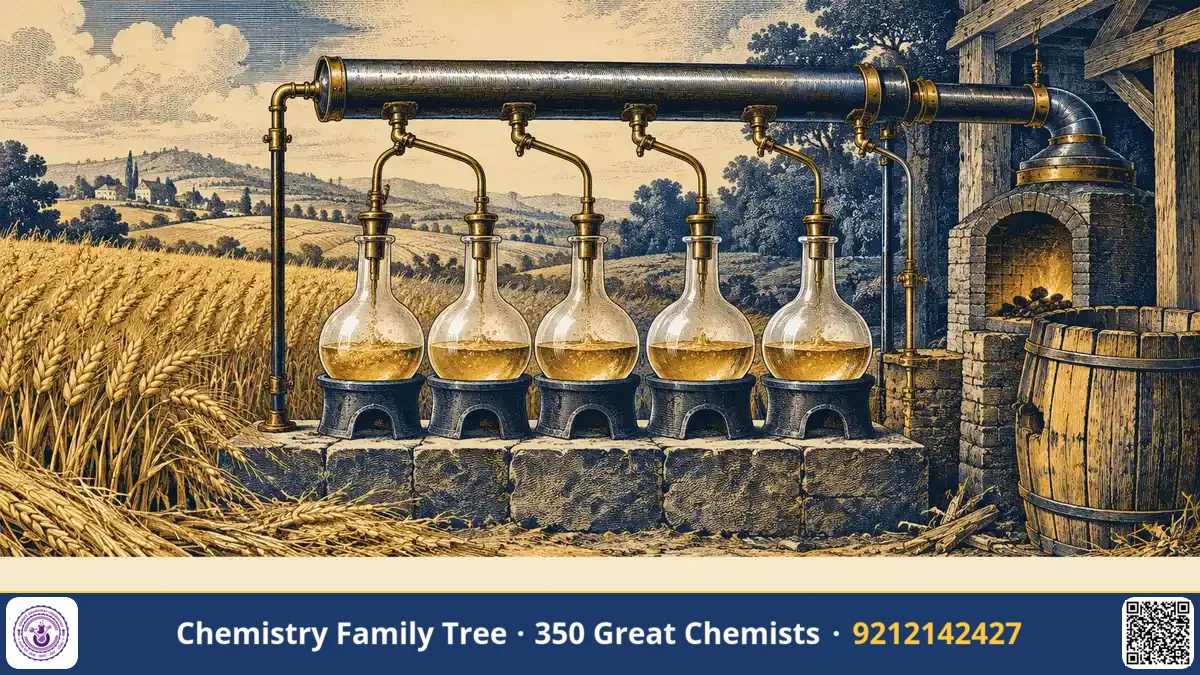
Two things in your daily life trace back to Justus von Liebig, a German chemist of the nineteenth century: the way chemists find the formula of an organic compound, and the idea that crops need chemical nutrients such as nitrogen, phosphorus and potassium. Liebig developed a precise method to determine the carbon and hydrogen content of organic compounds, which made modern organic chemistry quantitative. He also showed that plants take mineral nutrients from soil and that the nutrient in shortest supply limits growth, a principle known as the law of the minimum. In this post, we will explain these ideas with equations and numericals, and mention the exam points.
The Scientific Problem Before the Discovery
By the 1820s, chemists could analyse minerals and salts accurately, but organic compounds, which contain carbon, hydrogen, oxygen and nitrogen, were much harder. Gay-Lussac and Thénard had tried burning organic substances with oxidising agents, but the procedures were slow, unreliable and needed large samples. Without good analysis, chemists could not write correct formulae, and without formulae, they could not understand isomerism or the reactions of carbon compounds. In agriculture, the problem was equally serious. Farmers believed that plants grew mainly on humus (decayed organic matter), while Europe faced a growing population and poor harvests. Nobody knew exactly what plants needed from the soil.
The Discovery: Step by Step
- A teaching laboratory at Giessen (1824-1826). After studying in Paris with Gay-Lussac, Liebig became professor at the University of Giessen at only 21. He created a laboratory where students learnt analysis by doing it, which was a new idea at the time.
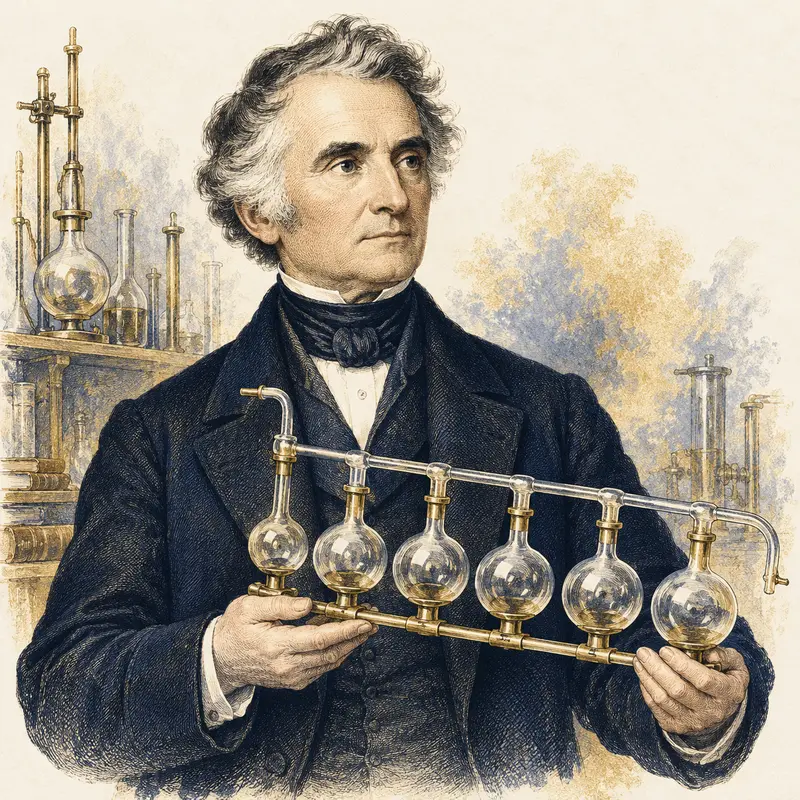
- Combustion analysis (about 1830-1831). He heated a weighed amount of an organic compound with copper(II) oxide (CuO) in a glass tube. Carbon was oxidised to CO₂ and hydrogen to H₂O. The water was absorbed in a tube of calcium chloride, and the CO₂ was absorbed in a solution of potassium hydroxide held in a glass apparatus of five connected bulbs, now called the Liebig potash bulb (Kaliapparat). The increase in mass of each absorber gave the mass of H₂O and CO₂ produced.
- Applying the method. With this method, he and his students analysed many compounds, including benzoic acid, uric acid, and the oils of almonds, giving reliable formulae in a few hours and not days.
- Plant nutrition (1840). In his book on organic chemistry in its application to agriculture and physiology, he argued that plants obtain carbon from carbon dioxide in air, hydrogen from water, and nitrogen as ammonia, and take essential mineral elements, such as phosphorus, potassium, calcium and magnesium, from the soil. He rejected the humus theory.
- The law of the minimum. He proposed that the yield of a crop is controlled by the nutrient that is present in the smallest relative amount, and not by the total amount of all nutrients. This idea was earlier suggested by Carl Sprengel, and Liebig popularised it.
- Artificial fertilisers. He encouraged the replacement of the nutrients taken by crops by mineral fertilisers, and experimented with treating bones with sulphuric acid to make phosphate more soluble.
The Chemistry Behind It
Combustion analysis: the reactions
CxHyOz + CuO (excess, heat) → CO₂ + H₂O + Cu
H₂O absorbed by anhydrous CaCl₂ (or Mg(ClO₄)₂)
CO₂ + 2KOH → K₂CO₃ + H₂O     (absorbed in the potash bulbs)
Worked numerical
A sample of 0.20 g of an organic compound gives 0.44 g of CO₂ and 0.18 g of H₂O on combustion. Find the percentage of C and H.
% C = (12/44) × (0.44/0.20) × 100 = 60 %
% H = (2/18) × (0.18/0.20) × 100 = 10 %
% O (by difference, if only C, H and O are present) = 30 %
Other organic methods
| Element | Method | Principle |
|---|---|---|
| C and H | Liebig's combustion | Mass of CO₂ and H₂O formed |
| N | Dumas method (1830) | Volume of N₂ at STP |
| N | Kjeldahl method (1883) | Conversion to (NH₄)₂SO₄ and then NH₃, titration |
| Halogens | Carius method | Fuming HNO₃ and AgNO₃ |
| S | Carius method | Conversion to H₂SO₄, precipitated as BaSO₄ |
The law of the minimum
The law is illustrated by a barrel with staves of unequal length. The water level (crop yield) can be no higher than the shortest stave (the most limiting nutrient). Adding more of a nutrient that is already abundant does not help. This is why modern fertilisers are balanced in terms of N-P-K ratios.
Fertiliser chemistry
Ca₃(PO₄)₂ + 2H₂SO₄ → Ca(H₂PO₄)₂ + 2CaSO₄      (single superphosphate)
(NH₂)₂CO + H₂O → 2NH₃ + CO₂                  (urea in soil)
Nitrogen supports leaf growth and protein formation, phosphorus supports roots and energy transfer (ATP), and potassium regulates water use and enzymes.
Other discoveries
- Chloroform and chloral (1831-1832), prepared by the reaction of ethanol or acetone with bleaching powder.
- The benzoyl radical, with Wöhler (1832).
- Silver fulminate (1824), isomeric with Wöhler's silver cyanate.
- The silver mirror process (1856), where silver ions are reduced by an aldehyde. The same chemistry is used in Tollens' test:
2[Ag(NH₃)₂]⁺ + RCHO + 3OH⁻ → 2Ag↓ + RCOO⁻ + 4NH₃ + 2H₂O
- Meat extract (1847), a concentrated beef extract made as a nutritional product.
Applications Today
- Elemental analysis in laboratories. Modern CHN analysers work by the same principle as Liebig's method, burning a sample and measuring CO₂, H₂O and N₂ with sensors. Every new compound published in a chemistry journal is checked by such analysis.
- Agriculture and the Green Revolution. India's food production depends heavily on NPK fertilisers (urea, DAP, MOP). Soil testing and the Soil Health Card scheme use the law of the minimum to recommend which nutrient a farm needs.
- Hydroponics and plant nutrition research. Nutrient solutions are prepared with known amounts of macro and micronutrients.
- Mirrors and decorative glass. The silver mirror method is the basis of modern silvering processes.
- Laboratory glassware. The Liebig condenser, a straight tube with a water jacket, is used in distillation in almost every organic laboratory.
- Food industry. His work on meat extract led to a commercial food product and to the broader field of food chemistry.
Exam Corner
- Liebig's method: determination of C and H by combustion with CuO; CO₂ absorbed in KOH, H₂O in anhydrous CaCl₂. % C = (12/44) × (mass CO₂/mass of compound) × 100; % H = (2/18) × (mass H₂O/mass of compound) × 100.
- Dumas method for nitrogen: volume of N₂ at STP; Kjeldahl method: not suitable for nitro, azo compounds and nitrogen in a ring (pyridine).
- Law of the minimum: growth is limited by the scarcest essential nutrient (Sprengel-Liebig law).
- Fertiliser nutrients: primary (N, P, K), secondary (Ca, Mg, S) and micronutrients (Fe, Zn, Mn, Cu, B, Mo).
- Tollens' reagent: ammoniacal silver nitrate, gives a silver mirror with aldehydes.
Common Misconceptions
- "Liebig invented the first fertiliser." Farmers had used manure, bone and guano for centuries. Liebig supplied the chemical reasoning for replacing nutrients.
- "More fertiliser always means higher yield." Only the limiting nutrient raises yield. Too much can harm crops and pollute water.
- "Liebig was right about everything in agriculture." He underestimated the role of nitrogen-fixing bacteria and soil organisms, and he first thought that plants did not need nitrogen fertiliser at all.
Quick Revision Box
- Liebig made organic analysis quantitative with CuO combustion and the five-bulb potash apparatus.
- %C = (12/44) × (CO₂ mass/sample mass) × 100; %H = (2/18) × (H₂O mass/sample mass) × 100.
- Law of the minimum: the most limiting nutrient controls yield.
- He rejected the humus theory and promoted mineral nutrition of plants.
- Giessen: first large teaching laboratory (1826).
- Also known for chloroform, chloral, the silver mirror process and the Liebig condenser.
FAQ
What is the law of the minimum?
It states that crop growth is controlled by the single essential nutrient that is in shortest supply, not by the total of all nutrients present.
How did Liebig find the percentage of carbon and hydrogen in a compound?
He burned a weighed sample with copper oxide and weighed the carbon dioxide and water produced, using absorbers of KOH and CaCl₂.
Why is the Liebig condenser named after him?
He popularised the water-jacketed straight-tube condenser in laboratories, although the design was known earlier and he did not invent it.
Which nutrients are in NPK fertilisers?
Nitrogen (N), phosphorus (P) and potassium (K), usually given as percentages of N, P₂O₅ and K₂O.
Published by ABC Chemistry — IIT-JAM | CSIR-NET | GATE Chemistry Coaching. Visit abcchemistry.com
About the chemist
Justus von Liebig
1803-1873 · Germany
Organic analysis; founder of teaching laboratories