Biography · Chemist no. 177 of 350
K. Barry Sharpless: The Chemist with Two Nobel Prizes
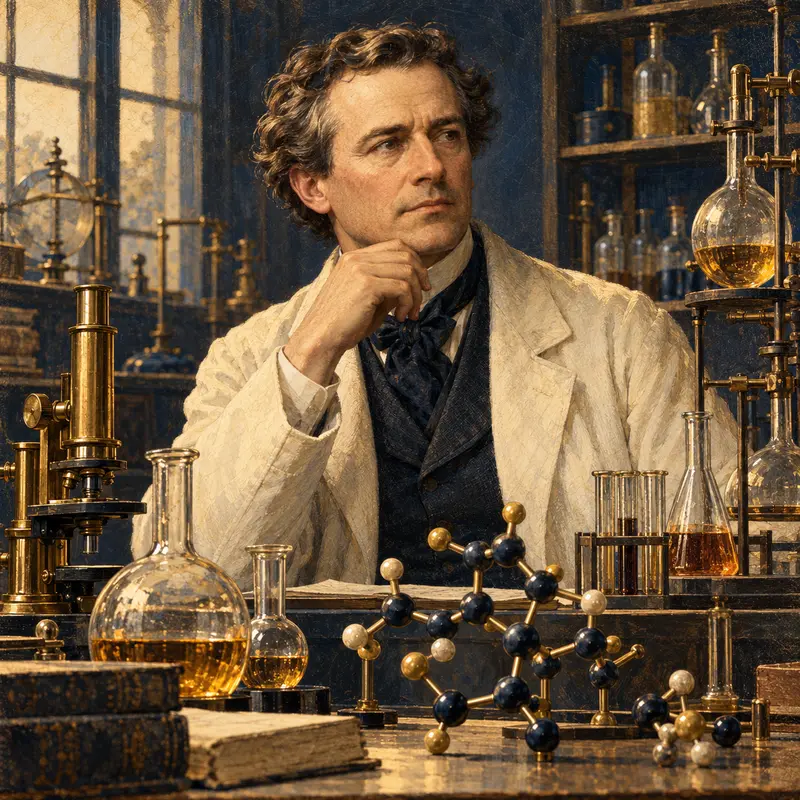
Karl Barry Sharpless, born in 1941, is an American chemist who has received the Nobel Prize in Chemistry twice: in 2001 for chirally catalysed oxidation reactions, and in 2022 for click chemistry. He is one of very few people in the world to have won two Nobel Prizes, and the only other person with two in Chemistry is Frederick Sanger. His research created tools that are used in every drug-discovery and organic synthesis laboratory.
Early Life and Family
Barry Sharpless was born on 28 April 1941 in Philadelphia, Pennsylvania, USA. He grew up in the Philadelphia area, and he has said that as a boy he loved fishing and the outdoors. His father was a doctor, and Sharpless was exposed to medicine in his family, though he chose chemistry. He gradually became fascinated with experimental science, which later led him to organic chemistry.
Education and Mentors
Sharpless studied chemistry at Dartmouth College in New Hampshire, graduating in 1963. He then went to Stanford University and received his PhD in organic chemistry in 1968, working with Eugene van Tamelen on the biosynthesis of terpenes and the chemistry of squalene oxide. He did postdoctoral research at Stanford and then at Harvard University with Konrad Bloch, a Nobel laureate in Physiology or Medicine (1964), studying the enzymology of squalene and cholesterol biosynthesis. These years gave him a taste for epoxides, which became central to his later work.
Career Timeline
| Year | Event |
|---|---|
| 1941 | Born in Philadelphia on 28 April |
| 1963 | Graduated from Dartmouth College |
| 1968 | PhD, Stanford University, under Eugene van Tamelen |
| 1968–70 | Postdoctoral research at Stanford and Harvard (with Konrad Bloch) |
| 1970–77 | Assistant and associate professor at the Massachusetts Institute of Technology (MIT) |
| 1977–80 | Moved to Stanford University |
| 1980 | Katsuki–Sharpless asymmetric epoxidation reported; returned to MIT |
| 1990 | Moved to the Scripps Research Institute in La Jolla, California |
| 2001 | Introduced the concept of click chemistry; Nobel Prize in Chemistry (half share) |
| 2002 | Discovery of copper-catalysed azide–alkyne cycloaddition (with Fokin; Meldal independently) |
| 2022 | Second Nobel Prize in Chemistry, shared with Morten Meldal and Carolyn Bertozzi |
Major Scientific Contributions
- Asymmetric epoxidation (1980). With Tsutomu Katsuki he developed the epoxidation of allylic alcohols with Ti(OiPr)4, tartrate and TBHP.
- Asymmetric dihydroxylation and aminohydroxylation. OsO4-based reactions with cinchona alkaloid ligands made enantiopure diols and amino alcohols.
- Click chemistry. He proposed in 2001 a set of "spring-loaded", reliable reactions to join molecular building blocks. The CuAAC reaction is the best-known example.
- SuFEx chemistry. Later, with colleagues, he introduced sulfur(VI) fluoride exchange as a second-generation click reaction.
- Reactions "on water". His group showed that some organic reactions proceed faster in water suspensions than in organic solvents.
Our discovery post gives the mechanisms and exam points on epoxidation and click chemistry.
Awards, Honours and the Nobel Prize
Sharpless received half of the 2001 Nobel Prize in Chemistry "for his work on chirally catalysed oxidation reactions", while the other half went to William Knowles and Ryoji Noyori for hydrogenation. In 2022, he shared the Nobel Prize in Chemistry with Carolyn R. Bertozzi and Morten Meldal "for the development of click chemistry and bioorthogonal chemistry". Other honours include the Wolf Prize in Chemistry (2001), election to the US National Academy of Sciences. He is the W. M. Keck Professor of Chemistry at the Scripps Research Institute.
Personality, Struggles and Lesser-Known Facts
- Losing an eye. A laboratory accident cost him the sight in one eye, as he has said in interviews. He kept working in the laboratory.
- Chemistry and fishing. He has often spoken about his love of fishing, and he has described the way chemists should "fish" for new reactions.
- New directions at Scripps. After moving to Scripps, he turned from classic synthetic methods towards problems close to medicinal chemistry and chemical biology.
- Strong views on reactions. He has often said that chemists should focus on reactions that are simple, reliable and practical rather than on difficult, elegant ones.
- Second Nobel Prize at 81. He received the second Nobel Prize at the age of 81, 21 years after the first.
Legacy and Influence on Modern Chemistry
Sharpless's epoxidation and dihydroxylation reactions are standard in textbooks and used in industry and in total synthesis. Click chemistry changed how chemists think about connecting molecules: it created an entire toolbox for materials science, chemical biology and drug discovery. His life shows that big contributions can come at different stages of a career. For Indian students, Sharpless reactions are core topics in organic chemistry for JAM, NET and GATE, along with Wilkinson, Noyori and Knowles hydrogenation.
Lessons for Students
- Look for simple, reliable reactions. Usefulness beats complexity.
- Stay curious for life. His second prize came decades after the first.
- Keep working after setbacks. He continued to do experiments after an eye injury.
- Cross-fertilise fields. Ideas from organic synthesis helped biology and medicine.
Quick Facts Box
- Born: 28 April 1941, Philadelphia, Pennsylvania, USA
- Died: Living (as of this writing)
- Nationality: American
- Field: Organic chemistry, catalysis, chemical biology
- Famous for: Sharpless epoxidation, asymmetric dihydroxylation, click chemistry
- Nobel: Chemistry, 2001 (half share) and Chemistry, 2022 (shared)
FAQ
How many Nobel Prizes has Sharpless won?
Two, both in Chemistry: in 2001 and in 2022.
Who else has two Nobel Prizes in Chemistry?
Frederick Sanger, in 1958 and 1980.
Where does he work?
At the Scripps Research Institute in La Jolla, California, after earlier positions at MIT and Stanford.
Who was his PhD supervisor?
Eugene van Tamelen at Stanford University.
Published by ABC Chemistry — IIT-JAM | CSIR-NET | GATE Chemistry Coaching. Visit abcchemistry.com
About the chemist
K. Barry Sharpless
1941- · United States · Nobel Chemistry 2001 and 2022
Asymmetric oxidation; click chemistry