The discovery, explained · Chemist no. 177 of 350
K. Barry Sharpless: Asymmetric Oxidation and Click Chemistry
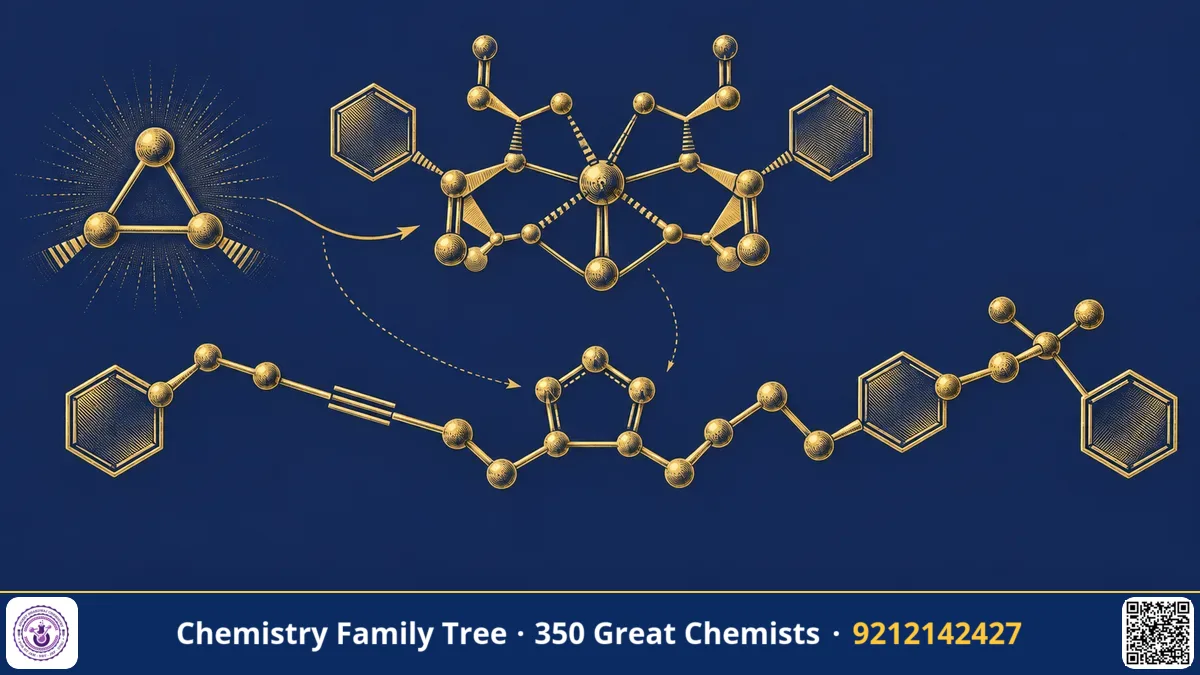
K. Barry Sharpless is one of only a few scientists to win the Nobel Prize in Chemistry twice. In 2001 he received half of the prize for chirally catalysed oxidation reactions, namely the Sharpless asymmetric epoxidation and the asymmetric dihydroxylation. In 2022 he shared the prize with Morten Meldal and Carolyn Bertozzi for the development of click chemistry and bioorthogonal chemistry. These two prizes cover two different parts of his work: making single-handed molecules by catalysis, and joining molecules quickly and reliably. This post explains both, with the reactions that students must know for JAM, NET and GATE.
The Scientific Problem Before the Discovery
Epoxides are three-membered cyclic ethers that are very useful in synthesis because the strained ring opens with many nucleophiles. But making an epoxide that is enantiomerically pure was difficult. Ordinary epoxidation of alkenes with peracids such as m-CPBA gives racemic products when the alkene is prochiral. Enzymes could do it but only for specific substrates. Knowles and Noyori had solved the problem for hydrogenation, but there was no general chiral catalyst for oxidation. Another problem was that drug discovery needed reliable reactions that join molecular fragments in high yield, with simple conditions and no by-products. Many classical reactions failed these requirements.
The Discovery: Step by Step
1. Sharpless asymmetric epoxidation (1980)
In 1980, Sharpless and Tsutomu Katsuki reported the epoxidation of allylic alcohols using titanium(IV) isopropoxide, an optically active dialkyl tartrate such as diethyl tartrate (DET) and tert-butyl hydroperoxide (TBHP) as the oxidant:
Allylic alcohol + TBHP --[Ti(OiPr)₄, (+)- or (−)-DET, CH₂Cl₂, −20 °C]--> 2,3-epoxy alcohol (>90% ee)
The choice of the tartrate enantiomer decides which face of the double bond is epoxidised. The famous mnemonic: draw the allylic alcohol in the plane with the CH2OH group at the bottom right. L-(+)-DET delivers oxygen from the bottom face, and D-(−)-DET from the top face. Molecular sieves (3 Å or 4 Å) are added later to make the reaction catalytic in titanium and tartrate.
2. Sharpless asymmetric dihydroxylation (late 1980s–1990s)
Sharpless also developed the asymmetric dihydroxylation of alkenes using osmium tetroxide and cinchona alkaloid ligands. It converts an alkene into a chiral vicinal diol with a syn-addition:
R–CH=CH–R′ + OsO₄ (cat.), K₃Fe(CN)₆ (co-oxidant), chiral ligand → syn-diol (high ee)
The ready-made reagent mixtures are called AD-mix-α (containing the ligand (DHQ)2PHAL) and AD-mix-β (containing (DHQD)2PHAL). They are sold as commercial mixtures and are among the most widely used chiral reagents. Sharpless also developed asymmetric aminohydroxylation to give amino alcohols.
3. Click chemistry (2001 onwards)
In 2001, Sharpless introduced the concept of "click chemistry": a set of reactions that are modular, wide in scope, high yielding, produce only harmless by-products, are stereospecific, and are done in simple conditions, preferably in water. The best example is the azide–alkyne cycloaddition. The thermal version (Huisgen cycloaddition) gives a mixture of 1,4- and 1,5-triazoles and requires heating. In 2002, the groups of Sharpless (with Valery Fokin and others) and Morten Meldal independently found that copper(I) catalysis gives only the 1,4-disubstituted 1,2,3-triazole at room temperature:
R–N₃ + R′–C≡CH --[Cu(I), room temp]--> 1,4-disubstituted 1,2,3-triazole
This is the copper-catalysed azide–alkyne cycloaddition (CuAAC). Carolyn Bertozzi later developed copper-free, strain-promoted versions using cyclooctynes that work inside living cells, which is why the 2022 prize also recognised bioorthogonal chemistry.
The Chemistry Behind It
Epoxidation mechanism
Titanium isopropoxide exchanges its alkoxide groups with the tartrate and with the allylic alcohol and TBHP, to form a dimeric titanium complex. The allylic alcohol and the peroxide are both bound to titanium, so the oxygen is delivered intramolecularly to one face of the alkene. The rigid chiral environment created by the tartrate decides which face. This requires a free hydroxyl group, so the reaction works with allylic alcohols but not with simple alkenes.
Why is it useful?
The product 2,3-epoxy alcohol can be opened regioselectively by nucleophiles at C-3 or C-2, giving diols, amino alcohols and other building blocks with defined stereochemistry. Such a transformation was used in syntheses of many natural products and drugs, including the production of (+)-disparlure, the sex pheromone of the gypsy moth, and the beta-blocker propranolol enantiomers.
CuAAC mechanism (simplified)
- Cu(I) coordinates to the terminal alkyne and replaces the terminal proton to give a copper acetylide.
- The azide binds to copper, and its terminal nitrogen attacks the acetylide carbon to form a six-membered metallacycle.
- The ring contracts to a triazolyl-copper intermediate, which is protonated to give the 1,4-triazole and release the Cu(I) catalyst.
Cu(I) is often generated in situ from CuSO4 with sodium ascorbate as the reducing agent.
Applications Today
- Drug synthesis: Chiral epoxides and diols are intermediates for many medicines. Indian pharmaceutical companies use such methods in process chemistry.
- Drug discovery: Click reactions make libraries of triazole-containing compounds quickly for screening.
- Polymers and materials: Click reactions join polymer chains, make dendrimers and functionalise surfaces.
- Biology: Bioorthogonal click reactions label sugars, proteins and lipids in living cells and are used to track molecules and to build antibody–drug conjugates.
- Cancer research: Bioorthogonal reactions are being studied for targeted drug activation inside tumours.
Exam Corner
- Sharpless epoxidation: Ti(OiPr)4, DET or DIPT, TBHP; works only on allylic alcohols; enantioselectivity set by the tartrate.
- Asymmetric dihydroxylation: OsO4 (catalytic), K3Fe(CN)6 or NMO as co-oxidant, cinchona ligands; AD-mix-α and AD-mix-β; syn-diol.
- CuAAC gives 1,4-disubstituted triazole; Ru-catalysed (RuAAC) gives the 1,5-isomer.
- Click chemistry criteria: high yield, simple conditions, wide scope, stereospecific, harmless by-products.
- Sharpless won half of the 2001 Nobel Prize in Chemistry (oxidation) and shared the 2022 Nobel Prize in Chemistry with Meldal and Bertozzi (click chemistry).
Common Misconceptions
- "Sharpless epoxidation works for all alkenes." It requires an allylic alcohol, because the hydroxyl group binds to titanium.
- "Click chemistry means one specific reaction." It is a philosophy; CuAAC is the best-known example, but other reactions, such as thiol–ene and SuFEx, also fit.
- "The thermal azide–alkyne reaction is regioselective." Without a catalyst it gives a mixture of 1,4- and 1,5-triazoles.
Quick Revision Box
- 1980: Katsuki–Sharpless epoxidation of allylic alcohols, Ti(OiPr)4/DET/TBHP.
- Asymmetric dihydroxylation: OsO4 + cinchona ligands, AD-mix-α/β, syn-diol.
- 2001: concept of click chemistry; CuAAC 2002 gives 1,4-triazoles.
- Bertozzi: copper-free, bioorthogonal click in living systems.
- Two Nobel Prizes in Chemistry: 2001 and 2022.
FAQ
Why did Sharpless get two Nobel Prizes?
The first, in 2001, was for chirally catalysed oxidation reactions. The second, in 2022, was for the development of click chemistry and bioorthogonal chemistry.
Which tartrate gives which face?
With the allylic alcohol drawn in the standard orientation, L-(+)-tartrate delivers oxygen from the bottom face and D-(−)-tartrate from the top face.
What is a bioorthogonal reaction?
It is a chemical reaction that can proceed inside living systems without interfering with native biochemical processes.
Who shared the 2022 prize?
Morten Meldal of Denmark and Carolyn Bertozzi of the United States shared the prize with Sharpless.
Published by ABC Chemistry — IIT-JAM | CSIR-NET | GATE Chemistry Coaching. Visit abcchemistry.com
About the chemist
K. Barry Sharpless
1941- · United States · Nobel Chemistry 2001 and 2022
Asymmetric oxidation; click chemistry