Biography · Chemist no. 310 of 350
Karl Fischer (1901–1958): The Industrial Chemist Whose Name Is on Every Water Titrator

Few chemists have their names printed on a machine that sits in thousands of laboratories. Karl Fischer, a German chemist, is one of them. The Karl Fischer titrator, found in pharmaceutical, food, oil and chemical companies around the world, is based on a method he published in 1935. Unlike many famous scientists, Fischer lived a relatively quiet life, and only limited biographical information about him is available in widely accessible sources. This article gives the well-established facts, explains the context of his work and avoids guesses about details that cannot be verified. His legacy in one line: he gave analytical chemistry its most trusted method for measuring water.
Early Life and Family
Karl Fischer was born in 1901 in Germany, in the years of the German Empire, when German chemistry led the world in dyes, pharmaceuticals and fertilisers. Information about his parents, siblings and childhood is not readily available in standard references, and it is not given here. What is clear is that he grew up in a country where chemical education was highly respected and industry offered careers to well-trained chemists.
Education and Mentors
Fischer was trained as a chemist at German institutions and went on to work in industry. Standard sources refer to him as a German chemist whose professional work was in analytical chemistry in industry. The names of his teachers and the details of his degrees are not stated here, since reliable specifics were not available for this article.
Career Timeline
| Year | Event |
|---|---|
| 1901 | Born in Germany |
| 1920s–1930s | Works as a chemist in industry, with a focus on analytical problems |
| 1935 | Publishes "Neues Verfahren zur maßanalytischen Bestimmung des Wassergehaltes von Flüssigkeiten und festen Körpern" (A new method for the volumetric determination of the water content of liquids and solids) in the journal Angewandte Chemie |
| 1940s | Method taken up in the United States by Mitchell, Smith and others, who study its mechanism |
| 1958 | Fischer dies |
| 1970s onward | Coulometric KF and automatic titrators spread the method widely |
Major Scientific Contributions
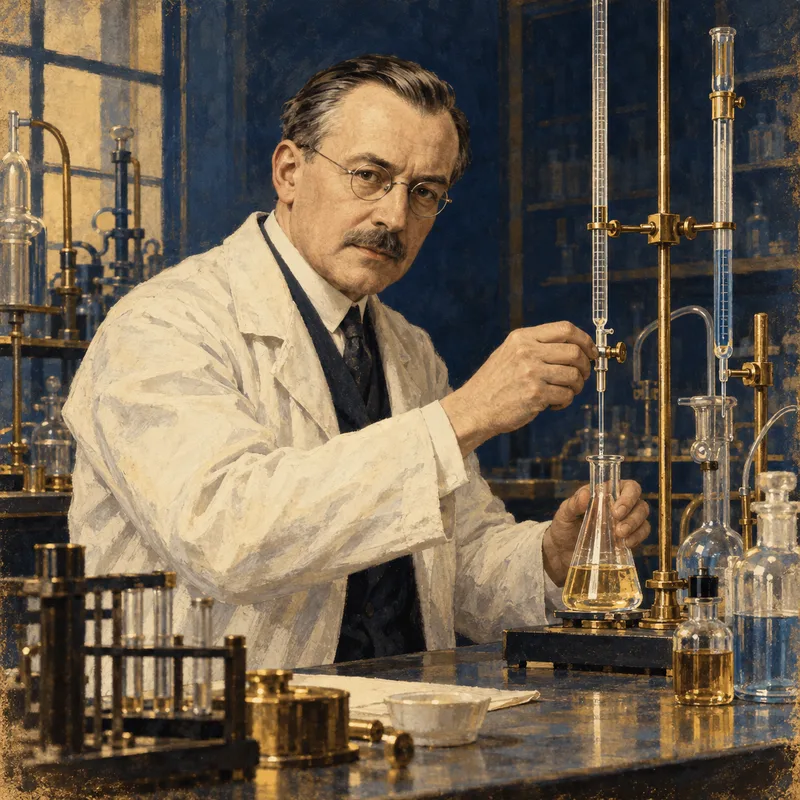
The Karl Fischer titration. Fischer's one outstanding contribution is the water titration. He noticed that the classical Bunsen reaction between iodine and sulphur dioxide needs water, and he adapted it to a non-aqueous system with methanol and pyridine. The result was a reagent that reacts with water in a fixed proportion. The chemical details, the electrode detection system and modern variants are discussed in the companion discovery article.
Practical value. The method was fast, used small samples and applied to liquids and solids alike. It was especially useful for materials from which water cannot easily be removed by drying without causing decomposition.
Stimulus for others. Fischer's paper pointed out that the reagent's titre changes over time and that stoichiometry varies with conditions. This stimulated later chemists to investigate the reaction mechanism, and to design stable reagents. The introduction of coulometric generation of iodine, a technique associated with the work of Meyer and Boyd in the 1950s, extended the technique to trace amounts.
Awards, Honours and Nobel Prize
Fischer did not receive a Nobel Prize. No major prizes in his name are well documented, and none are claimed here. The strongest sign of recognition is that his name is attached to a method used every day around the world: "Karl Fischer titration", "KF reagent", "KF titrator" and "KF moisture".
Personality, Struggles and Lesser-Known Facts
- The name problem. Several chemists are called Karl Fischer, and the name is very common in Germany. Students sometimes confuse him with Hans Fischer (Nobel Prize in Chemistry 1930, for work on porphyrins, chlorophyll and haemin), Emil Fischer (Nobel Prize in Chemistry 1902, sugars and purines) and Ernst Otto Fischer (Nobel Prize in Chemistry 1973, organometallic sandwich compounds). Karl Fischer is not related to any of them as far as can be determined, and he won no Nobel Prize.
- A method from industry. Many of the great discoveries in chemistry came from universities, but this one grew from a practical need in industrial analysis.
- Short title, long impact. His original paper was only a few pages long, yet it changed how materials are tested. The method is still described in the same terms 90 years later.
- Improved after him. The pyridine-based reagent he used has been largely replaced by safer and more stable modern reagents, but the principle is unchanged.
- Born in the same era as many quantum pioneers. His year of birth, 1901, is shared with Enrico Fermi, Werner Heisenberg and Linus Pauling, showing how much changed in science during a single generation.
Legacy and Influence on Modern Chemistry
The KF titration is probably the most common method for water determination in the world. It is listed in the major pharmacopoeias, including the Indian, British, United States and European ones. It is used in the control of edible oils, in the export of spices and tea, in the production of lithium-ion batteries and in the monitoring of transformer oil in power utilities. Modern titrators are automated, with motorised burettes, dead-stop endpoint detection and software. The method also shows an important principle: the best analytical methods are based on a clean, well-understood chemical reaction that is specific for the target substance.
Lessons for Students
- Solve practical problems. A real industrial need can lead to a lasting scientific contribution.
- Choose a specific reaction. The strength of KF lies in the fact that iodine reacts with sulphur dioxide only when water is present.
- Do not confuse similar names. Learn the differences between the various Fischers: Emil, Hans, Ernst Otto, Karl and others.
- Understand the mechanism. Later work improved the method only after the chemistry was properly understood.
Quick Facts Box
- Born: 1901, Germany
- Died: 1958
- Nationality: German
- Field: Analytical chemistry
- Famous for: Karl Fischer titration for water (1935)
- Nobel: None
FAQ
Is Karl Fischer the same as Emil Fischer or Hans Fischer?
No. Emil Fischer (1852–1919) worked on sugars and purines and received the Nobel Prize in Chemistry in 1902. Hans Fischer (1881–1945) received it in 1930 for his work on haemin and chlorophyll. Karl Fischer, of the water titration, received no Nobel Prize.
When was the Karl Fischer titration published?
In 1935, in the journal Angewandte Chemie.
Why is the KF method so widely used?
It is specific for water, sensitive down to ppm levels, fast, accurate and applicable to many kinds of materials.
What is the chemical principle?
Iodine oxidises sulphur dioxide in the presence of water, with a base and alcohol, consuming iodine and water in a 1:1 mole ratio.
Published by ABC Chemistry — IIT-JAM | CSIR-NET | GATE Chemistry Coaching. Visit abcchemistry.com
About the chemist
Karl Fischer
1901-1958 · Germany
Karl Fischer titration for water