The discovery, explained · Chemist no. 310 of 350
Karl Fischer and the Titration That Counts Every Drop of Water
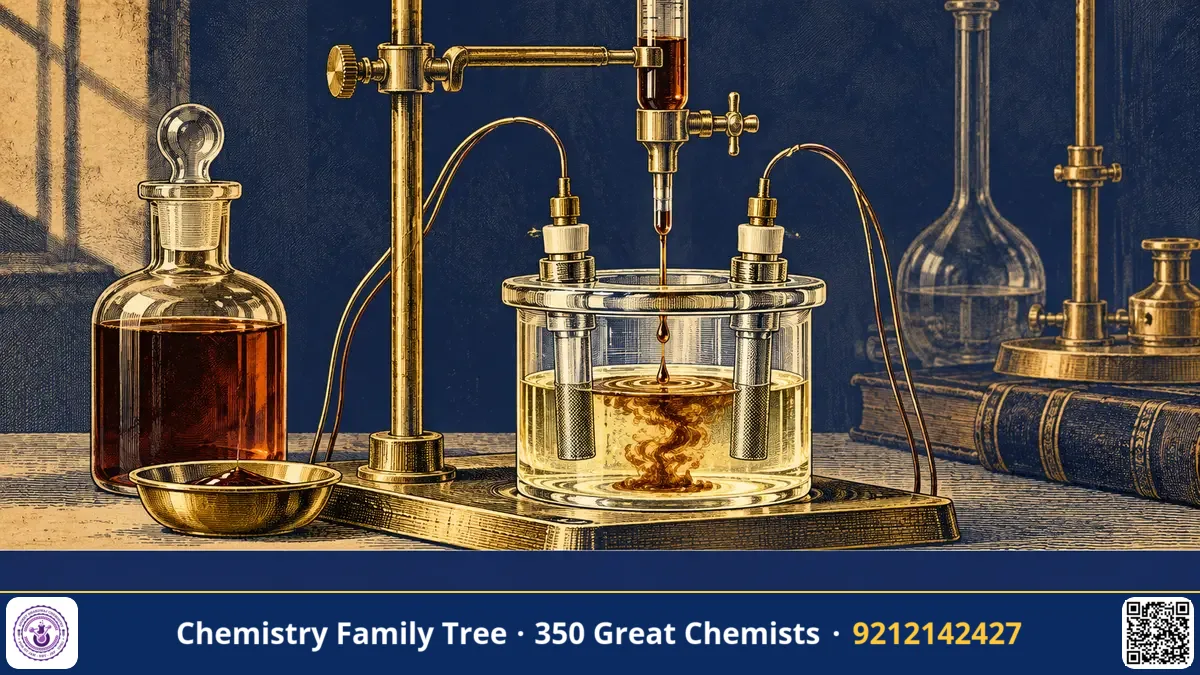
How much water is there in a tablet, a bottle of transformer oil, a packet of milk powder or a jar of honey? A little water can ruin a medicine, cause corrosion in a fuel system or let mould grow in food. Drying a sample in an oven is one way to estimate water, but it also drives off other volatile substances and cannot detect tightly bound water. In 1935, the German chemist Karl Fischer published a specific chemical method that measures water, and only water, even at the level of a few parts per million. The Karl Fischer (KF) titration is today a standard method in pharmacopoeias (including the Indian Pharmacopoeia), food laboratories and industry, and it is a regular topic in analytical chemistry for IIT-JAM, CSIR-NET and GATE.
The Scientific Problem Before the Discovery
Before 1935, the main ways to determine water were:
- Loss on drying: weigh the sample, heat it, and weigh again. Anything volatile is counted as water.
- Distillation with a solvent (such as toluene in a Dean–Stark apparatus), which needs large samples and long times.
- Reaction with reagents such as calcium carbide (producing acetylene gas), which was not sensitive and was suitable only for certain materials.
None of these was both specific and sensitive. Industry needed a quick method to measure traces of water in organic solvents, oils and other products. Fischer was an industrial chemist, and he looked for a reaction that would consume water in a fixed ratio and could be followed by a simple endpoint.
The Discovery: Step by Step
Fischer started from an old reaction in aqueous solution known as the Bunsen reaction, in which iodine oxidises sulphur dioxide in the presence of water:
I₂ + SO₂ + 2H₂O → 2HI + H₂SO₄
In water, the reaction needs two moles of water per mole of iodine, but Fischer modified it to work in a non-aqueous medium, where it consumes one mole of water per mole of iodine. His steps were:
- Remove water from the medium. Use dry methanol as the solvent, so that all the water that is titrated comes from the sample.
- Add a base. Pyridine was added to neutralise the acids (HI and sulphuric acid derivatives) as they form and to drive the reaction to completion.
- Prepare the reagent. A solution of iodine and sulphur dioxide in pyridine and methanol became the "Karl Fischer reagent".
- Titrate. The reagent is added from a burette to the sample dissolved in dry methanol. Iodine is used up as long as water is present.
- Detect the endpoint. When all the water has reacted, a slight excess of iodine appears and gives a brown colour, or, better, an electrical signal.
Later work by J. Mitchell and D. M. Smith in the United States, and by other groups, clarified the true course of the reaction. In alcohol, sulphur dioxide first reacts with the alcohol and the base (RN) to form an alkyl sulphite:
CH₃OH + SO₂ + RN → [RNH]⁺ CH₃OSO₂⁻          (alkyl sulphite)
[RNH]⁺ CH₃OSO₂⁻ + I₂ + H₂O + 2RN → [RNH]⁺ CH₃OSO₃⁻ + 2[RNH]⁺ I⁻
Overall, 1 mol of I₂ reacts with 1 mol of H₂O. The methanol is not just a solvent but a reactant. This is why the method fails in some solvent mixtures that lack an alcohol, and why the sample should be dissolved in a suitable medium.
The Chemistry Behind It
Reagent variations
Pyridine has a strong smell and is toxic. Modern reagents replace it with imidazole or other amines, and in some cases use 2-methoxyethanol or other alcohols in place of methanol. Reagents come as a one-component system (iodine, SO₂, base and solvent in one bottle) or as a two-component system (solvent and titrant separately), which is more stable and faster.
Endpoint detection
The visual brown endpoint is poor for coloured samples. The standard approach is bipotentiometric (dead-stop) detection: two platinum electrodes with a small constant current. While water remains, only I⁻ is present and the electrodes are polarised (high voltage). When excess I₂ appears, the I₂/I⁻ couple depolarises the electrodes, and the voltage drops suddenly, marking the endpoint.
Volumetric and coulometric methods
| Feature | Volumetric KF | Coulometric KF |
|---|---|---|
| Iodine source | Added from a burette as reagent | Generated electrochemically at the anode (2I⁻ → I₂ + 2e⁻) |
| Typical range | 0.1% to 100% water | 1 ppm to about 5% water |
| Calibration | Titre of reagent in mg H₂O per mL, found with a standard such as sodium tartrate dihydrate (15.66% water) | No titre needed; based on Faraday's law |
| Best for | Moderate to high water content | Trace water in oils, solvents, plastics |
In the coulometric method, the amount of water is calculated from the charge Q used to generate iodine. Since 1 mol of water needs 2 moles of electrons (2F):
m(H₂O) = Q × 18.015 / (2 × 96485) → 1 mg of water ≈ 10.71 coulombs
The titre of a volumetric reagent is calculated as: F = (mass of water added in mg) / (volume of reagent used in mL). The water content of a sample is then (V × F)/(mass of sample) × 100%.
Interferences
The method is selective but not perfect. Aldehydes and ketones react with methanol to form acetals or ketals and release water, giving false high results; special reagents based on non-alcohol solvents are used for them. Strong reducing agents (thiols, ascorbic acid) and oxidising agents (peroxides) react with iodine or iodide. Basic and acidic samples shift the optimum pH of the reaction (about 5–7), so buffers are used. Samples must be protected from atmospheric moisture, because the cell absorbs water from air.
Applications Today
- Pharmaceuticals: Water in tablets, injections and lyophilised powders directly affects shelf life; KF is a required test in pharmacopoeias.
- Food and agriculture: Moisture in spices, milk powder, edible oils, honey, tea and cereals, relevant to India's export quality checks.
- Petrochemicals and power: Water in transformer oil, diesel and lubricants, which can cause equipment failure.
- Batteries and polymers: Lithium-ion electrolytes and plastics must be kept extremely dry.
- Chemical laboratories: Checking the dryness of solvents and reagents.
Exam Corner: 5 Likely Points
- KF reaction stoichiometry: I₂ : H₂O = 1 : 1; reagent contains iodine, SO₂, base (pyridine or imidazole) and methanol.
- Endpoint is detected by the bipotentiometric (dead-stop) method using two platinum electrodes.
- Sodium tartrate dihydrate (15.66% water) is a standard for titre determination; 1 mg H₂O corresponds to 10.71 C in coulometry.
- Aldehydes and ketones interfere by forming acetals/ketals with methanol, releasing water.
- Coulometric KF is for trace water (ppm), volumetric KF for larger amounts.
Common Misconceptions
- "KF detects any volatile liquid." No, it is specific to water (and a few interfering species), unlike loss on drying.
- "The reagent has a permanent titre." The titre falls with time as the reagent absorbs moisture or reacts, so standardise regularly.
- "Methanol is only the solvent." It participates in the reaction.
Quick Revision Box
- Karl Fischer published the method in 1935, based on the Bunsen reaction.
- Reagent: I₂ + SO₂ + base + alcohol; 1 mol I₂ per mol H₂O.
- Endpoint: dead-stop bipotentiometry with two Pt electrodes.
- Volumetric: titre in mg H₂O/mL. Coulometric: 10.71 C per mg water.
- Standard: sodium tartrate dihydrate, 15.66% water.
- Interferences: aldehydes, ketones, thiols, peroxides, strong acids and bases.
FAQ
Why does the KF titration need dry glassware?
Because the method measures water, even a small amount of moisture from air or glassware causes a large error, especially at ppm levels.
Why is pyridine now replaced?
It is toxic, has an unpleasant smell and is a regulated chemical. Imidazole-based reagents are more stable and give faster, sharper endpoints.
Can KF measure water in a solid that does not dissolve?
Yes. Methods such as an oven attachment, which heats the sample and carries the released water by a dry gas into the cell, or extraction with a solvent can be used.
What does the titre of the KF reagent mean?
It is the mass of water, in mg, that 1 mL of the reagent consumes. It must be determined before analysis.
Published by ABC Chemistry — IIT-JAM | CSIR-NET | GATE Chemistry Coaching. Visit abcchemistry.com
About the chemist
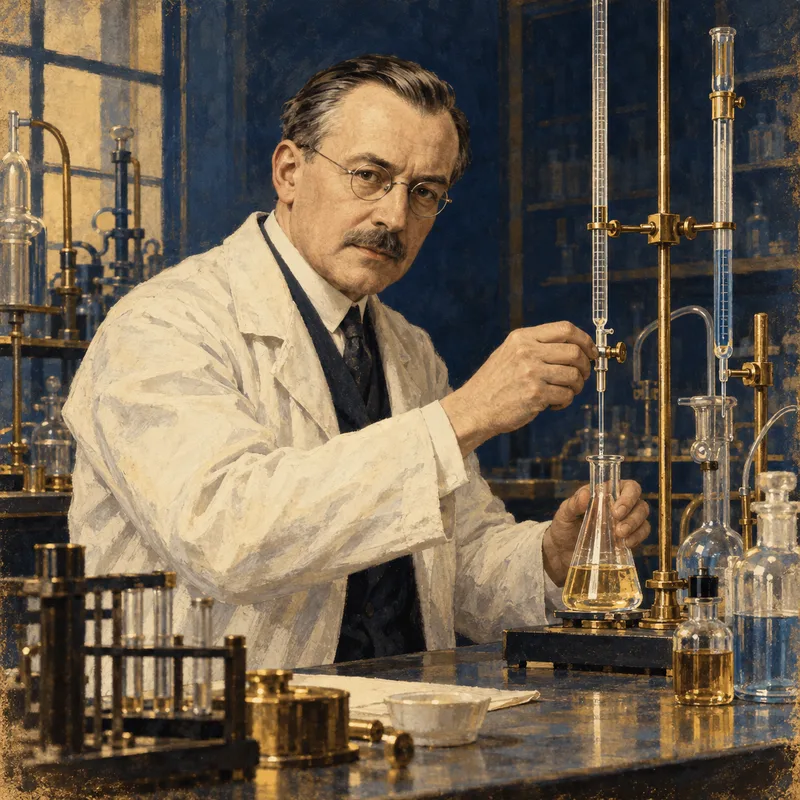
Karl Fischer
1901-1958 · Germany
Karl Fischer titration for water