Biography · Chemist no. 74 of 350
Karl Ziegler: The Chemist Who Taught Polymers to Grow in Order
Karl Waldemar Ziegler (1898-1973) was a German organic and organometallic chemist who discovered a catalyst system that made polyethylene at low pressure. His work with organoaluminium compounds created a new field of industrial chemistry and plastics. He shared the 1963 Nobel Prize in Chemistry with the Italian chemist Giulio Natta. His legacy in one line: he showed that organometallic catalysts can build plastics with precision, and so changed the materials of daily life.
Early Life and Family
Karl Ziegler was born on 26 November 1898 in Helsa, near Kassel, in the state of Hesse, Germany. His father was a Lutheran minister, and the family lived in a small town atmosphere where education and religion were valued. As a boy, Karl became interested in chemistry. He attended school in Marburg, where the family moved after his father took a new post, and went on to study at the university there.
Education and Mentors
Ziegler studied chemistry at the University of Marburg, and obtained his doctorate in 1920 under Karl von Auwers, a respected organic chemist. His thesis was in organic chemistry. He then continued as an assistant, and in Heidelberg he earned his habilitation in 1923 and began teaching. Early in his independent career, he developed an interest in free radicals and in organometallic compounds, particularly organolithium compounds, which became the foundation for his later discoveries.
Career Timeline
| Year | Event |
|---|---|
| 1898 | Born in Helsa, near Kassel, Germany |
| 1920 | PhD at the University of Marburg |
| 1923 | Habilitation; becomes lecturer at Heidelberg |
| 1942 | Develops N-bromosuccinimide allylic bromination (Wohl-Ziegler reaction) |
| 1936 | Becomes professor and director at the University of Halle |
| 1943 | Becomes director of the Kaiser Wilhelm Institute for Coal Research in Mülheim an der Ruhr |
| 1953 | Nickel effect leads to the discovery of the low-pressure polymerisation catalysts |
| 1963 | Nobel Prize in Chemistry (with Natta) |
| 1969 | Retires as director at Mülheim |
| 1973 | Dies in Mülheim an der Ruhr |
Major Scientific Contributions
Ziegler's early work included the use of N-bromosuccinimide (NBS) for allylic bromination, known as the Wohl-Ziegler reaction, and a high-dilution method for making large-ring compounds. He developed practical routes to organolithium reagents. His most important contribution came in the 1950s: the Aufbau reaction of organoaluminium compounds with ethylene, which gives long-chain compounds, and the discovery of the Ziegler catalyst, a combination of a transition metal halide (such as TiCl4) with an aluminium alkyl, which polymerises ethylene at low pressure to linear polyethylene. The chemistry, including the Cossee-Arlman mechanism, is explained in our discovery post.
Awards, Honours and Nobel Prize
- Nobel Prize in Chemistry, 1963, shared with Giulio Natta "for their discoveries in the field of the chemistry and technology of high polymers".
- Honorary doctorates and memberships in many scientific academies.
- The Karl Ziegler Prize of the Gesellschaft Deutscher Chemiker is named in his honour.
Personality, Struggles and Lesser-Known Facts
- Accident and insight: The "nickel effect" arose from an unexpected result due to nickel contamination in a reactor. Ziegler's skill was to recognise its meaning and to follow it systematically.
- Chemical industry partnership: His institute worked with industry, and patents on the polymerisation catalysts brought income that supported research at the Mülheim institute.
- Patent disputes: Because Natta applied Ziegler's catalyst to propylene, there were long legal and priority disputes between the groups and their industrial partners, which affected their relationship.
- Institute head: He directed the coal research institute for more than 25 years and shaped it into a leading centre of organometallic chemistry.
- Strong leader: He ran his institute with a firm hand but enabled his co-workers, such as Heinz Martin, Erhard Holzkamp and Heinz Breil, to contribute.
Legacy and Influence on Modern Chemistry
Ziegler-Natta catalysis is among the most important industrial processes ever discovered. Polyethylene and polypropylene are now produced in tens of millions of tonnes per year, and they are the most common plastics in the world. The ideas of Ziegler also helped to create the field of organometallic catalysis, which later included metallocene catalysts and olefin metathesis. In India, students meet his work in polymer chemistry, organometallic chemistry and industrial chemistry, and the large HDPE and PP plants in the country use descendants of his catalyst.
Ziegler's career also shows how basic and applied chemistry can support each other. His years of work on organometallic compounds, such as organolithium and organoaluminium reagents, looked like pure laboratory chemistry. Yet this background gave him the knowledge to understand the surprising results of 1953 and to turn them into an industrial process within a very short time. Today, students who learn the preparation and reactivity of Grignard, organolithium and organoaluminium reagents are using the same family of ideas that led to the Ziegler catalyst.
Lessons for Students
- Pay attention to unexpected results; they may hide a major discovery.
- Combine curiosity-driven research with practical applications.
- Collaboration with industry can help science, but credit should be shared fairly.
- Systematic testing of many variables can turn a lucky accident into a general method.
Quick Facts Box
- Born: 26 November 1898, Helsa, Germany
- Died: 12 August 1973, Mülheim an der Ruhr, Germany
- Nationality: German
- Field: Organometallic and polymer chemistry
- Famous for: Ziegler catalyst; low-pressure polyethylene
- Nobel: Chemistry, 1963 (with Giulio Natta)
FAQ
What is the Wohl-Ziegler reaction?
It is the allylic bromination of alkenes using N-bromosuccinimide and a radical initiator.
Where did Ziegler do his main work?
At the Max Planck (formerly Kaiser Wilhelm) Institute for Coal Research in Mülheim an der Ruhr.
Did Ziegler and Natta work together?
They worked separately but shared the Nobel Prize. Natta used Ziegler's catalyst for propylene.
Why is his work important for India?
It underlies the production of HDPE and polypropylene, which are used widely in packaging, pipes and household goods.
Published by ABC Chemistry — IIT-JAM | CSIR-NET | GATE Chemistry Coaching. Visit abcchemistry.com
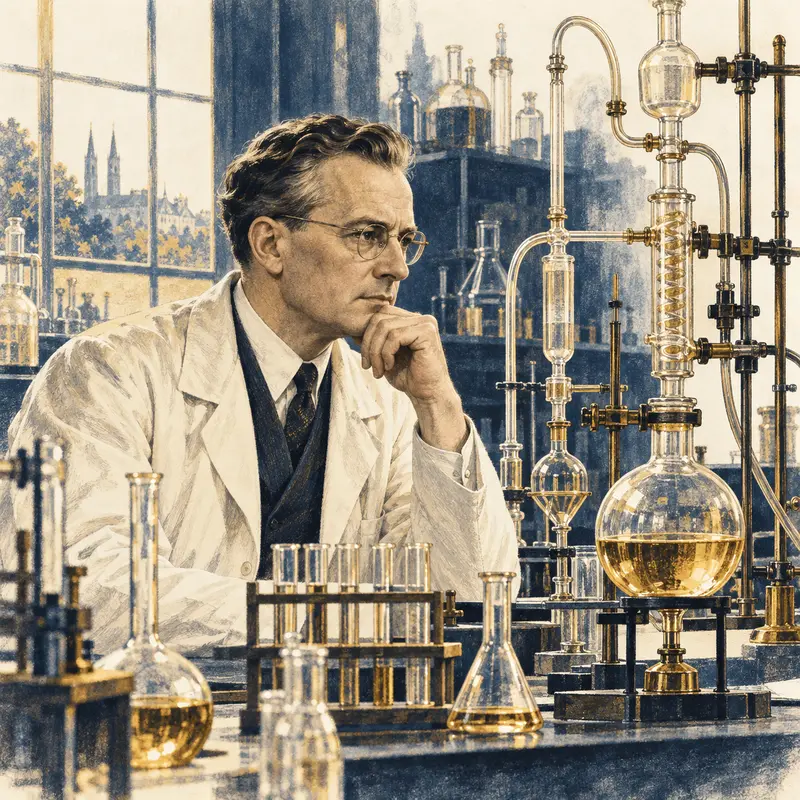
About the chemist
Karl Ziegler
1898-1973 · Germany · Nobel Chemistry 1963
Ziegler-Natta polymerization catalysts