The discovery, explained · Chemist no. 74 of 350
Karl Ziegler and the Ziegler Catalyst: Making Polyethylene at Low Pressure
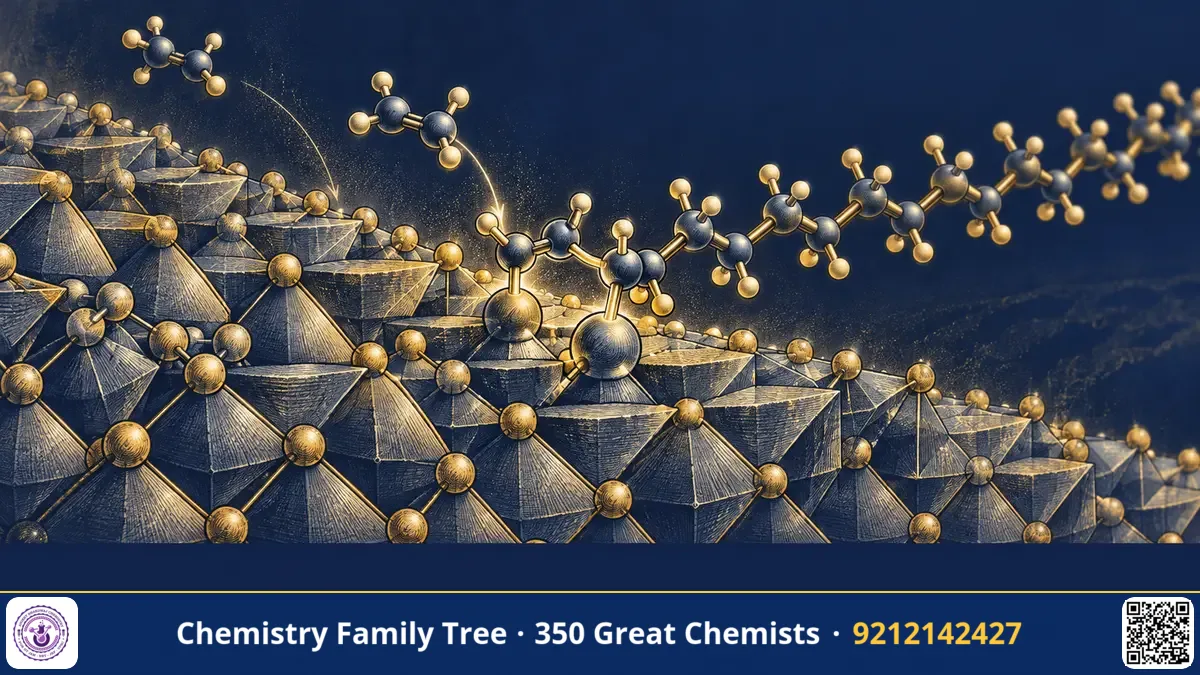
The plastic bucket, the milk pouch, the water pipe and the carry bag in your home are most likely made of polyethylene. For the first twenty years of its life, polyethylene could only be made at very high pressure, around 1,000 to 3,000 atmospheres, and at about 200 °C. In 1953 and 1954, the German chemist Karl Ziegler and his co-workers at the Max Planck Institute for Coal Research in Mülheim found a catalyst that works at normal pressure and moderate temperature. A mixture of titanium chloride and an aluminium alkyl converted ethylene into strong, high-density polyethylene. This discovery started the era of stereoregular polymers and earned Ziegler the Nobel Prize in Chemistry in 1963, shared with Giulio Natta.
The Scientific Problem Before the Discovery
Polyethylene was discovered by accident in 1933 at ICI in England, and by the late 1930s it was being made by free-radical polymerisation of ethylene at high pressure. The product is low-density polyethylene (LDPE), which is soft and flexible because the radical mechanism produces many short and long branches that stop the chains from packing closely. Industry wanted a harder, more heat-resistant polymer, but the high-pressure process was costly and dangerous, and the structure could not be controlled.
Chemists also did not know how to polymerise simple alkenes such as propylene in a controlled way. Free radicals gave only low molecular weight oils from propylene. A catalyst that could control chain growth was needed.
The Discovery: Step-by-Step
- Studying organoaluminium compounds. Ziegler's group studied the reaction of aluminium alkyls such as triethylaluminium, Al(C2H5)3, with ethylene. They found the "Aufbau" (growth) reaction: ethylene inserts into the Al–C bond repeatedly, lengthening the alkyl chain.
Al–CH2CH3 + n CH2=CH2 → Al–(CH2CH2)n–CH2CH3
- The limit of the growth reaction. At higher temperatures, the chain is displaced as an alpha-olefin by β-hydride elimination, so only short chains (up to about C20) were obtained.
- The "nickel effect" (1953). In one experiment (carried out by Ziegler's co-workers) the product was only 1-butene instead of long chains. The reason was traces of nickel left in the autoclave from cleaning, which catalysed the displacement reaction. This accident made Ziegler wonder whether other transition metals could change the reaction in the opposite way.
- Screening transition metal compounds. Ziegler's group tested compounds of many metals as additives. Zirconium acetylacetonate gave a surprising result: very high molecular weight polyethylene formed. Soon titanium compounds were found to be even better.
- The Ziegler catalyst. A mixture of titanium tetrachloride (TiCl4) and triethylaluminium polymerised ethylene at about 1 atmosphere and below 100 °C in a hydrocarbon solvent, producing a linear, high-density polyethylene (HDPE).
The Chemistry Behind It
The catalyst is formed when the alkylaluminium reduces and alkylates the titanium:
TiCl4 + Al(C2H5)3 → TiCl3 (solid) + other products
The solid TiCl3 has surface titanium atoms with a vacant coordination site and a Ti–alkyl bond. The accepted mechanism (the Cossee-Arlman mechanism) is:
- Ethylene coordinates to the vacant site on titanium by donating its π electrons.
- The alkyl group (growing chain) migrates to the coordinated ethylene (migratory insertion), and the chain grows by two carbons.
- The vacant site is regenerated at a new position, and the cycle repeats thousands of times.
Ti–R + CH2=CH2 → Ti–CH2CH2–R (chain grows by 2 carbons)
This is called coordination polymerisation, because the monomer coordinates to the metal before insertion. It produces polymer chains without branches, so HDPE chains pack closely and are highly crystalline.
| Property | LDPE (radical, high pressure) | HDPE (Ziegler, low pressure) |
|---|---|---|
| Pressure | 1000-3000 atm | about 1-50 atm |
| Branching | Many | Very few |
| Density | about 0.92 g/cm³ | about 0.95-0.97 g/cm³ |
| Crystallinity | Low | High |
Applications Today
- Plastics: HDPE is used for pipes, milk crates, bottles, drums and containers. LLDPE (made by copolymerising ethylene with 1-butene or 1-hexene) is used for packaging films.
- Industrial chemicals: The Aufbau reaction is used to make long-chain linear alcohols for detergents.
- Polypropylene: Related catalysts, developed further by Natta, produce polypropylene for ropes, car parts and food containers.
- Rubber: Ziegler-type catalysts produce polybutadiene and other synthetic rubbers used for tyres.
- India: Large Indian petrochemical complexes manufacture HDPE and polypropylene using Ziegler-Natta and related catalyst systems.
Exam Corner
- Ziegler-Natta catalyst: TiCl4 (or TiCl3) with Al(C2H5)3 as co-catalyst.
- Mechanism: coordination of alkene, then migratory insertion (Cossee-Arlman).
- Product: linear, high-density polyethylene at low pressure.
- Free-radical polymerisation gives LDPE at high pressure and temperature.
- Ziegler and Natta shared the Nobel Prize in Chemistry in 1963.
Common Misconceptions
- "Ziegler invented polyethylene." LDPE was discovered at ICI in 1933; Ziegler found the low-pressure route to HDPE.
- "The titanium compound is just a catalyst and aluminium does nothing." Aluminium alkyl activates the titanium by alkylation and reduction, and also scavenges impurities.
- "Ziegler also made isotactic polypropylene." That was Natta's achievement, using Ziegler's catalyst.
Quick Revision Box
- Aufbau reaction: Al–R inserts ethylene repeatedly.
- Nickel effect (1953) led to the search for other metals.
- Catalyst: TiCl4 + AlEt3, working at about 1 atm.
- Mechanism: coordination then insertion at a vacant site.
- Product: HDPE, linear and highly crystalline.
- Nobel Prize in Chemistry 1963 (with Natta).
FAQ
Why is Ziegler catalyst heterogeneous?
The active TiCl3 is a solid, and polymerisation occurs at titanium sites on its surface.
What is the role of AlEt3?
It reduces and alkylates titanium to create the active Ti–C bond, and it removes poisons such as water and oxygen.
What is the difference between HDPE and LDPE?
HDPE has linear chains and high density and crystallinity. LDPE has branched chains, lower density and is softer.
What is the nickel effect?
It is the observation that traces of nickel change the Aufbau reaction so that ethylene is displaced as 1-butene, which led Ziegler to systematically test other metals.
Published by ABC Chemistry — IIT-JAM | CSIR-NET | GATE Chemistry Coaching. Visit abcchemistry.com
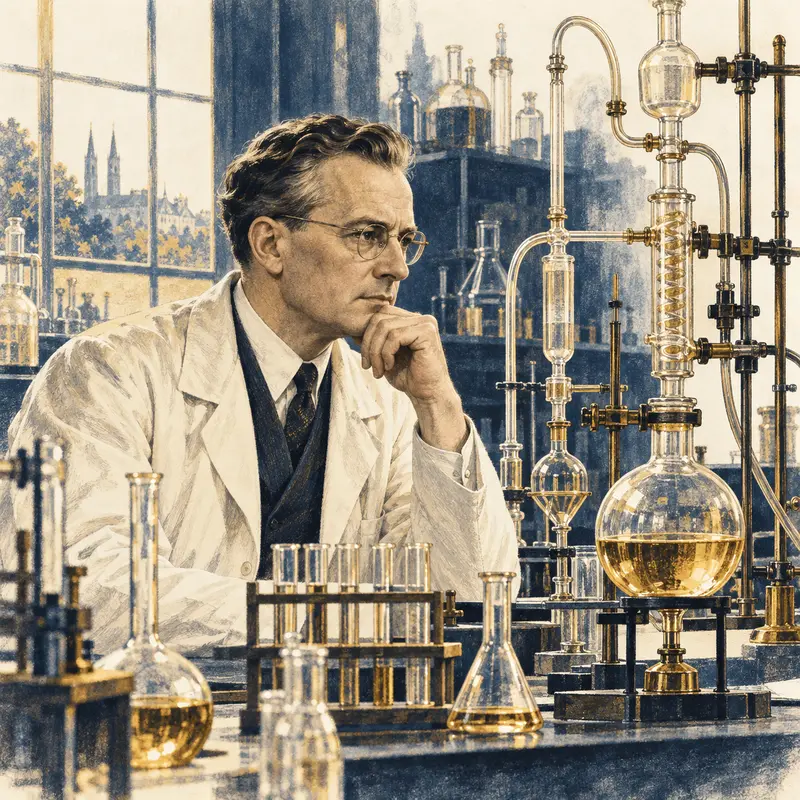
About the chemist
Karl Ziegler
1898-1973 · Germany · Nobel Chemistry 1963
Ziegler-Natta polymerization catalysts