The discovery, explained · Chemist no. 163 of 350
Kary Mullis and PCR: Copying DNA a Billion Times in a Test Tube
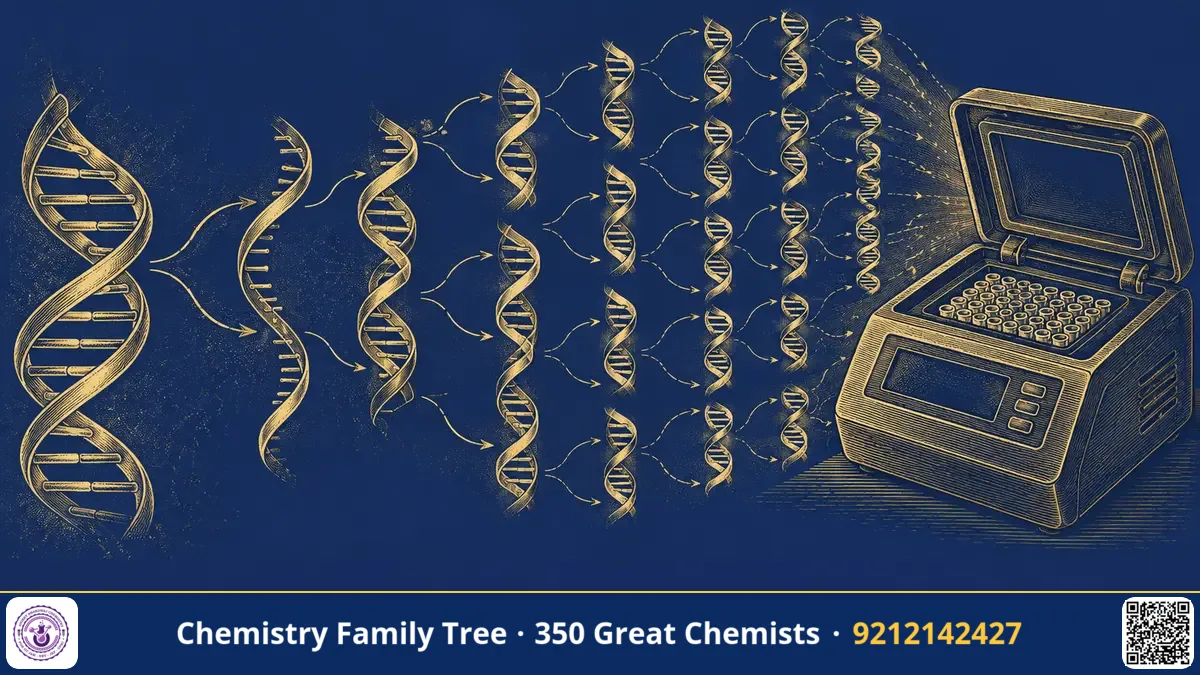
Imagine finding a single drop of blood at a crime scene, a fragment of ancient bone, or a few virus particles in a patient's swab. To read the DNA, you first need millions of copies. Before the 1980s, making such copies meant cloning in bacteria, a slow process taking days. In 1983 a young biochemist, Kary Mullis, conceived a method that does it in a few hours using only a test tube, a pair of short DNA primers, a DNA polymerase and repeated cycles of heating and cooling. It is called the polymerase chain reaction (PCR). Mullis received the 1993 Nobel Prize in Chemistry, sharing it with Michael Smith. PCR is now used in medicine, forensics, agriculture and research, and it became widely known to the public during the COVID-19 pandemic.
The Scientific Problem Before the Discovery
By the late 1970s, scientists could read DNA sequences and cut DNA with restriction enzymes, but they could only obtain enough of a specific DNA segment by cloning: inserting it into a plasmid, putting it in E. coli, growing the bacteria and purifying the DNA. This process needed many days and a lot of skill. Detecting a single gene in a complex genome, or studying a rare mutation in a few cells, was very difficult.
Chemists and biologists needed a way to amplify a chosen DNA sequence selectively and quickly, starting from a very small amount of material, and without living cells.
The Discovery: A Chain Reaction of Copying
Mullis was working at the Cetus Corporation in California, where he was synthesising oligonucleotides. The idea, he later recalled, came to him in April 1983 while driving on a California highway. He realised that if two primers are designed to flank a target sequence, one on each strand, and DNA polymerase is allowed to extend them, then repeating the process would double the target amount in each cycle.
One PCR cycle has three steps:
- Denaturation (about 94–95 °C). Heating separates the two strands of the double-stranded DNA by breaking hydrogen bonds between base pairs.
- Annealing (about 50–65 °C). The temperature is lowered so that the short single-stranded primers bind to their complementary sequences on each template strand.
- Extension (about 72 °C). DNA polymerase adds nucleotides (dATP, dTTP, dGTP, dCTP) to the 3′ end of each primer, copying the template in the 5′→3′ direction.
After n cycles, the number of copies of the target is approximately:
Copies = N₀ × 2ⁿ
So after 30 cycles, one starting molecule gives about 2³⁰ ≈ 10⁹ copies. In practice, efficiency is slightly less than 100%, but the amplification is still enormous.
At first, Mullis and colleagues used the Klenow fragment of E. coli DNA polymerase I, which was destroyed by heat in each denaturation step, so fresh enzyme had to be added in every cycle. The practical breakthrough came with Taq polymerase, a heat-stable enzyme from the bacterium Thermus aquaticus, which lives in hot springs. It survives 95 °C and works best near 72 °C. Using Taq, the whole reaction can be put in a tube and automated in a machine called a thermal cycler. The first publications on PCR appeared in 1985 (Saiki and colleagues) and 1986 (Mullis and colleagues), and in 1988 Taq polymerase was introduced for the method.
The Chemistry Behind It
PCR uses basic nucleic acid chemistry that appears in your biochemistry syllabus.
| Component | Role |
|---|---|
| Template DNA | Contains the target sequence to be copied |
| Primers | Short oligonucleotides (about 18–25 bases) that mark the start of copying |
| Taq polymerase | Heat-stable enzyme that extends the primer |
| dNTPs | Building blocks for new DNA |
| Mg²⁺ and buffer | Cofactor for polymerase, controls pH and ionic strength |
The polymerase forms a phosphodiester bond between the 3′-OH of the growing chain and the α-phosphate of the incoming nucleotide, releasing pyrophosphate:
DNA(n) + dNTP → DNA(n+1) + PPi
The annealing temperature depends on the melting temperature (Tm) of the primers, which rises with GC content, because G–C pairs have three hydrogen bonds and A–T pairs have two. A rough rule for short primers is Tm ≈ 4(G+C) + 2(A+T) °C.
Applications Today
- Medical diagnosis: Detection of viruses and bacteria, including HIV, tuberculosis and SARS-CoV-2 (by RT-PCR, in which RNA is first converted to DNA by reverse transcriptase).
- Forensics and identity: DNA profiling from tiny samples; used in criminal investigation and paternity testing, including in Indian forensic laboratories.
- Genetic testing: Detection of inherited disease mutations, such as sickle-cell mutation and thalassaemia, which are important in India.
- Research: Gene cloning, sequencing, site-directed mutagenesis and gene expression analysis by quantitative PCR (qPCR).
- Agriculture and food: Detection of genetically modified organisms and food adulteration.
- Evolution studies: Analysis of DNA from ancient remains.
Exam Corner
- Kary Mullis shared the 1993 Nobel Prize in Chemistry with Michael Smith.
- PCR steps: denaturation (~94 °C), annealing (primer-dependent), extension (~72 °C).
- Number of copies after n cycles = 2ⁿ (for 100% efficiency).
- Taq polymerase comes from Thermus aquaticus and is thermostable.
- RT-PCR uses reverse transcriptase to make cDNA from RNA; qPCR measures amplification in real time.
Common Misconceptions
- "PCR makes RNA copies directly." It copies DNA; RNA must first be converted to cDNA.
- "More cycles always give more specific results." Too many cycles can produce non-specific products and plateau as reagents are consumed.
- "A positive PCR means the person is sick." It shows the presence of genetic material; clinical interpretation also needs symptoms and context.
Quick Revision Box
- PCR conceived by Kary Mullis in 1983 at Cetus.
- Three steps: denature (~94 °C), anneal, extend (~72 °C).
- Exponential growth: 2ⁿ copies after n cycles.
- Taq polymerase from Thermus aquaticus allowed automation.
- Needs template, two primers, dNTPs, Mg²⁺, polymerase.
- Nobel Prize in Chemistry 1993 (shared with Michael Smith).
FAQ
Why is Taq polymerase used?
Because it does not denature at 95 °C, so it does not need to be added again at each cycle.
How many copies are produced after 20 cycles?
Ideally 2²⁰, which is about one million copies per starting molecule.
Why are two primers needed?
One primer binds to each strand, defining both ends of the region to be amplified.
Is the Nobel Prize in Chemistry or Medicine?
Chemistry, in 1993.
Published by ABC Chemistry — IIT-JAM | CSIR-NET | GATE Chemistry Coaching. Visit abcchemistry.com
About the chemist
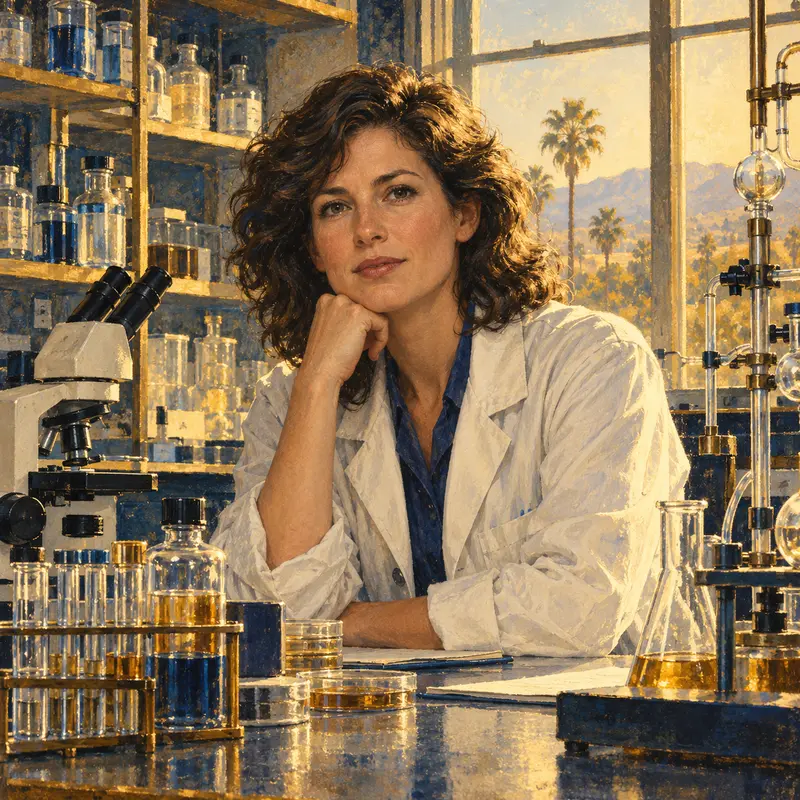
Kary Mullis
1944-2019 · United States · Nobel Chemistry 1993
Polymerase chain reaction