The discovery, explained · Chemist no. 343 of 350
Katharine Burr Blodgett: Monolayer Films and Invisible Glass
Spectacles, camera lenses, telescope mirrors and the glass of picture frames all lose some light by reflection. An uncoated glass surface reflects about 4 percent of the light that strikes it. In a camera lens with many glass elements, those losses add up and produce ghost images and flare. In 1938 Katharine Burr Blodgett, a scientist at General Electric, solved the problem by building up extremely thin films, molecules thick, on glass. Her coatings made glass nearly "invisible" by cutting reflection to almost nothing. Her method of depositing layer after layer of molecules, now known as the Langmuir-Blodgett technique, also became a foundation of nanotechnology and surface chemistry. This article explains the idea in simple language.
The Scientific Problem Before the Discovery
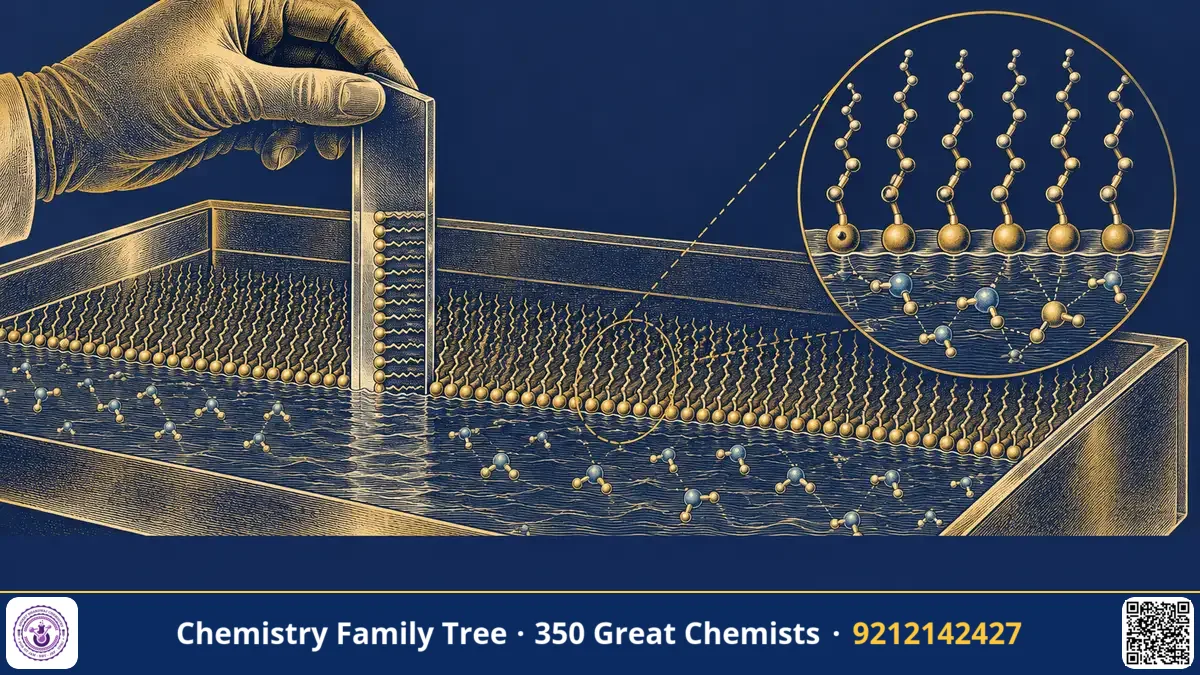
Irving Langmuir, her mentor at General Electric, had studied how certain molecules spread on the surface of water in a layer exactly one molecule thick, called a monolayer. Fatty acids such as stearic acid, CH₃(CH₂)₁₆COOH, are amphiphilic: they have a polar, water-loving (hydrophilic) head, –COOH, and a long non-polar, water-hating (hydrophobic) hydrocarbon tail. On water, the heads dip into the water and the tails stand up in the air, like a carpet of upright pencils.
Langmuir could create and study these monolayers on a water surface. The unsolved problem was how to transfer them reliably onto a solid surface, and to build up many layers in a controlled way. Without that, such films were a laboratory curiosity. At the same time, optical engineers wanted a way of reducing reflection from glass surfaces, which was an important practical problem for cameras and, later, military optics.
The Discovery: Step by Step
- Spreading the film. A drop of a fatty acid, such as stearic acid dissolved in a volatile solvent, is placed on the surface of water in a shallow trough. The solvent evaporates, leaving the molecules spread on the water.
- Compressing the film. Movable barriers push the molecules together until they form a tightly packed, ordered monolayer. A pressure measured on the surface, the surface pressure, helps the experimenter control packing.
- Dipping the slide. A clean glass plate is lowered through the film into the water and lifted again. On each pass through the surface, one monolayer is transferred onto the plate, with the molecules oriented in a defined way.
- Building the multilayer. By repeating the dipping, Blodgett built stacks of dozens of layers. Each added layer is about the length of the molecule, only a few nanometres thick.
- Controlling thickness. Because the thickness increases in exact steps, she could make films with a precise thickness. She noticed that films of different thickness showed different colours by reflected light, and she used this to make a "step gauge" for measuring film thickness to a very high accuracy.
- Making non-reflective glass. By adding specific numbers of layers to give a thickness of about one-quarter of the wavelength of light, she produced a coating that sharply reduced reflection. In 1938 she announced the invention of non-reflecting ("invisible") glass.
The Chemistry Behind It
Amphiphilic molecules and orientation
The molecule orients itself because of the difference in affinity: the polar head forms hydrogen bonds with water, and the tail avoids water. In the film, tails are held together by weak van der Waals (London) forces, which is why the monolayer is stable and ordered. When transferred to a glass slide that is hydrophilic, the first layer attaches with heads to the glass; on the next dip, a tail-to-tail arrangement appears (Y-type deposition), forming a stable multilayer.
Why do quarter-wave coatings cut reflection?
Light reflects from both the top surface of the film and from the film-glass boundary. If the film thickness t is such that the extra path travelled by the second ray leads to a phase difference of half a wavelength, the two reflected waves interfere destructively and cancel.
Condition for minimum reflection:  2 n t = λ / 2   →   t = λ / (4n)
Ideal film index:  n(film) ≈ √ n(glass)
For visible light of wavelength around 550 nm and film refractive index about 1.4 to 1.5, the thickness comes to about 100 nm, which corresponds to dozens of molecular layers. Blodgett's films of barium stearate built up from many layers met this condition, and later industry replaced them with tougher inorganic coatings such as magnesium fluoride.
Surface pressure
The surface pressure of a monolayer is π = γ₀ − γ, where γ₀ is the surface tension of pure water and γ is that with the film. This is measured in a Langmuir trough and gives the "pressure-area isotherm", which shows phases of the film, much like a 2-D gas, liquid and solid.
Applications Today
- Optics: anti-reflection coatings on spectacles, camera lenses, binoculars, telescopes, solar cells and display screens.
- Nanotechnology: Langmuir-Blodgett films are used to build ordered nanoscale layers for sensors, molecular electronics and biological membrane models.
- Biochemistry: lipid monolayers imitate cell membranes for studying how proteins and drugs interact with them.
- Everyday life: the principle appears in soap films, detergents, lung surfactant and oil-spill chemistry.
- India: thin-film and surface chemistry research in IITs and national laboratories uses Langmuir-Blodgett troughs for sensors and nanomaterials.
Exam Corner
- Langmuir-Blodgett film: a monolayer formed at an air-water interface and transferred to a solid substrate by dipping.
- Amphiphilic molecules (e.g., fatty acids, soaps) have a hydrophilic head and a hydrophobic tail; they form oriented monolayers on water.
- Anti-reflection coating condition: thickness t = λ/(4n); the two reflected rays interfere destructively.
- Surface pressure π = γ₀ − γ; its unit is N m⁻¹ (mN/m).
- Monolayer thickness equals the molecular length, a few nanometres for stearic acid (C18).
Common Misconceptions
- "Invisible glass destroys light." The light is not destroyed; the coating reduces reflected light, so more light passes through.
- "A monolayer is a chemical bond to water." It is a physical arrangement driven by polarity, not a covalent reaction.
- "Langmuir alone made the films." Langmuir discovered monolayers on water; Blodgett developed the transfer and multilayer building and the optical uses.
Quick Revision Box
- Blodgett built multilayer films, one molecule at a time, on glass.
- Stearic acid: polar COOH head and long non-polar tail.
- Non-reflecting condition: t = λ/4n; destructive interference.
- Bare glass reflects about 4 percent of incident light.
- Film colours act as a thickness gauge.
- Her non-reflecting glass was announced in 1938.
FAQ
What is a Langmuir-Blodgett film?
It is a film of one or more molecular layers deposited from a water surface onto a solid by dipping the solid through the monolayer.
Why does a quarter-wavelength coating reduce reflection?
Waves reflected from the top and bottom of the film are out of phase by half a wavelength, so they cancel each other.
Is stearic acid hydrophilic or hydrophobic?
Both: the COOH head is hydrophilic and the long hydrocarbon tail is hydrophobic, which is why it is called amphiphilic.
Where do we use anti-reflection coatings today?
They are found on spectacles, camera lenses, phone screens and solar panels to increase transmitted light and reduce glare.
Published by ABC Chemistry — IIT-JAM | CSIR-NET | GATE Chemistry Coaching. Visit abcchemistry.com
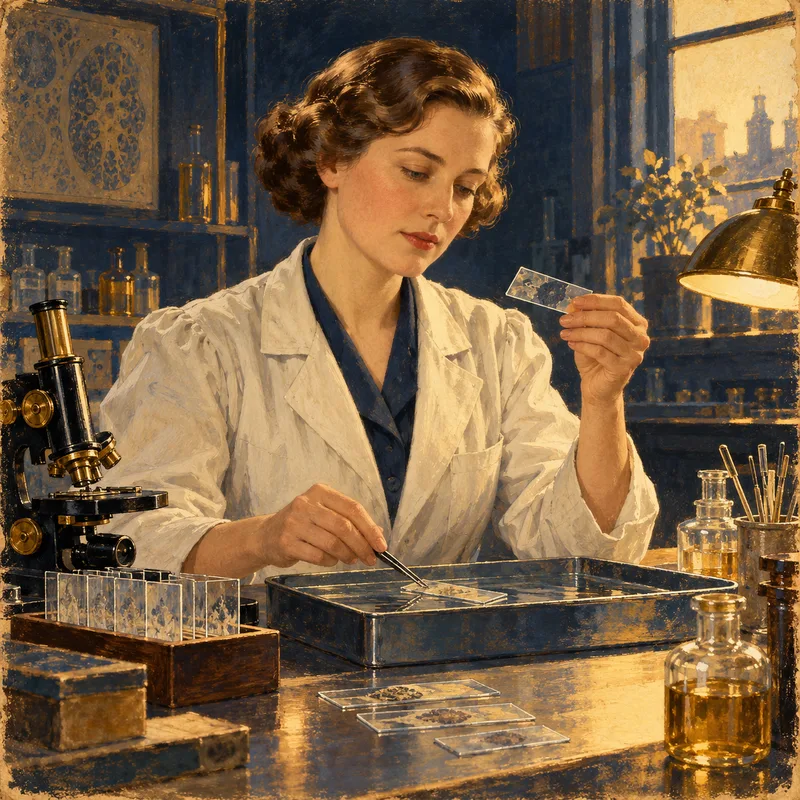
About the chemist
Katharine Burr Blodgett
1898-1979 · United States
Langmuir-Blodgett films; non-reflective glass