Biography · Chemist no. 343 of 350
Katharine Burr Blodgett: Pioneer of Thin Films and Invisible Glass
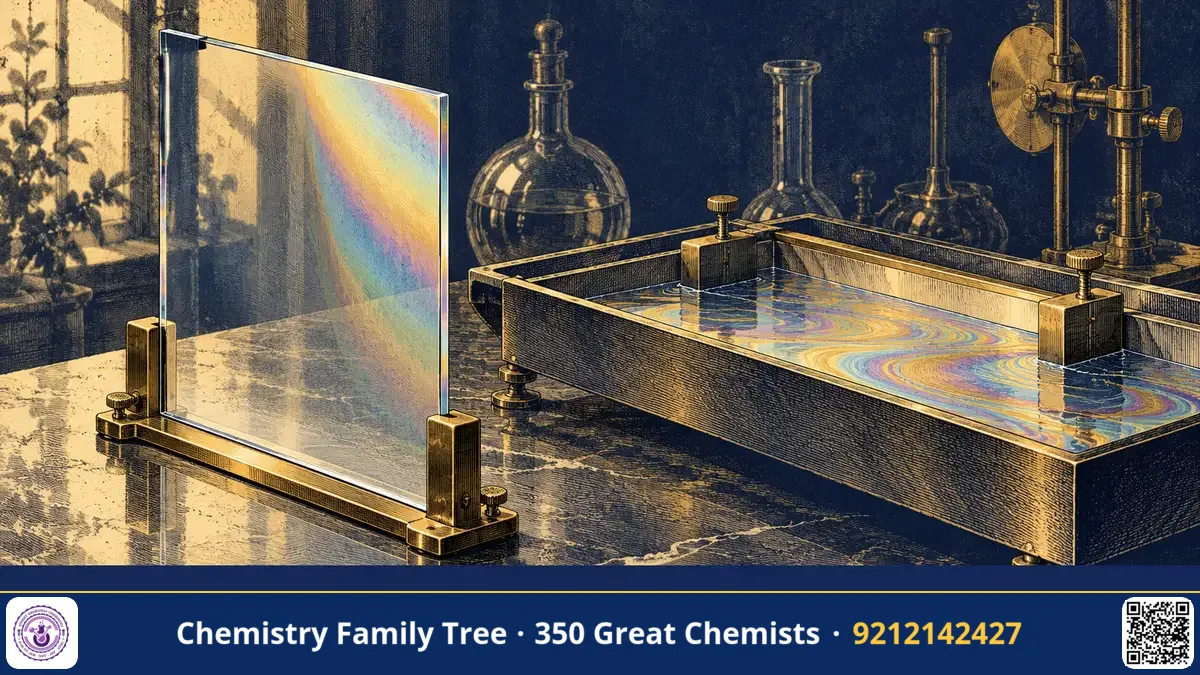
Katharine Burr Blodgett (1898-1979) was an American physicist and chemist, and the first woman to be hired as a scientist at the General Electric Research Laboratory. She was also the first woman to earn a PhD in physics from the University of Cambridge. She developed techniques for depositing layers of molecules only one molecule thick, and in 1938 she used them to invent non-reflective glass. Her one-line legacy: she showed how to build materials one molecular layer at a time, an idea at the heart of modern nanotechnology.
Early Life and Family
Katharine Burr Blodgett was born on 10 January 1898 in Schenectady, New York. Her father, also named George Blodgett, worked as a patent attorney at General Electric, and was killed in a burglary at the family home shortly before she was born. Her mother, Katharine Buchanan Burr, was left to bring up the children. The family moved to France and later to New York, and Katharine spent part of her childhood in Europe, where she learned French. The family had enough money to give her a good education, and she showed strong ability in mathematics and science from an early age.
Education and Mentors
Blodgett studied at Bryn Mawr College, a women's college in Pennsylvania, where she graduated in physics in 1917 at the age of 19. She then went to the University of Chicago, where she took an MSc degree in 1918, working on the chemistry of gas masks, in particular on the absorption of gases by carbon. On a visit to the General Electric laboratory in Schenectady, she met the Nobel laureate Irving Langmuir, who was impressed by her. He advised her to continue her studies before joining the company. She went to Cambridge, where she worked at the Cavendish Laboratory with Sir Ernest Rutherford and completed her PhD in 1926, the first woman to earn a Cambridge doctorate in physics. Her thesis dealt with electrons moving through mercury vapour.
Career Timeline
| Year | Event |
|---|---|
| 1898 | Born in Schenectady, New York |
| 1917 | Graduates from Bryn Mawr College |
| 1918 | MSc, University of Chicago; joins General Electric Research Laboratory as its first woman scientist |
| 1924 to 1926 | Studies at the Cavendish Laboratory, Cambridge; PhD in 1926 |
| 1926 onward | Returns to GE and works with Irving Langmuir on monolayers |
| 1930s | Develops methods for multilayer deposition and the colour step gauge |
| 1938 | Announces non-reflecting glass |
| 1940s | Works on smoke screens and de-icing of aircraft wings in the Second World War |
| 1963 | Retires from General Electric |
| 1979 | Dies in Schenectady |
Major Scientific Contributions
- Langmuir-Blodgett films: reliable transfer of monolayers from a water surface to solid supports, building multilayers one at a time.
- Film step gauge: using colours produced by interference from films of known thickness to measure very thin films accurately.
- Non-reflective glass: coating glass with films of quarter-wavelength thickness so that reflected waves cancel,
t = λ / 4n. - War-time research: work on chemical smoke screens to hide troops and on de-icing wing surfaces of aircraft, important for safe flying.
- Surface chemistry: improved understanding of how amphiphilic molecules such as stearic acid,
CH₃(CH₂)₁₆COOH, orient on water and glass.
The companion discovery article describes the technique and the optics in more detail.
Awards, Honours and Nobel Prize
Blodgett did not receive a Nobel Prize. Her honours included:
- The Francis P. Garvan Medal of the American Chemical Society (1951), awarded to women chemists for distinguished service to chemistry.
- The Photographic Society of America's Progress Medal (1972).
- Induction into the National Inventors Hall of Fame (2007), after her death.
Personality, Struggles and Lesser-Known Facts
- Fatherless from birth. Her father's death happened before she was born, yet the company where he worked later became her own workplace.
- A prodigy. She finished college at 19 and her first job interview at GE took place when she was a teenager.
- A trailblazer. As the first woman scientist at GE Research, she faced the challenges of a workplace where women researchers were almost unknown.
- Practical impact. Her coated glass solved a very real problem for lens makers: glare and ghost images caused by reflection from many glass surfaces.
- Many interests. She enjoyed gardening, amateur theatre, travel and astronomy, and she had her own small telescope. She stayed unmarried and lived in Schenectady.
Legacy and Influence on Modern Chemistry
Every phone camera, set of spectacles and photovoltaic panel with an anti-reflective coating is a descendant of her work. Her monolayer-deposition technique became a standard tool in surface science, and the Langmuir-Blodgett trough is found in many research laboratories worldwide, including in India. In biophysics, monolayer models of cell membranes are used to study lipids, proteins and drugs. In nanotechnology and molecular electronics, ordered molecular films are being studied for sensors and transistors. Her career also helped to open the door of industrial research to women scientists, which is a broader legacy.
Lessons for Students
- Combine physics and chemistry. Her best work lies at the border between the two subjects.
- Find a mentor, then build on their idea. Langmuir discovered monolayers; Blodgett found how to use them.
- Precision matters. Controlling thickness down to a few nanometres led to her success.
- Break barriers. She pushed into spaces where women had not worked before.
- Use science for society. Her research served cinema, optics and defence safety alike.
Quick Facts Box
- Born: 10 January 1898, Schenectady, New York, USA
- Died: 12 October 1979, Schenectady, New York, USA
- Nationality: American
- Field: Surface chemistry, physics and thin films
- Famous for: Langmuir-Blodgett films and non-reflective glass (1938)
- Nobel Prize: None; Garvan Medal 1951
FAQ
Did Katharine Blodgett win a Nobel Prize?
No. Her mentor Irving Langmuir won the Nobel Prize in Chemistry in 1932, but Blodgett received other major honours such as the Garvan Medal.
Where did she study for her PhD?
At the University of Cambridge's Cavendish Laboratory under Ernest Rutherford, completing her doctorate in 1926.
What is the difference between Langmuir and Blodgett's contributions?
Langmuir studied monolayers on water. Blodgett developed the method of transferring them layer by layer onto solid surfaces and applied it to optics.
Why is her work relevant to competitive exams?
It brings together amphiphilic molecules, surface tension, monolayers and interference, topics found in physical chemistry and surface chemistry papers.
Published by ABC Chemistry — IIT-JAM | CSIR-NET | GATE Chemistry Coaching. Visit abcchemistry.com
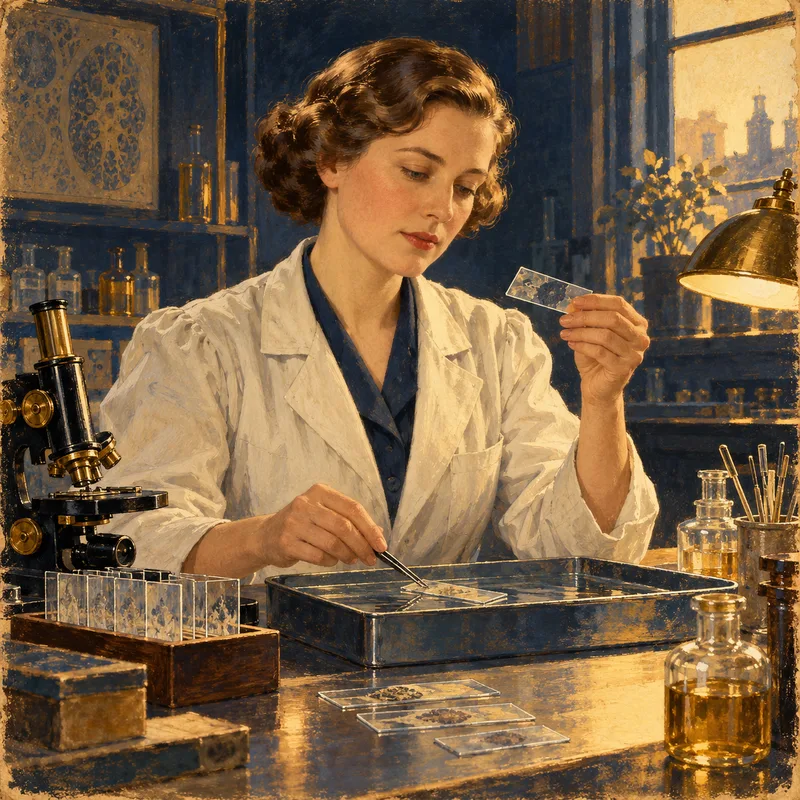
About the chemist
Katharine Burr Blodgett
1898-1979 · United States
Langmuir-Blodgett films; non-reflective glass