Biography · Chemist no. 57 of 350
Kenichi Fukui: The First Asian Nobel Laureate in Chemistry
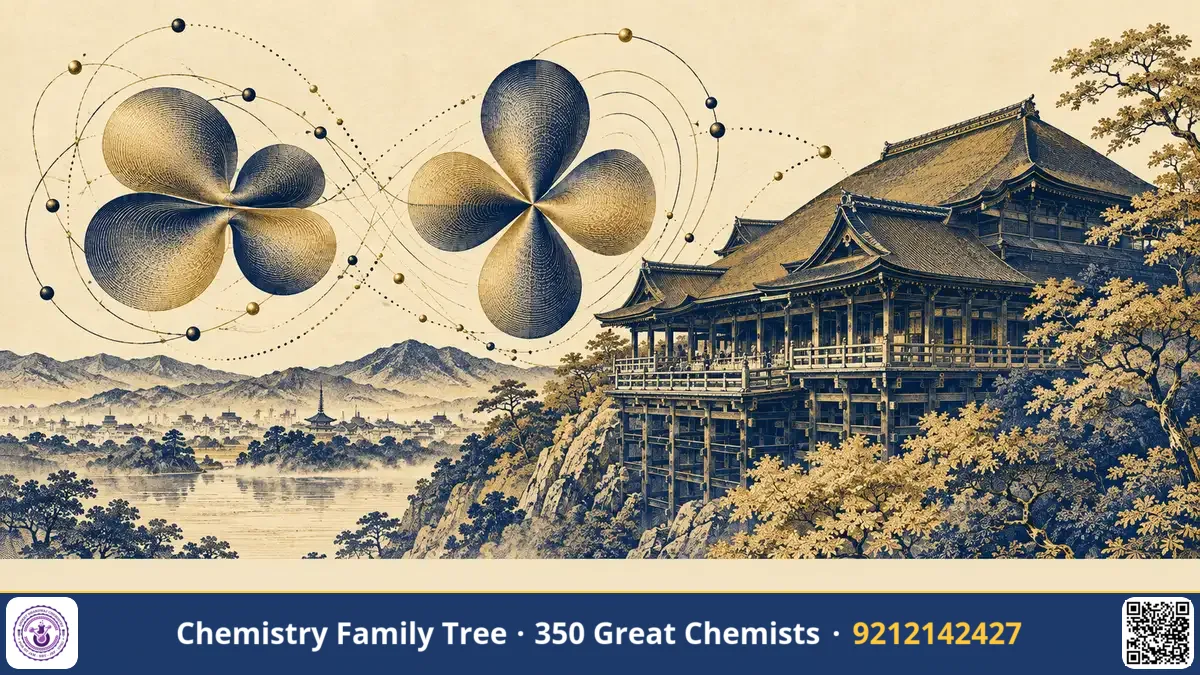
Kenichi Fukui (1918-1998) was a Japanese theoretical chemist who showed that the key to chemical reactivity lies in a small group of orbitals, the HOMO and the LUMO. His frontier orbital theory was first published in 1952 and was largely ignored for years. When it was finally recognised, it earned him the 1981 Nobel Prize in Chemistry, shared with Roald Hoffmann, making him the first Asian to win the Nobel Prize in Chemistry. His life is a lesson in patience, in following one's own ideas and in the value of simple theories. This biography covers his life, his science and what students can learn from him.
Early Life and Family
Kenichi Fukui was born on 4 October 1918 in Nara, Japan, the eldest of three sons. His father, Ryokichi Fukui, was a businessman engaged in foreign trade. Nara, an ancient capital of Japan with old temples and a deer park, was a quiet place to grow up. As a schoolboy Fukui was strong in literature and mathematics, and he was not particularly drawn to chemistry. His interests were wide, and he did not follow the path of a typical future chemist.
Education and Mentors
Fukui studied at the Third Higher School in Kyoto. His father asked Professor Genitsu Kita of Kyoto Imperial University, a leading chemist, for advice on his son's studies. Kita recommended that Kenichi study chemistry in spite of his interest in other subjects. Fukui later said that this advice changed his life. He joined the Department of Industrial Chemistry of Kyoto Imperial University, graduating in 1941. His training was in applied chemistry, not in theoretical physics, which makes his later contribution to quantum chemical theory even more remarkable.
Career Timeline
| Year | Event |
|---|---|
| 1918 | Born in Nara, Japan (4 October) |
| 1941 | Graduated from Kyoto Imperial University (industrial chemistry) |
| 1941-1943 | Worked at the Army Fuel Laboratory in the early war years |
| 1943 | Joined the faculty at Kyoto Imperial University |
| 1951 | Became professor of physical chemistry at Kyoto University |
| 1952 | Published frontier electron theory of reactivity |
| 1964-1965 | Extended frontier orbital ideas to cycloaddition and other pericyclic reactions |
| 1970 | Introduced the intrinsic reaction coordinate concept |
| 1981 | Nobel Prize in Chemistry, shared with Roald Hoffmann |
| 1982-1988 | President of the Kyoto Institute of Technology |
| 1988 | Became head of the Institute for Fundamental Chemistry, Kyoto |
| 1998 | Died in Kyoto (9 January) |
Major Scientific Contributions
1. Frontier electron theory
Fukui proposed that in a reaction the HOMO of one species and the LUMO of the other are the key orbitals. The reactive position of a molecule is that where the density of the frontier orbital is highest. This explained the reactivity patterns of aromatic hydrocarbons and later many other reactions.
Electrophilic attack  → largest HOMO coefficient
Nucleophilic attack   → largest LUMO coefficient
Rate increases as (E_HOMO - E_LUMO) decreases
2. Orbital theory of pericyclic reactions
Fukui showed that the Diels-Alder reaction and other cycloadditions and electrocyclic reactions can be understood by the overlap of the HOMO of one component and the LUMO of the other. In this way his theory gave the same conclusions as the Woodward-Hoffmann rules.
3. Intrinsic reaction coordinate
In 1970 he proposed the IRC, the minimum-energy path linking reactants to products through the transition state. IRC calculations are now routine in computational chemistry packages.
4. Later work
Fukui also worked on the theory of chemical reactions on surfaces and on the interactions of molecules with each other, including ideas about the "interaction frontier orbitals".
Awards, Honours and Nobel Prize
Fukui was awarded the Nobel Prize in Chemistry 1981, jointly with Roald Hoffmann, "for their theories, developed independently, concerning the course of chemical reactions". Fukui was the first Asian to receive the Nobel Prize in Chemistry. In Japan he received the Order of Culture, one of the country's highest honours. He was elected a foreign member of national academies, including the US National Academy of Sciences, and held many honorary doctorates. His paper of 1952 is now regarded as a classic of theoretical chemistry.
Personality, Struggles and Lesser-Known Facts
- Chemistry by advice, not by choice: He was not initially planning to become a chemist. A conversation between his father and Professor Kita led him to chemistry.
- A theory that was not welcomed: His 1952 paper received critical comments from reviewers, and for a decade or so many chemists did not take frontier orbitals seriously. Fukui said that the paper was not appreciated at first, and that the support from the orbital symmetry results in 1965 helped to bring recognition. His perseverance is an inspiration.
- Theory from an applied background: Trained as an industrial chemist and not as a theoretical physicist, he built his theory from the study of experimental reactivity data.
- Intuition over heavy computation: He believed that chemical insight is more important than complicated mathematics and that simple models should connect with experiment.
- War years: After graduating in 1941, he worked in a military fuel research laboratory, so his early research was linked to fuel chemistry. Later he moved to Kyoto University and turned to the theory of chemical reactions.
Legacy and Influence on Modern Chemistry
Every time a student draws a HOMO-LUMO diagram, they use Fukui's way of thinking. Frontier orbital theory is built into textbooks of organic, inorganic and physical chemistry. In computational chemistry, "Fukui functions" help to locate reactive sites in density functional theory. The Fukui Institute for Fundamental Chemistry in Kyoto continues research on the theory of chemical reactions. His example also shows that a scientist from Asia working outside the large Western centres could make a fundamental contribution to world chemistry.
Lessons for Students
- Be patient with good ideas: Recognition of FMO theory took more than a decade.
- Listen to good advice: A teacher's suggestion changed Fukui's career path.
- Keep theory connected to experiment: Fukui's theory started from real reactivity data.
- Look for simple models: HOMO and LUMO explain a lot of chemistry without heavy calculations, a useful way to answer mechanism questions.
Quick Facts Box
- Born: 4 October 1918, Nara, Japan
- Died: 9 January 1998, Kyoto, Japan
- Nationality: Japanese
- Field: Theoretical and physical chemistry
- Famous for: Frontier molecular orbital theory, intrinsic reaction coordinate
- Nobel Prize: Chemistry 1981 (shared with Roald Hoffmann)
FAQ
Was Fukui the first Asian to win the Nobel Prize in Chemistry?
Yes. In 1981 he became the first Asian to receive the Nobel Prize in Chemistry.
Where did Fukui work?
He spent most of his career at Kyoto University, and later served as president of the Kyoto Institute of Technology.
What is the main idea of Fukui's theory?
The course of a reaction is largely determined by the interaction between the HOMO of one reactant and the LUMO of the other.
How did Fukui and Hoffmann's work differ?
Fukui worked independently with frontier orbitals, and Hoffmann (with Woodward) used orbital symmetry conservation. Both explain the stereochemistry of pericyclic reactions.
Published by ABC Chemistry — IIT-JAM | CSIR-NET | GATE Chemistry Coaching. Visit abcchemistry.com
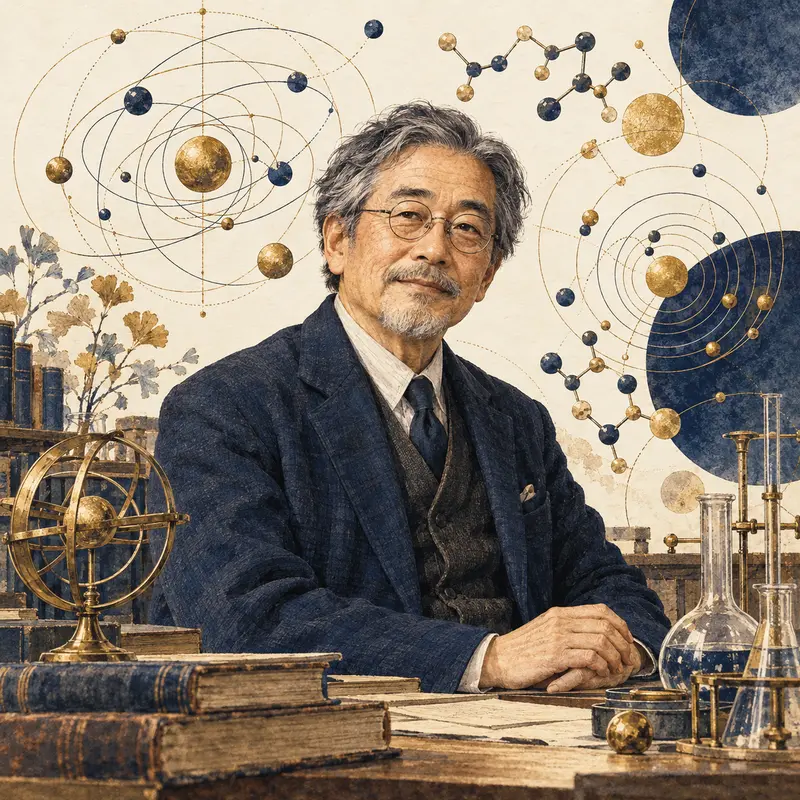
About the chemist
Kenichi Fukui
1918-1998 · Japan · Nobel Chemistry 1981
Frontier molecular orbital theory