The discovery, explained · Chemist no. 57 of 350
Frontier Molecular Orbital Theory: How Kenichi Fukui Explained Reactivity with HOMO and LUMO
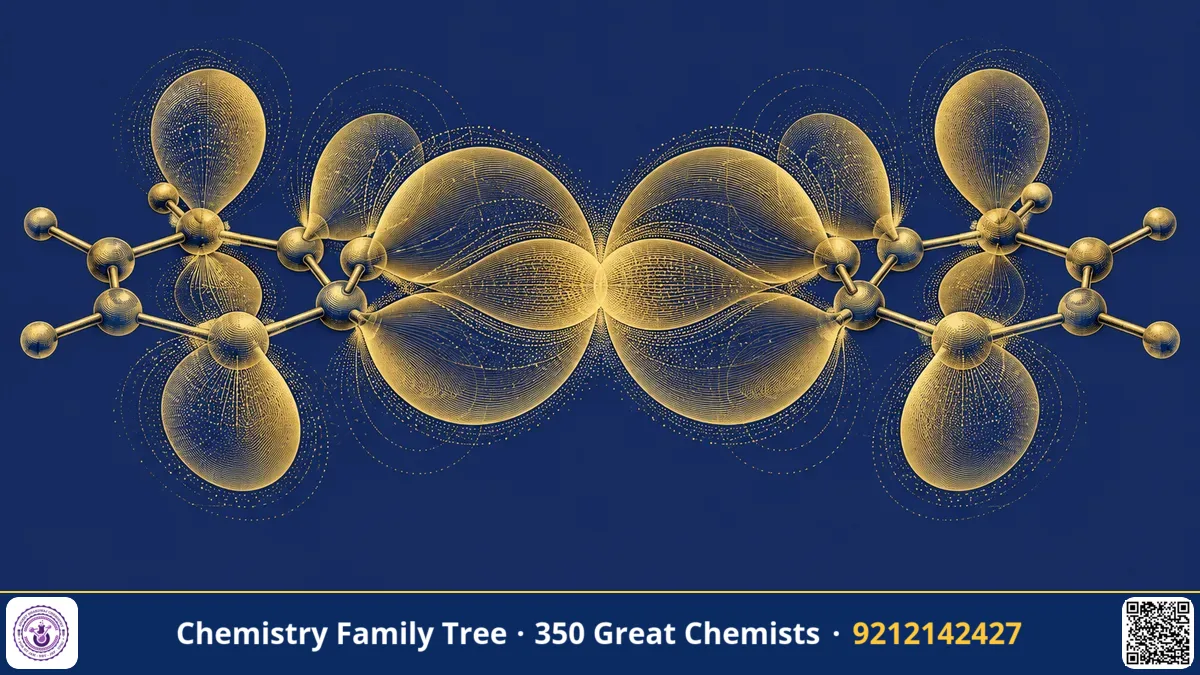
Why does an electrophile attack the 1-position of naphthalene and not the 2-position? Why do some molecules react easily while others, similar in structure, hardly react at all? In 1952, the Japanese chemist Kenichi Fukui gave a surprisingly simple answer: look only at the frontier orbitals, the highest occupied molecular orbital (HOMO) and the lowest unoccupied molecular orbital (LUMO). This idea, called frontier molecular orbital (FMO) theory, earned him the 1981 Nobel Prize in Chemistry, which he shared with Roald Hoffmann. FMO theory is now the quickest way for students to understand pericyclic reactions, regioselectivity, nucleophilic and electrophilic attack, and it appears again and again in JAM, NET and GATE papers.
The Scientific Problem Before the Discovery
In the first half of the 20th century, reactivity was explained using resonance structures, inductive effects and electron density. For instance, the charge distribution of an aromatic molecule was calculated and the site of highest electron density was predicted as the site of electrophilic attack. But this approach often failed. Some positions with high charge were not the most reactive ones. In addition, reactions that involve no charge separation at all, such as the Diels-Alder reaction, could not be explained by charge arguments.
Fukui, who was studying the reactivity of aromatic hydrocarbons in Kyoto, found that charge densities calculated from the Hückel method did not match the observed sites of substitution. He needed a new parameter that connected theory and experiment.
The Discovery: Step by Step
- Compute the orbitals: Fukui and his co-workers computed the π molecular orbitals of aromatic hydrocarbons using the Hückel method.
- Focus on the HOMO: He observed that the position where the electron density of the HOMO is largest is the position most easily attacked by an electrophile. He called this the frontier electron density.
- Extend to nucleophiles: For nucleophilic attack, the LUMO is the important orbital: the nucleophile donates its electrons into the LUMO of the substrate. The position with the largest LUMO coefficient is attacked.
- Publish: The 1952 paper in the Journal of Chemical Physics, "A molecular orbital theory of reactivity in aromatic hydrocarbons", introduced the idea. At first it received little attention, and some experts doubted it. After 1965, when Woodward and Hoffmann's orbital symmetry rules appeared, chemists recognised that Fukui's approach was equally powerful and related.
- Generalise: In 1964 and later papers, Fukui and co-workers applied frontier orbital ideas to cycloadditions, electrocyclic reactions and sigmatropic shifts.
The Chemistry Behind It
Basic idea
When two molecules approach, their orbitals mix. Perturbation theory says that the stabilisation is largest when the interacting orbitals are close in energy and overlap well. Between the occupied orbitals of one molecule and the empty orbitals of the other, the interaction between the HOMO of one and the LUMO of the other is the most important. In simple form:
Stabilisation energy ∝ (overlap)^2 / (E_HOMO - E_LUMO)
A small HOMO-LUMO gap and a good overlap give a fast reaction.
Hückel orbitals of butadiene
For butadiene, the Hückel energies are:
ψ4 = α - 1.618β   (LUMO+1)
ψ3 = α - 0.618β   (LUMO)
ψ2 = α + 0.618β   (HOMO)
ψ1 = α + 1.618β
Since β is negative, ψ1 is the lowest energy. Four π electrons fill ψ1 and ψ2, so ψ2 is the HOMO and ψ3 the LUMO. For ethene, the HOMO is π and the LUMO is π*.
Application 1: Diels-Alder reaction
The diene HOMO (ψ2) overlaps in phase at both terminals with the dienophile LUMO (π*). Both new bonds can form at once, so the reaction is thermally allowed. In a thermal [2+2] reaction of two ethenes, the HOMO-LUMO overlap is bonding at one end and antibonding at the other, so the reaction is forbidden thermally; under light the excited-state HOMO changes this and the reaction becomes allowed. An electron-withdrawing group on the dienophile lowers the LUMO energy and makes the gap smaller, and so speeds the reaction.
Application 2: Electrophilic aromatic substitution
In naphthalene the HOMO has larger coefficient at the α positions (C1) than at β (C2), so electrophiles attack C1 under kinetic control. For substituted benzenes, an electron-donating group raises the HOMO and gives large coefficients at ortho and para positions.
Application 3: SN2 and carbonyl addition
In an SN2 reaction, the HOMO of the nucleophile (a lone pair) donates into the LUMO of the substrate, which is the σ* orbital of the C-X bond. This LUMO has its large lobe on the side of carbon opposite to the leaving group, which explains backside attack and inversion. For a carbonyl group, the LUMO is π*C=O, largest on carbon, so nucleophiles attack carbon at an angle of about 107° (the Bürgi-Dunitz angle).
Application 4: Regioselectivity
In Diels-Alder reactions of unsymmetrical partners, the bond forms between the atoms with the largest orbital coefficients, which explains the "ortho" and "para" products, and why 1-substituted dienes give "ortho" adducts.
Applications Today
- Organic synthesis planning: FMO theory is used to predict regiochemistry in cycloadditions and conjugate additions.
- Computational chemistry: Programs print HOMO and LUMO plots and energies as a standard output, and "Fukui functions" derived from his ideas are used to predict reactive sites in density functional theory.
- Drug design: HOMO-LUMO gaps are used as a rough indicator of chemical reactivity and stability of drug candidates.
- Materials and solar cells: In organic electronics and dye-sensitised solar cells, HOMO and LUMO energy levels decide light absorption and charge flow.
- Reaction path concept: Fukui also introduced the intrinsic reaction coordinate (IRC), widely used in computational studies of mechanisms.
Exam Corner
- FMO theory: reactions are controlled by the interaction of the HOMO of one reactant with the LUMO of the other.
- For electrophilic attack on an aromatic ring, the site with the largest HOMO coefficient is attacked; for nucleophilic attack, the largest LUMO coefficient.
- Butadiene: ψ2 is HOMO and ψ3 is LUMO; ethene: π is HOMO and π* is LUMO.
- Thermal [4+2] allowed (HOMO-LUMO in phase); thermal [2+2] forbidden; photochemical [2+2] allowed.
- Fukui and Hoffmann shared the 1981 Nobel Prize; Fukui was the first Asian chemist to win a Nobel Prize in Chemistry.
Common Misconceptions
- "Only charge decides reactivity." Charge control matters for hard, ionic reactions, but orbital control (FMO) matters for soft, covalent ones.
- "HOMO-LUMO must be from the same molecule." No, the key interaction is between the HOMO of one molecule and the LUMO of the other.
- "FMO theory and Woodward-Hoffmann rules are rivals." They are complementary: one uses symmetry, the other uses frontier orbital interactions, and they give the same predictions for pericyclic reactions.
Quick Revision Box
- FMO theory (Fukui, 1952): HOMO-LUMO interaction decides the course of a reaction.
- Electrophile attacks where the HOMO coefficient is largest; nucleophile where the LUMO coefficient is largest.
- Smaller HOMO-LUMO gap means faster reaction.
- SN2 backside attack: Nu HOMO into the σ* (C-X) LUMO.
- Nobel Prize in Chemistry 1981, shared with Roald Hoffmann.
FAQ
What are frontier orbitals?
They are the highest occupied molecular orbital (HOMO) and the lowest unoccupied molecular orbital (LUMO) of a molecule, the orbitals at the "frontier" between filled and empty.
Why are only HOMO and LUMO considered?
These orbitals are closest in energy to the orbitals of the partner molecule, so they mix most strongly and give the largest stabilisation.
How is FMO theory different from the Woodward-Hoffmann rules?
Both predict the same outcomes for pericyclic reactions. FMO theory uses the overlap of HOMO and LUMO, whereas the Woodward-Hoffmann approach uses the symmetry of orbitals through the reaction path.
When did Fukui win the Nobel Prize?
In 1981, jointly with Roald Hoffmann, for theories concerning the course of chemical reactions.
Published by ABC Chemistry — IIT-JAM | CSIR-NET | GATE Chemistry Coaching. Visit abcchemistry.com
About the chemist
Kenichi Fukui
1918-1998 · Japan · Nobel Chemistry 1981
Frontier molecular orbital theory