Biography · Chemist no. 179 of 350
Koichi Tanaka: The Engineer Who Made Proteins Fly and Won a Nobel Prize
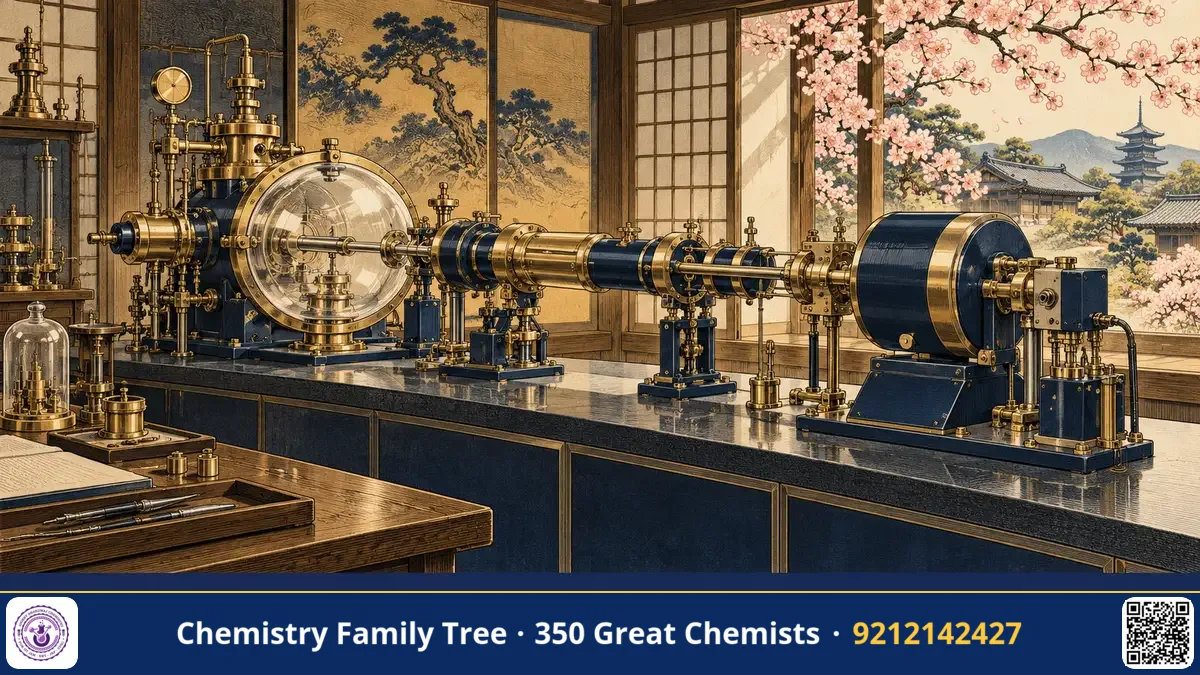
Koichi Tanaka (born 3 August 1959) is a Japanese analytical chemist and engineer who works at Shimadzu Corporation. In 2002 he shared the Nobel Prize in Chemistry for developing a "soft" laser method that lets mass spectrometers weigh intact proteins. His legacy is a lesson in humility: an employee with a bachelor's degree, working in a company laboratory, changed biochemistry.
Early Life and Family
Tanaka was born in Toyama City, on the Sea of Japan coast, in 1959. Toyama is known for its mountains, its pharmaceutical tradition and its heavy snowfall. He grew up in the post-war boom years, when Japan was rebuilding itself through engineering, electronics and manufacturing. As a boy he was interested in science and technology, a common path for children of his generation who saw instrument makers and electronics firms as symbols of national progress.
Education and Mentors
Tanaka studied electrical engineering at Tohoku University in Sendai and received his bachelor's degree in 1983. He did not follow the usual academic route of master's and doctoral degrees. Instead, he joined Shimadzu Corporation in Kyoto, a company founded in 1875 that makes analytical and medical instruments. At Shimadzu he was assigned to the mass spectrometry group, where his engineering background in electronics, lasers and detectors suited a time-of-flight instrument well. In place of a university supervisor, his colleagues in the Shimadzu laboratory were his working teachers.
Career Timeline
| Year | Event |
|---|---|
| 1959 | Born in Toyama, Japan |
| 1983 | Graduated in electrical engineering, Tohoku University; joined Shimadzu Corporation |
| 1987 | Demonstrated soft laser desorption of proteins using a cobalt-glycerol matrix |
| 1988 | Published the method in a mass spectrometry journal |
| 2002 | Awarded the Nobel Prize in Chemistry (shared) |
| 2003 onwards | Led the Koichi Tanaka Laboratory of Advanced Science and Technology at Shimadzu; also a Fellow of the company |
| 2010s | Contributed to blood tests for amyloid-beta peptides in Alzheimer's research |
Major Scientific Contributions
Tanaka's main contribution was soft laser desorption/ionisation. By mixing a protein with ultrafine cobalt powder in glycerol and exposing it to a nitrogen laser (337 nm), he produced intact protein ions that could be analysed by time-of-flight mass spectrometry. In simple terms, ions of charge z accelerated through a voltage V obey t ∝ √(m/z). Because the method generates mostly singly charged species, the spectrum is easy to read. You can see the full chemistry in our discovery article on this topic. His approach showed that proteins above 30,000 daltons could be handled, and it complemented the MALDI method of Karas and Hillenkamp and the electrospray ionisation of John Fenn.
Awards, Honours and Nobel Prize
- Nobel Prize in Chemistry 2002: half of the prize was shared by John B. Fenn and Koichi Tanaka "for their development of soft desorption ionisation methods for mass spectrometric analyses of biological macromolecules"; the other half went to Kurt Wüthrich for NMR in solution. This is a Chemistry Prize.
- Order of Culture and recognition as a Person of Cultural Merit in Japan (2002).
- Honours from Japanese institutions and his home region of Toyama after the Nobel Prize.
- Fellow of Shimadzu Corporation, where he continued research.
Personality, Struggles and Lesser-Known Facts
- The surprise winner: When the prize was announced, many scientists outside mass spectrometry had never heard of him, and the news surprised Japan as much as the rest of the world.
- The glycerol story: He has described that the matrix result partly came from using the "wrong" liquid by mistake. It is a good illustration of observant curiosity.
- Humble style: At the Nobel press conference he appeared in his blue Shimadzu work uniform, and became a national hero, a "salaryman" Nobel laureate.
- Industry first: He is among the few Nobel laureates in Chemistry whose award-winning work was done fully inside a company.
Legacy and Influence on Modern Chemistry
Before laser desorption and electrospray, chemists could not easily study the mass of proteins, nucleic acids and polymers. After 1988 an entire field, proteomics, became possible. Today MALDI-TOF instruments identify bacteria in hospital laboratories within minutes, check food authenticity, analyse polymers and map drugs in tissue slices. In India, MALDI-TOF is used in clinical microbiology labs and in biotech research institutes. Tanaka also demonstrated that applied, instrument-oriented research can lead to fundamental discoveries.
Lessons for Students
- A Nobel Prize does not require a famous university or a doctorate; it requires a good question and careful experiments.
- Pay attention to unexpected results. A "mistake" can be a clue.
- Instrumentation and engineering skills are as valuable in chemistry as theory.
- Publish your results widely and in a language that the community can read.
- Stay modest: Tanaka kept doing laboratory work after becoming famous.
Quick Facts Box
- Born: 3 August 1959, Toyama, Japan
- Died: Living
- Nationality: Japanese
- Field: Analytical chemistry, mass spectrometry
- Famous for: Soft laser desorption ionisation of proteins (1987)
- Nobel: Chemistry 2002 (shared with John B. Fenn and Kurt Wüthrich)
FAQ
Which Nobel Prize did Koichi Tanaka win?
He won the Nobel Prize in Chemistry in 2002, sharing half with John Fenn. Kurt Wüthrich received the other half.
Where did Koichi Tanaka work?
At Shimadzu Corporation in Kyoto, Japan, from 1983. He was an employee and engineer, not a university professor, when he did the prize-winning work.
What did he discover in one line?
A way to turn large intact protein molecules into gas-phase ions with a laser so that their mass can be measured.
Is Koichi Tanaka related to MALDI?
His method is closely related and a forerunner of the techniques that led to modern MALDI-TOF mass spectrometry, although MALDI itself was introduced by Karas and Hillenkamp.
Published by ABC Chemistry — IIT-JAM | CSIR-NET | GATE Chemistry Coaching. Visit abcchemistry.com
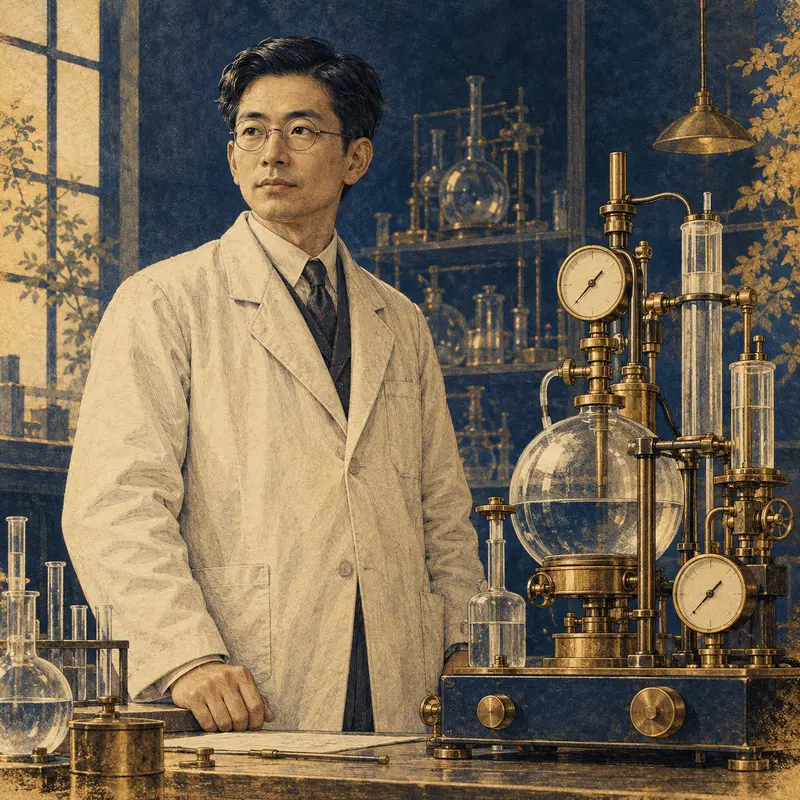
About the chemist
Koichi Tanaka
1959- · Japan · Nobel Chemistry 2002
Soft laser desorption for protein mass spectrometry