The discovery, explained · Chemist no. 179 of 350
Koichi Tanaka and Soft Laser Desorption: How Proteins Learned to Fly
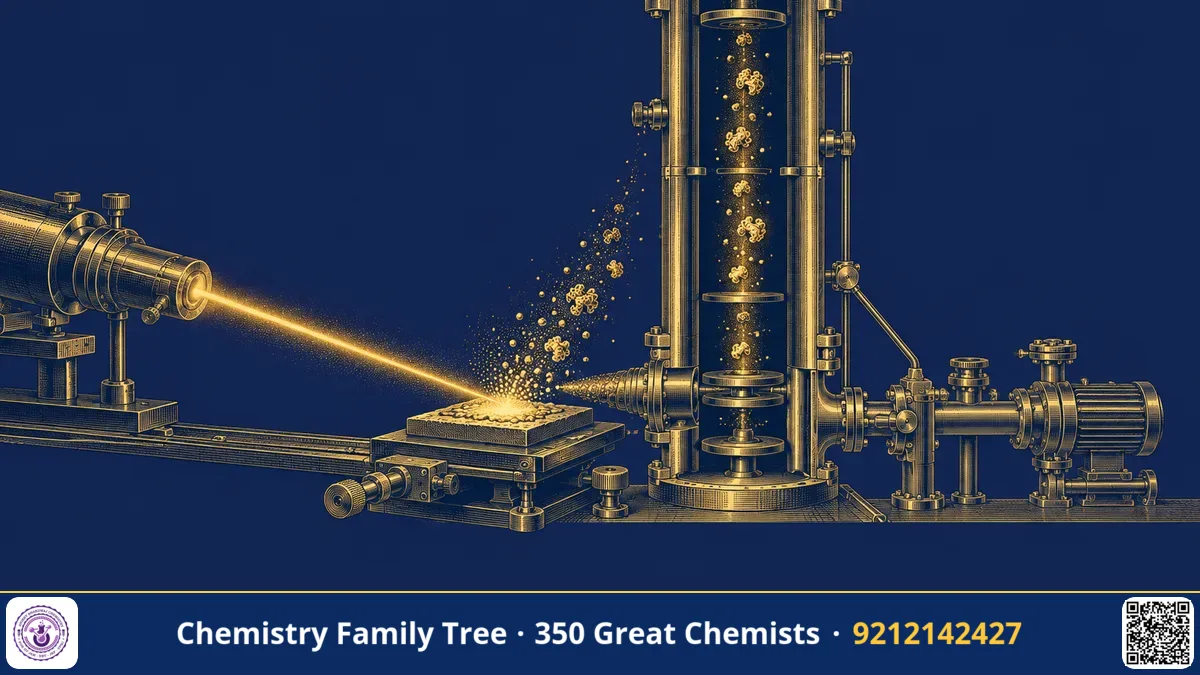
Before the late 1980s, a chemist could weigh a small organic molecule on a mass spectrometer with ease, but a protein was a different story. Proteins are huge, fragile and non-volatile. Heat them and they burn; hit them with a laser and they shatter. In 1987 a young engineer at Shimadzu Corporation in Kyoto, Koichi Tanaka, found a way to lift whole protein molecules into the gas phase as intact ions using a pulse of laser light. His method is called soft laser desorption, and it is the ancestor of the MALDI technique used in thousands of laboratories today.
For this work Tanaka shared the 2002 Nobel Prize in Chemistry (with John B. Fenn, for electrospray ionisation; the other half of that year's prize went to Kurt Wüthrich for NMR). Tanaka was remarkable: a corporate engineer with a bachelor's degree, not a university professor. In this post we look at the problem, the experiment, the chemistry and the exam points.
The Scientific Problem Before the Discovery
A mass spectrometer measures the mass-to-charge ratio (m/z) of gas-phase ions. To use it you must do two things to your sample: turn it into a gas and give it a charge. For small molecules, electron impact (EI) or chemical ionisation (CI) works well. For biomolecules these methods fail, because:
- Proteins have molar masses of thousands to hundreds of thousands of g/mol and do not evaporate on heating.
- Hard ionisation deposits too much energy, so the molecule fragments before it reaches the detector.
- Pure laser irradiation of an organic solid mostly decomposes it.
Biochemists needed a soft method: one that gives the molecule enough energy to leave the surface and carry a charge, but not enough to break covalent bonds. Fast atom bombardment (FAB) was one partial answer, but it worked only up to a few thousand daltons.
The Discovery: Step by Step
Tanaka's team at Shimadzu was building a time-of-flight (TOF) instrument with a nitrogen laser (wavelength 337 nm). They tried different "matrices", materials mixed with the sample to absorb laser energy. His key idea was to use a suspension of ultrafine cobalt powder (particle size about 30 nm) in glycerol. A widely told story says he picked glycerol by mistake while preparing the sample; whatever the detail, the result was striking.
- Mix the protein solution with the cobalt-glycerol suspension.
- Dry a small spot of the mixture on a metal target plate.
- Place the plate in a vacuum and fire short laser pulses at it.
- The laser energy is absorbed by the matrix; a tiny plume of material is ejected and the protein molecules enter the gas phase carrying a charge.
- The ions are accelerated in an electric field and fly down a field-free tube. Their flight time is measured at a detector.
In 1987 his group detected singly charged ions of proteins such as carboxypeptidase-A (about 34,000 Da) and later larger proteins, reported in a scientific meeting in 1987 and in print in 1988. Importantly, the proteins arrived intact. The team named it soft laser desorption (SLD).
The Chemistry Behind It
The principle is energy management. The matrix absorbs the pulse, heats and expands explosively, and the large analyte molecules are carried along "as passengers" without absorbing much energy themselves. Ionisation is usually by protonation:
M + H⁺ → [M+H]⁺ (m/z = (M + 1) / 1)
Because the ions mostly carry a single charge (z = 1), the spectrum is simple: the m/z value of a peak is practically the molar mass. The TOF analyser is based on kinetic energy. An ion of charge z·e accelerated through potential V gains energy:
z·e·V = ½ m v² → t = L / v = L · √( m / (2 z e V) )
So flight time t is proportional to √(m/z): lighter ions arrive first, heavier ones later. A TOF tube has no upper mass limit in principle, which makes it ideal for macromolecules.
At about the same time, Michael Karas and Franz Hillenkamp in Germany developed a related approach using an organic acid matrix (nicotinic acid) and a UV laser, and showed it could ionise proteins above 10,000 Da. Their technique, MALDI (matrix-assisted laser desorption/ionisation), became the standard because organic matrices such as sinapinic acid and α-cyano-4-hydroxycinnamic acid were easy to use. The Nobel committee recognised Tanaka for the first demonstration that intact large biomolecules could be desorbed and ionised by laser.
Applications Today
- Proteomics: Proteins are digested with trypsin and the peptide masses are matched with databases ("peptide mass fingerprinting").
- Clinical microbiology: MALDI-TOF identifies bacteria and fungi within minutes by their protein fingerprints, and many hospitals in India now use it.
- Polymers and materials: Molar mass distribution of synthetic polymers.
- Medicine research: Tanaka's later work at Shimadzu contributed to mass spectrometric methods for detecting amyloid-beta related peptides in blood in Alzheimer's research.
- Food and forensics: Detection of adulteration, and analysis of biomolecules in tissue sections (imaging mass spectrometry).
Exam Corner
- Tanaka received half of the 2002 Nobel Prize in Chemistry (shared with Fenn and Wüthrich), for soft desorption ionisation methods for mass spectrometric analysis of biological macromolecules.
- His matrix: ultrafine cobalt powder in glycerol; laser: nitrogen laser, 337 nm.
- In TOF, t ∝ √(m/z), so lighter ions reach the detector first.
- MALDI mostly gives singly charged ions [M+H]⁺, unlike electrospray which gives multiply charged ions.
- Soft ionisation means little fragmentation, so the molecular ion peak is seen.
Common Misconceptions
- "Tanaka invented MALDI." Not exactly. MALDI was developed by Karas and Hillenkamp; Tanaka's contribution was the soft laser desorption with a metal-powder matrix. Both are laser desorption methods.
- "The laser breaks the protein into pieces that are then weighed." The point of the method is the opposite: the protein stays whole.
- "Mass spectrometry measures mass directly." It measures m/z; mass is obtained only when the charge is known.
Quick Revision Box
- Koichi Tanaka: Shimadzu engineer, Nobel Prize in Chemistry 2002 (shared).
- Method: soft laser desorption with cobalt-in-glycerol matrix, 1987.
- Principle: matrix absorbs laser energy, analyte leaves intact as an ion.
- Detector: time-of-flight, t = L√(m/2zeV).
- Related technique: MALDI (Karas and Hillenkamp); ESI (Fenn).
- Uses: proteomics, microbial identification, polymer analysis.
FAQ
Why was the Nobel Prize given for a method and not a molecule?
The Chemistry Nobel often honours tools that change what scientists can do. Soft ionisation made it possible to analyse proteins by mass spectrometry, which opened proteomics.
What is the difference between MALDI and electrospray ionisation?
MALDI ionises a dried solid sample with a laser and mostly gives singly charged ions. Electrospray sprays a liquid sample through a charged needle and gives multiply charged ions, so very large molecules appear at lower m/z.
Why is a matrix needed?
The matrix absorbs the laser energy, protects the analyte from direct damage and helps transfer a proton to it.
Did Tanaka have a PhD?
No. He studied electrical engineering at Tohoku University and spent his career at Shimadzu, which made his Nobel Prize unusual and inspiring for students.
Published by ABC Chemistry — IIT-JAM | CSIR-NET | GATE Chemistry Coaching. Visit abcchemistry.com
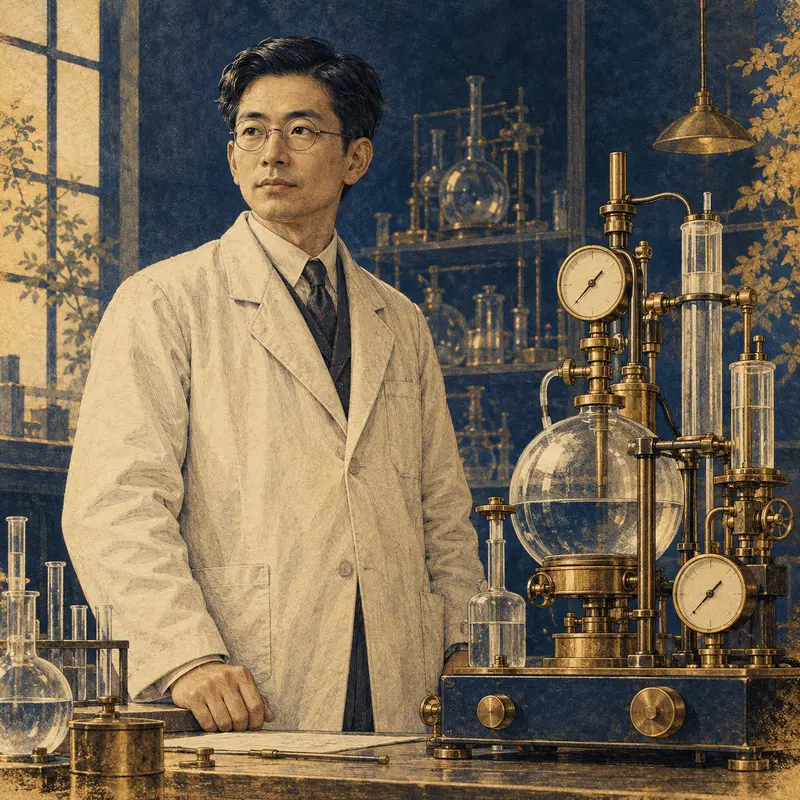
About the chemist
Koichi Tanaka
1959- · Japan · Nobel Chemistry 2002
Soft laser desorption for protein mass spectrometry