Biography · Chemist no. 54 of 350
Kurt Alder: The Life of the Young Chemist Who Co-Discovered the Diene Synthesis
Kurt Alder (1902-1958) was a German organic chemist who became famous at the young age of 26 for the Diels-Alder reaction and who shared the 1950 Nobel Prize in Chemistry with his teacher Otto Diels. He did not stop with that single success. He developed the endo rule, discovered the ene reaction, worked on synthetic rubber in industry, and led a large chemistry institute at the University of Cologne. He died in 1958 at the age of 55, still active in research. This biography follows his life from a small industrial town in Silesia to the Nobel podium in Stockholm, with lessons for students who want to make chemistry their career.
Early Life and Family
Kurt Alder was born on 10 July 1902 in Königshütte, in Upper Silesia, a coal and steel region that was then part of Germany. The town is now Chorzów in Poland. Alder grew up in a period of war, inflation and political unrest, a difficult background for a young student. Even so he showed a strong interest in science and mathematics, which led him to chemistry.
Education and Mentors
Alder began his university studies in Berlin and then moved to the University of Kiel, where he studied chemistry and worked with Otto Diels. He completed his doctorate at Kiel in 1926, working in the area of organic chemistry in which he later became famous. Diels was a rigorous teacher who gave him freedom to follow his own ideas. It was Alder's habit of testing every promising reaction on a broad range of substrates that turned an interesting observation into a general synthetic method.
Career Timeline
| Year | Event |
|---|---|
| 1902 | Born in Königshütte, Upper Silesia (10 July) |
| 1926 | Doctorate at Kiel under Otto Diels |
| 1928 | Published the diene synthesis with Diels |
| 1930 | Habilitation; became a lecturer at Kiel |
| 1936 | Joined I.G. Farben, Leverkusen, working on synthetic rubber and related polymers |
| 1937 | Alder-Stein endo rule formulated |
| 1940 | Appointed professor and director of the chemical institute at the University of Cologne |
| 1943 | Described the ene reaction (Alder-ene) |
| 1950 | Nobel Prize in Chemistry shared with Otto Diels |
| 1958 | Died in Cologne (20 June) |
Major Scientific Contributions
- Diene synthesis (1928): The [4+2] cycloaddition of a conjugated diene and a dienophile to give a cyclohexene ring. Its scope, limits and stereochemistry were largely worked out by Alder and his group.
- Endo rule: The empirical rule that endo adducts are the kinetic products of Diels-Alder reactions, now explained by secondary orbital interactions.
- Ene reaction: The reaction of an alkene having allylic hydrogens with an enophile, now one of the standard pericyclic reactions.
- Alder-Rickert reaction: A Diels-Alder reaction followed by a retro-Diels-Alder step to give aromatic compounds.
- Industrial chemistry: Work on Buna-type synthetic rubber and polymers during his years at I.G. Farben, linking the reactions of dienes such as butadiene with practical materials.
Typical Alder-type chemistry is summarised in the equations below:
butadiene + maleic anhydride  →  cyclohexene dicarboxylic anhydride (Diels-Alder)
propene + maleic anhydride   →  allylsuccinic anhydride (ene reaction)
Awards, Honours and Nobel Prize
The Nobel Prize in Chemistry 1950 was awarded jointly to Otto Diels and Kurt Alder "for their discovery and development of the diene synthesis". Alder was then 48. The prize recognised both the discovery of 1928 and the long years of work that showed how general the reaction is. Alder received other academic honours during his life, but the Nobel Prize is the one that defines his legacy. The reaction also lives on in the names of aldrin and dieldrin, two insecticides prepared by Diels-Alder chemistry and named after the two scientists.
Personality, Struggles and Lesser-Known Facts
- Very young at the time of discovery: Alder was only in his mid-twenties when the diene synthesis was published. It shows that major discoveries can come from young researchers working in a good group.
- Teacher and student share a prize: Alder and Diels were separated by 26 years in age, and the Nobel Prize in 1950 recognised the unusual partnership of teacher and student.
- From university to industry and back: He moved from academia to the research laboratories at Leverkusen in 1936, where practical problems in synthetic rubber kept him close to real-world chemistry, and then to a professorship in Cologne in 1940.
- Working through the war: His years at Cologne coincided with the Second World War and its aftermath. The city was heavily bombed, and rebuilding the institute was a major task for him and his colleagues.
- A shorter life: He died at age 55 in 1958, only eight years after the Nobel Prize. Diels outlived him by four years.
Legacy and Influence on Modern Chemistry
The Diels-Alder reaction is now so central to organic synthesis that it is often called the most useful ring-forming reaction. Through the work of Woodward and Hoffmann in the 1960s, followed by Fukui's frontier orbital theory, the reaction became the model case for understanding pericyclic reactions. The endo rule remains a standard teaching example of kinetic versus thermodynamic control. The ene reaction is still being developed with chiral Lewis acid catalysts, and the concept of "atom economy" in green chemistry has the Diels-Alder and ene reactions as its textbook examples, since all atoms of the starting materials end up in the product.
Lessons for Students
- Test your idea widely: A reaction becomes a method only when tried with many substrates. Alder did this systematically.
- Know the difference between kinetic and thermodynamic products: The endo rule is one of the best examples for exam answers.
- Respect your teachers and share credit: Diels and Alder's partnership is a model of scientific collaboration.
- Do not hesitate to move between academia and industry: Alder's work in industry fed his later research.
Quick Facts Box
- Born: 10 July 1902, Königshütte, Upper Silesia (now Chorzów, Poland)
- Died: 20 June 1958, Cologne, Germany
- Nationality: German
- Field: Organic chemistry
- Famous for: Diels-Alder reaction, endo rule, ene reaction
- Nobel Prize: Chemistry 1950 (shared with Otto Diels)
FAQ
Was Kurt Alder a student of Otto Diels?
Yes. Alder completed his doctorate at Kiel under Diels in 1926, and two years later they published the diene synthesis together.
Where did Kurt Alder work after Kiel?
He worked at I.G. Farben in Leverkusen from 1936, mainly on synthetic rubber, and from 1940 he was professor and institute director at the University of Cologne.
What other reactions are named after Alder?
The Alder-ene reaction, the Alder-Rickert reaction and the Alder (or Alder-Stein) endo rule.
When did Kurt Alder win the Nobel Prize?
In 1950, jointly with Otto Diels, "for their discovery and development of the diene synthesis".
Published by ABC Chemistry — IIT-JAM | CSIR-NET | GATE Chemistry Coaching. Visit abcchemistry.com
About the chemist
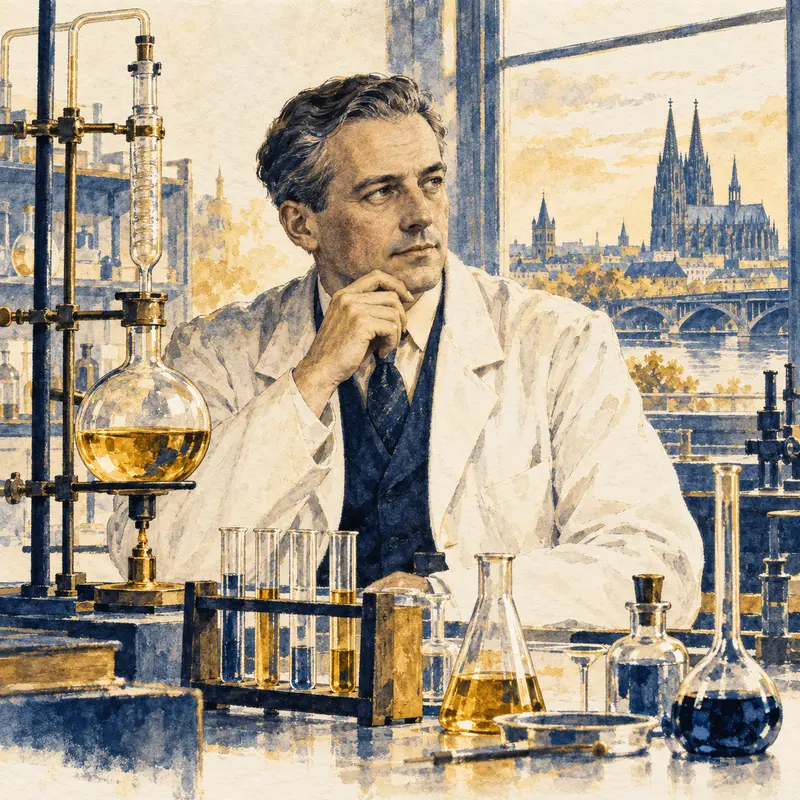
Kurt Alder
1902-1958 · Germany · Nobel Chemistry 1950
Diels-Alder reaction