The discovery, explained · Chemist no. 54 of 350
Kurt Alder's Chemistry: The Endo Rule, the Ene Reaction and the Art of Building Rings
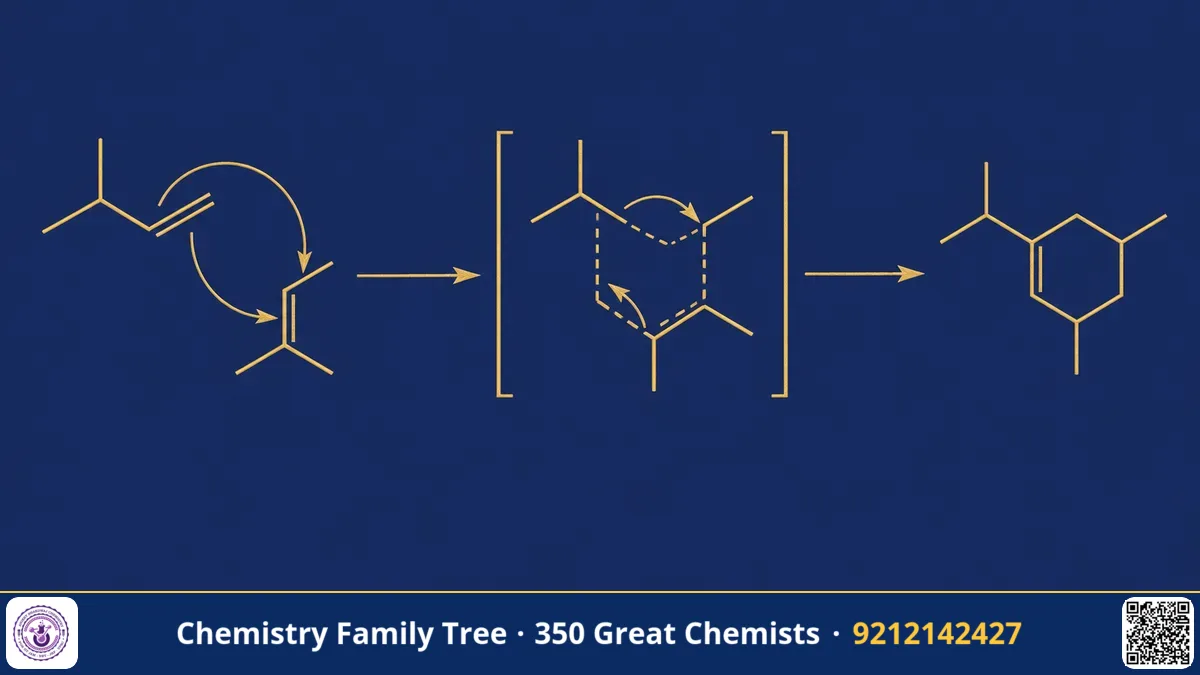
Most students know Kurt Alder as the "Alder" of the Diels-Alder reaction. But Alder was not only a co-discoverer. After 1928 he spent three decades developing the diene synthesis and its relatives. He formulated the endo rule that tells us which stereoisomer is formed, he discovered the Alder-ene reaction in 1943, and he showed how a Diels-Alder reaction followed by a retro-Diels-Alder step can be used to make aromatic compounds (the Alder-Rickert reaction). Together with Otto Diels he received the Nobel Prize in Chemistry in 1950. This post explains these ideas in simple language, with the equations and exam points you need for IIT-JAM, CSIR-NET and GATE.
The Scientific Problem Before the Discovery
When Diels and Alder published the diene synthesis in 1928, the reaction worked, but many questions were still open. Why did the reaction of cyclopentadiene with maleic anhydride give one particular stereoisomer, and not the other? Could the same idea be extended to other kinds of molecules? If conjugated dienes add to electron-poor alkenes to form six-membered rings, what happens when an alkene has an allylic hydrogen but no second double bond?
At that time, the theory of reaction mechanism was only starting to develop. Chemists did not have orbital-symmetry rules, so predictions had to come from careful experiments. Alder's strength was exactly this: systematic experimental work, product structure proof, and recognising patterns.
The Discovery: Step by Step
The endo rule (Alder-Stein rule, 1937)
Alder and his co-worker G. Stein studied additions of dienes to dienophiles such as maleic anhydride, and found that two stereoisomeric adducts are possible, endo and exo. In the endo product, the electron-withdrawing substituent of the dienophile lies under the newly formed double bond (it points toward the diene's π system) in the bicyclic framework. The experiments showed that the endo adduct is the main product under normal, kinetically controlled conditions. This empirical observation became known as the Alder endo rule.
cyclopentadiene + maleic anhydride → endo-norbornene-5,6-dicarboxylic anhydride (major)
The ene reaction (1943)
Alder, with co-workers, studied the reaction of alkenes that carry an allylic hydrogen (the "ene") with electron-poor multiple bonds (the "enophile"). For example, propene reacts with maleic anhydride at high temperature to give an allylsuccinic anhydride:
CH2=CH-CH3 + maleic anhydride → CH2=CH-CH2-(succinic anhydride)
In this reaction, a new C-C σ bond forms at the terminal carbon of the alkene, the double bond shifts, and the allylic hydrogen is transferred to the enophile. All of this takes place in one step.
The Alder-Rickert reaction
Alder and Rickert showed that the Diels-Alder adduct of a cyclohexadiene with an alkyne (such as dimethyl acetylenedicarboxylate) can lose a small molecule such as ethene in a retro-Diels-Alder step, which leaves an aromatic ring. This is a useful way to build substituted benzene derivatives:
1,3-cyclohexadiene + RC≡CR → bicyclic adduct → arene + CH2=CH2 (retro-Diels-Alder)
The Chemistry Behind It
Why endo?
In the endo transition state, the p-orbitals of the substituent (such as the C=O of maleic anhydride) lie close to the central carbons (C2 and C3) of the diene. This "secondary orbital interaction" gives extra stabilisation, which lowers the activation energy. The exo transition state avoids steric crowding, so the exo adduct is often thermodynamically more stable. At high temperature, where the reaction is reversible, exo products can dominate. So the correct statement is: endo = kinetic product, exo = thermodynamic product.
Ene reaction mechanism
The ene reaction involves six electrons: the π bond of the ene (2 electrons), the allylic C-H σ bond (2 electrons) and the π bond of the enophile (2 electrons). The transition state is a six-membered ring-like arrangement, and the process is a concerted, pericyclic reaction, sometimes described as a [σ2s + π2s + π2s] process. It is related to the Diels-Alder reaction but, because one component is a C-H σ bond, it is not a cycloaddition: no ring is formed in the product. The ene reaction usually needs higher temperature than the Diels-Alder reaction because the allylic C-H bond must be broken as the new bond forms. Lewis acids (such as Me2AlCl) can lower the temperature, especially with carbonyl enophiles.
Variants
- Carbonyl-ene: an aldehyde acts as the enophile and gives a homoallylic alcohol.
- Intramolecular ene: ring formation when the ene and enophile are tethered; used in terpene synthesis.
- Singlet oxygen ene (Schenck ene): singlet oxygen adds to an alkene to give an allylic hydroperoxide with a double-bond shift.
- Conia-ene: the enol form of a ketone acts as the ene partner and a tethered alkyne or alkene as the enophile.
Applications Today
- Total synthesis: Intramolecular ene reactions form five- and six-membered rings in terpenes and other natural products.
- Perfumery: Photooxygenation by the ene pathway is used in the preparation of fragrance compounds such as rose oxide, starting from citronellol.
- Industrial chemistry: Ene-type additions of maleic anhydride to polyisobutylene give the succinic anhydride derivatives used for lubricant and fuel additives.
- Polymers: Alder worked at I.G. Farben on synthetic rubber, and Diels-Alder chemistry of dienes remains central to understanding rubber and resin chemistry.
- Stereocontrolled drug synthesis: The endo rule is used to predict relative stereochemistry in Diels-Alder steps in the synthesis of drugs and natural products.
Exam Corner
- Endo rule: kinetic control favours the endo adduct due to secondary orbital interactions; exo is thermodynamically more stable.
- The ene reaction has six electrons in the transition state: ene (π + allylic C-H σ) and enophile (π). Product: new σ bond, shifted double bond, H transferred.
- Propene + maleic anhydride gives allylsuccinic anhydride, an example of the thermal Alder-ene reaction.
- Singlet oxygen reacts with an alkene having allylic hydrogens through an ene pathway to give an allylic hydroperoxide.
- Alder-Rickert reaction: Diels-Alder with an alkyne, then retro-Diels-Alder with loss of a small alkene, leaving an arene.
Common Misconceptions
- "The ene reaction is a cycloaddition." It is a pericyclic group transfer reaction. No ring is formed in the product, so it is not a cycloaddition.
- "Endo means more stable." Endo means more quickly formed. The exo isomer is often more stable.
- "Alder only worked on the Diels-Alder reaction." He also worked on ene reactions, synthetic rubber and several named reactions.
Quick Revision Box
- Kurt Alder (1902-1958), Nobel Prize in Chemistry 1950 with Otto Diels.
- Alder endo rule (Alder-Stein, 1937): endo adduct is the kinetic product.
- Alder-ene reaction (1943): alkene with allylic H + enophile, six-electron concerted process.
- Alder-Rickert: Diels-Alder followed by retro-Diels-Alder gives an aromatic ring.
- Lewis acids lower the temperature needed for ene reactions.
- Alder worked on Buna synthetic rubber at I.G. Farben, Leverkusen.
FAQ
What is the Alder-ene reaction?
It is a reaction between an alkene having an allylic hydrogen (the ene) and a multiple bond (the enophile). A new σ bond forms, the double bond shifts and the hydrogen moves to the enophile.
What is the difference between the ene and the Diels-Alder reaction?
Diels-Alder is a [4+2] cycloaddition between a diene and a dienophile and forms a ring. The ene reaction transfers an allylic hydrogen and forms no new ring, although both are concerted six-electron pericyclic processes.
What is the endo rule in simple words?
In a Diels-Alder reaction, the substituent on the dienophile prefers to sit under the diene in the transition state, giving the endo product as the main kinetic product.
Why do ene reactions need heat?
Because the allylic C-H bond is cleaved during the reaction and the overlap in the transition state is less favourable, high temperatures or Lewis acid catalysts are normally needed.
Published by ABC Chemistry — IIT-JAM | CSIR-NET | GATE Chemistry Coaching. Visit abcchemistry.com
About the chemist
Kurt Alder
1902-1958 · Germany · Nobel Chemistry 1950
Diels-Alder reaction