Biography · Chemist no. 180 of 350
Kurt Wüthrich: The Swiss Scientist Who Made NMR See Proteins
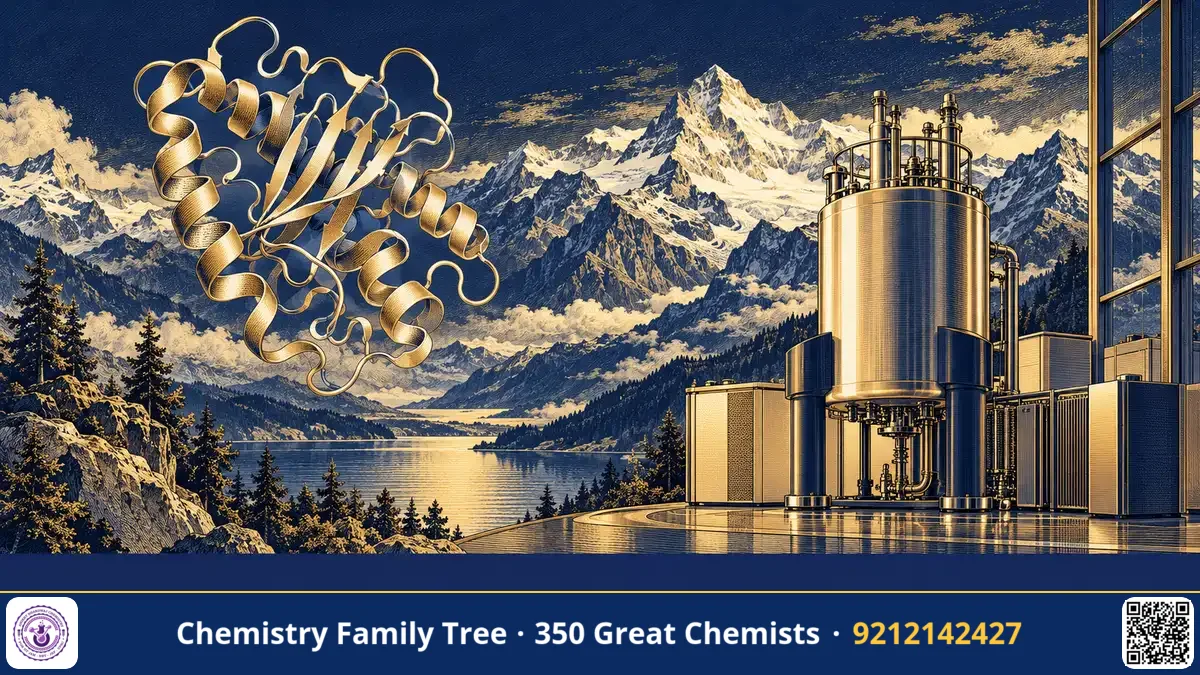
Kurt Wüthrich (born 4 October 1938) is a Swiss chemist and biophysicist, and one of the founders of modern structural biology. He turned nuclear magnetic resonance from a tool for small organic molecules into a method that reveals the 3D structure of proteins in solution. For this he received half of the Nobel Prize in Chemistry in 2002. His legacy is every NMR-derived structure in the Protein Data Bank.
Early Life and Family
Wüthrich was born in Aarberg, a small town in the canton of Bern, Switzerland. He grew up in the Swiss countryside, in a modest family. Swiss schools of that period combined practical learning with rigorous science, and he showed an early aptitude for both chemistry and physics. He is also known as a person who loves the outdoors and the mountains of his country, a theme that appears often in descriptions of his character.
Education and Mentors
Wüthrich studied chemistry, physics and mathematics at the University of Bern, and then completed his doctorate at the University of Basel, receiving the degree in 1964. He then went abroad for postdoctoral training: first at the University of Basel, then at the University of California, Berkeley, where he worked with Sunney Chan, and afterwards at Bell Telephone Laboratories in the United States with Robert G. Shulman, who was applying NMR to biological problems. At Bell Labs he worked on haemoglobin and other biomolecules, which convinced him that NMR could one day solve biological structures. He returned to Switzerland and joined ETH Zurich (the Swiss Federal Institute of Technology), where he built his research group. At ETH he worked in the same environment as Richard Ernst, who developed Fourier-transform and two-dimensional NMR methods.
Career Timeline
| Year | Event |
|---|---|
| 1938 | Born in Aarberg, Switzerland |
| 1964 | Doctorate from the University of Basel |
| 1960s | Postdoctoral work at Berkeley and Bell Laboratories |
| 1969 | Joined ETH Zurich |
| 1980 | Became professor of biophysics at ETH Zurich |
| 1985 | Group reported the first protein structure determined entirely by NMR in solution |
| 1997 | Introduced TROSY with colleagues, extending NMR to large biomolecules |
| 2001 | Became a professor at The Scripps Research Institute in California as well, keeping his Zurich position |
| 2002 | Nobel Prize in Chemistry (half share) |
Major Scientific Contributions
His central contribution is the sequential assignment strategy and the use of NOE-derived distance restraints, explained in detail in our discovery article. In outline: two-dimensional NMR resolves overlapping proton signals; spin-coupling patterns identify the amino-acid residues; NOEs between adjacent residues allow the signals to be placed along the chain; and many short distances (below about 5 Å) are converted into a three-dimensional model by computer calculations. The NOE intensity falls with distance as 1/r⁶, so it is a sensitive ruler.
Later contributions include TROSY, which reduces line broadening in big molecules, and the structure determination of the prion protein, which helped researchers understand diseases such as bovine spongiform encephalopathy at molecular level. He also pioneered methods for studying membrane proteins and large complexes by NMR in combination with other techniques.
Awards, Honours and Nobel Prize
- Nobel Prize in Chemistry 2002: half of the prize "for his development of nuclear magnetic resonance spectroscopy for determining the three-dimensional structure of biological macromolecules in solution". The other half went jointly to John B. Fenn and Koichi Tanaka. This was a Chemistry prize.
- Membership in many academies of science, including foreign membership of the US National Academy of Sciences and the Royal Society.
- Numerous honorary doctorates and international prizes for his contributions to structural biology.
Personality, Struggles and Lesser-Known Facts
- Colleague Nobel laureate: At ETH Zurich the 1991 chemistry laureate Richard Ernst worked next door in the same field, and their complementary ideas (pulse methods and biological applications) made Zurich a world centre of NMR.
- Beginning with doubt: When he began, many spectroscopists believed that a protein spectrum was too complicated ever to be interpreted. His method succeeded by turning that crowded spectrum into a puzzle that could be solved step by step.
- Trans-Atlantic scientist: He divided his time between Zurich and the Scripps Research Institute in California for years.
- Hiker and mountain lover: Interviews have described his enthusiasm for the Swiss mountains and for walking.
- Teaching: He trained a generation of NMR spectroscopists who now lead laboratories in many countries, including India.
Legacy and Influence on Modern Chemistry
Before Wüthrich, protein structure meant crystals. After him, scientists could study folding, binding and motion in solution. Thousands of structures in the Protein Data Bank were determined by NMR, and the same chemical-shift and relaxation concepts are used in drug-discovery screening. Indian institutes such as IISc Bangalore, the National Chemical Laboratory in Pune and several IITs run high-field NMR facilities for protein work, and students learning HSQC and NOESY are using a legacy that started in Zurich.
Lessons for Students
- Choose a hard problem that others call impossible, and break it into logical steps.
- Build bridges between fields: Wüthrich combined physics, chemistry and biology.
- Learn mathematics and computing; modern structure work needs both.
- Collaborate with neighbours; the Zurich NMR community advanced together.
- Keep your mind refreshed outdoors, as he does.
Quick Facts Box
- Born: 4 October 1938, Aarberg, Switzerland
- Died: Living
- Nationality: Swiss
- Field: Biophysical chemistry, NMR, structural biology
- Famous for: Determining protein 3D structure by NMR in solution; TROSY
- Nobel: Chemistry 2002 (half share)
FAQ
Did Kurt Wüthrich win a Nobel Prize in Medicine?
No. He won the Nobel Prize in Chemistry in 2002, although his work is central to biology and medicine.
Where did he work?
Mainly ETH Zurich in Switzerland, and also at The Scripps Research Institute in California.
What is TROSY?
Transverse relaxation-optimised spectroscopy, a technique that gives narrower NMR lines for large molecules and extends the size limit of protein NMR.
Is he related to X-ray crystallography?
He is not an X-ray crystallographer; his NMR method is an alternative and complementary route to the same kind of 3D structure.
Published by ABC Chemistry — IIT-JAM | CSIR-NET | GATE Chemistry Coaching. Visit abcchemistry.com
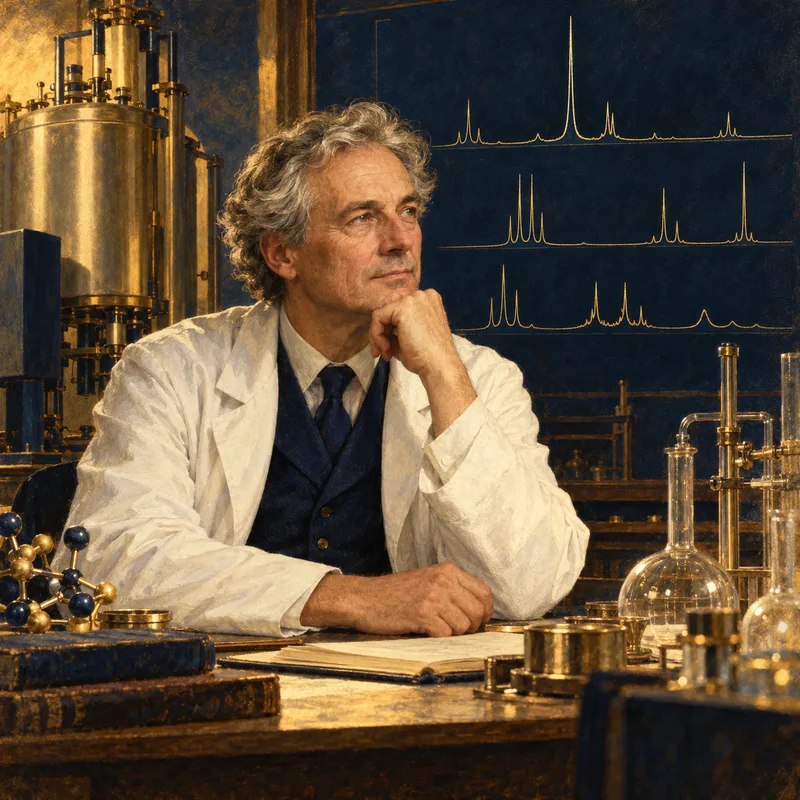
About the chemist
Kurt Wüthrich
1938- · Switzerland · Nobel Chemistry 2002
NMR structure determination of proteins