The discovery, explained · Chemist no. 180 of 350
Kurt Wüthrich and NMR: Reading the 3D Shape of Proteins in Solution
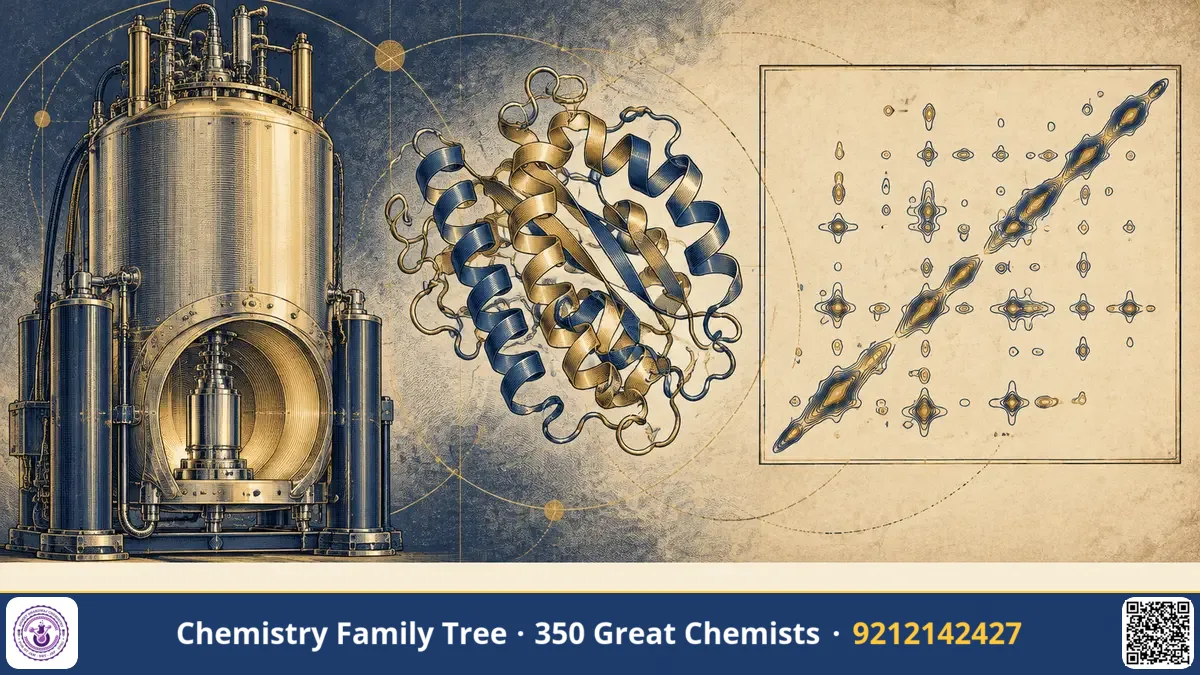
Proteins do their work in water, inside living cells, and they move. For decades the only way to see their three-dimensional structure was X-ray crystallography, which needs a well-formed crystal. In the 1980s the Swiss chemist and biophysicist Kurt Wüthrich showed that nuclear magnetic resonance (NMR) spectroscopy could solve the complete 3D structure of a protein dissolved in solution. He developed the logic, the experiments and the data-handling strategy, and in 1985 his group reported the first protein structure determined entirely by NMR.
In 2002 Wüthrich received half of the Nobel Prize in Chemistry "for his development of nuclear magnetic resonance spectroscopy for determining the three-dimensional structure of biological macromolecules in solution". (The other half went to John Fenn and Koichi Tanaka for mass spectrometry.) This article explains the problem, the method, and the physics behind it in exam-friendly language.
The Scientific Problem Before the Discovery
By the 1970s NMR was an established tool for organic chemists. It could identify small molecules by chemical shifts and coupling constants. But a protein of 100 amino acids has well over a thousand hydrogen atoms, and a one-dimensional 1H NMR spectrum of such a molecule is a crowded forest of overlapping peaks. Nobody could tell which peak belonged to which atom, so no structure could be derived.
X-ray crystallography gave beautiful structures (haemoglobin, myoglobin, lysozyme) but had its own limits: not every protein crystallises, crystal packing may alter the structure, and the method says little about dynamics in solution. Biologists needed an alternative that worked under near-physiological conditions.
The Discovery: Step by Step
Wüthrich's strategy, developed through the late 1970s and early 1980s in his group at ETH Zurich, is often called the sequential assignment method. It rests on two kinds of NMR information:
- Through-bond coupling (scalar J-coupling, COSY/TOCSY): identifies the proton spin system of each amino-acid residue, for example, the NH, Cα-H and side-chain protons of alanine versus valine.
- Through-space interaction (the nuclear Overhauser effect, NOE, observed in NOESY): identifies protons that are close in space (less than about 5 Å), even if they are far apart in the sequence.
With these, the procedure runs as follows:
- Use two-dimensional spectra (introduced by Richard Ernst, a colleague at ETH who won the 1991 Nobel Prize in Chemistry) to spread peaks into a second dimension and resolve the overlap.
- Identify the type of each residue from its spin-coupling pattern.
- Walk along the chain: NOEs between the NH proton of residue i+1 and the Cα-H of residue i connect neighbouring residues. This connects the islands into a full assignment of every proton to its position in the sequence.
- Collect many NOE-derived distance limits, plus dihedral-angle restraints from coupling constants.
- Feed the restraints into computer programs (distance geometry, later simulated annealing) to calculate structures that satisfy them. Because the data are only upper limits, one gets an ensemble of closely related structures.
The first proteins solved were small, such as the bull seminal proteinase inhibitor IIA, and the method rapidly extended to proteins of 20–30 kDa. In 1997 his group introduced TROSY (transverse relaxation-optimised spectroscopy), which pushed the size limit upward by cleverly cancelling relaxation mechanisms in large molecules.
The Chemistry Behind It
NMR rests on nuclear spin. Nuclei with spin I = ½ (1H, 13C, 15N) behave as tiny magnets. In a field B₀ the two spin states are split, and the resonance condition is:
ν = γ B₀ / 2π      (Larmor frequency)
ΔE = h ν
The exact frequency depends on the electronic environment, giving the chemical shift δ (in ppm):
δ = (ν_sample − ν_reference) / ν_reference × 10⁶
Three concepts are central to Wüthrich's work:
- NOE: A through-space dipolar relaxation effect whose intensity falls off as 1/r⁶, where r is the distance between two protons. That steep dependence makes it a sensitive ruler for short distances.
- 2D NMR: A sequence of radiofrequency pulses with an evolution time t₁ and detection time t₂; Fourier transformation in both gives a spectrum with two frequency axes. Cross-peaks show coupled or spatially close nuclei.
- Isotope labelling: Later work used 15N and 13C enrichment of proteins to add more dimensions (3D and 4D NMR) and handle bigger molecules.
Large proteins tumble slowly in solution, which makes the lines broad and weak. TROSY selects the narrowest component of a multiplet in a 15N–1H pair, giving sharper lines in molecules of several hundred kDa.
Applications Today
- Structural biology: Thousands of protein and nucleic acid structures in the Protein Data Bank were solved by NMR.
- Drug discovery: Fragment-based screening detects weak binding of small molecules to a protein target through chemical-shift perturbation.
- Protein folding and dynamics: NMR sees motions on timescales from picoseconds to seconds.
- Prion research: Wüthrich's group determined the structure of the cellular prion protein, helping to understand diseases such as mad cow disease.
- Medicine: The same physical principle gives us MRI scanners in Indian hospitals.
Exam Corner
- Wüthrich won half of the Nobel Prize in Chemistry 2002 for NMR structure determination of biomolecules in solution.
- NOE intensity ∝ 1/r⁶ and is observable for proton pairs closer than about 5 Å.
- Sequential assignment connects neighbouring residues using NOEs between amide NH(i+1) and Cα-H(i).
- Richard Ernst (Nobel Chemistry 1991) developed Fourier-transform and 2D NMR; Wüthrich applied it to proteins.
- TROSY improves NMR of large biomolecules by reducing transverse relaxation.
Common Misconceptions
- "NMR gives a single exact structure." It gives an ensemble consistent with the distance limits; the spread reflects both precision and real flexibility.
- "NMR works on any size of protein." Size is a real limit, although methods like TROSY have extended it greatly.
- "Wüthrich won the Nobel Prize in Medicine." No. His prize was in Chemistry.
Quick Revision Box
- Wüthrich: Swiss, ETH Zurich; half of Nobel Prize in Chemistry 2002.
- First complete protein structure by NMR in solution: mid-1980s.
- Tools: 2D NMR (COSY, TOCSY, NOESY), sequential assignment.
- NOE gives distances up to about 5 Å; ∝ r⁻⁶.
- TROSY (1997) allows large systems.
- Complements X-ray crystallography: solution state and dynamics.
FAQ
Why is NMR better than X-ray for some proteins?
It works on proteins in solution, needs no crystals, and tells you about motion and weak interactions. X-ray usually gives sharper structures for large, rigid proteins.
What is the role of the nuclear Overhauser effect?
It transfers magnetisation between protons close in space, which gives distance restraints needed to fold the chain computationally.
Which nuclei are used in protein NMR?
Mainly 1H, with 13C and 15N introduced by isotopic labelling.
How is Wüthrich's work linked to MRI?
Both rely on nuclear magnetic resonance and Fourier-transform methods, though MRI images water protons in the body rather than determining molecular structure.
Published by ABC Chemistry — IIT-JAM | CSIR-NET | GATE Chemistry Coaching. Visit abcchemistry.com
About the chemist
Kurt Wüthrich
1938- · Switzerland · Nobel Chemistry 2002
NMR structure determination of proteins