Biography · Chemist no. 139 of 350
Lars Onsager (1903-1976): The Theoretical Chemist Whom Colleagues Called a Genius's Genius
Lars Onsager was a Norwegian-born American theoretical chemist and physicist. He proved the reciprocal relations of irreversible thermodynamics, perfected the theory of electrolyte conductivity, and found the exact solution of the two-dimensional Ising model. He received the 1968 Nobel Prize in Chemistry, awarded to him alone. His one-line legacy: he found elegant mathematical laws in the messy world of non-equilibrium processes, and his ideas still guide chemistry and physics.
Early Life and Family
Onsager was born on 27 November 1903 in Kristiania (now Oslo), Norway. His father was a lawyer, and he grew up in a family that valued education. He was a brilliant student with exceptional mathematical ability. From childhood he showed independence of thought.
Education and Mentors
Onsager studied chemical engineering at the Norwegian Institute of Technology (NTH) in Trondheim, graduating in 1925. While still a student he was already reading the research literature on electrolytes, and he found a weakness in the Debye-Hückel theory of ionic conductivity. In 1926 he travelled to Zurich to see Peter Debye, one of the authors of the theory, and told him of the flaw in his theory. Debye, impressed, offered him a position as his assistant at the ETH in Zurich, where Onsager worked from 1926 to 1928 and published his improved conductance theory (1927).
Career Timeline
| Year | Event |
|---|---|
| 1903 | Born in Kristiania (Oslo), Norway |
| 1925 | Graduates in chemical engineering, NTH Trondheim |
| 1926-1928 | Assistant to Peter Debye at ETH Zurich; Onsager conductance theory (1927) |
| 1928 | Moves to the United States; Johns Hopkins University, then Brown University |
| 1931 | Publishes the reciprocal relations |
| 1933 | Joins Yale University; marries Margrethe Arledter |
| 1935 | Receives his PhD from Yale |
| 1944 | Publishes the exact solution of the two-dimensional Ising model |
| 1945 | Becomes an American citizen; Gibbs Professor of Theoretical Chemistry at Yale |
| 1949 | Predicts quantised vortices in superfluid helium |
| 1968 | Nobel Prize in Chemistry |
| 1972 | Joins the University of Miami's Center for Theoretical Studies |
| 1976 | Dies in Coral Gables, Florida |
Major Scientific Contributions
Conductance of electrolytes. Onsager corrected the Debye-Hückel theory by including Brownian motion in the relaxation of the ionic atmosphere, giving the Debye-Hückel-Onsager equation Λm = Λm° − (A + BΛm°)√c. He also explained the Wien effect and, with Raymond Fuoss, studied conduction in more complex electrolytes.
Reciprocal relations (1931). For systems near equilibrium with coupled fluxes, J_i = Σ L_ij X_j, he proved L_ij = L_ji from the time-reversal symmetry of molecular motion. This became the foundation of non-equilibrium thermodynamics and was later extended by Ilya Prigogine, among others.
Ising model (1944). He obtained the exact free energy of the two-dimensional Ising model in zero field, proving that such a model exhibits a phase transition. It was a landmark in statistical mechanics and remains one of the very few exactly solvable models of a phase transition.
Superfluids and other work. He proposed in 1949 that circulation in superfluid helium is quantised, an idea later developed by Richard Feynman. He also worked on dielectrics (the Onsager equation for polar liquids), on liquid crystals, and on the theory of water and ice.
See the companion discovery article for the reciprocal relations in detail.
Awards, Honours and Nobel Prize
Onsager received the 1968 Nobel Prize in Chemistry "for the discovery of the reciprocal relations bearing his name, which are fundamental for the thermodynamics of irreversible processes". He was a member of the US National Academy of Sciences, received the Lorentz Medal and the Rumford Prize, as well as the National Medal of Science, and held honorary degrees from several universities.
Personality, Struggles and Lesser-Known Facts
- When Onsager first presented his reciprocal relations in 1931, they received little attention. It was only in the 1940s, after the work of others on thermodynamics, that scientists recognised their importance. The Nobel Prize came 37 years later.
- He left Brown University in 1933, reportedly because of difficulties over his teaching, and moved to Yale. At Yale he was first a research associate and later became a professor.
- He received his Yale PhD in 1935 for a thesis on a mathematical subject, Mathieu functions, even though he was already famous. He had no earlier doctorate.
- He announced the Ising solution at a meeting in 1942, writing the result so briefly that other scientists took years to reconstruct his derivation. He was known for terse, cryptic explanations, and his papers often left out steps that a reader would have to rebuild.
- He was widely admired for his deep intuition and for a range that covered mathematics, physics and chemistry, and he remained modest about his achievements.
Legacy and Influence on Modern Chemistry
Onsager's relations are a standard part of physical chemistry and chemical engineering courses. Fields as varied as thermoelectricity, membrane transport, diffusion in mixtures and neuroscience use them. The Debye-Hückel-Onsager theory is the starting point for all modern theories of electrolyte conductance, important for batteries and fuel cells. The Ising model, which he solved, is a basic model in physics, biology, computer science and social science. In India, Onsager's limiting law and the electrophoretic and relaxation effects are examined in physical chemistry papers for IIT-JAM, CSIR-NET and GATE, along with Kohlrausch's law and Debye-Hückel theory.
Lessons for Students
- Question the established theory respectfully but firmly, as Onsager did with Debye's work as a student.
- Be patient: an important discovery may not be recognised for decades.
- Strengthen your mathematics. It was Onsager's principal tool.
- Explain your results clearly; terse derivations can delay understanding.
Quick Facts Box
- Born: 27 November 1903, Kristiania (Oslo), Norway
- Died: 5 October 1976, Coral Gables, Florida, USA
- Nationality: Norwegian-born; American citizen from 1945
- Field: Theoretical chemistry, statistical mechanics, thermodynamics
- Famous for: Reciprocal relations; Debye-Hückel-Onsager equation; 2D Ising model solution
- Nobel Prize: Chemistry, 1968
FAQ
Why was the Nobel Prize given so long after the 1931 discovery?
The importance of the reciprocal relations became widely appreciated only after the development of non-equilibrium thermodynamics in the 1940s and 1950s.
Who was Onsager's mentor in Zurich?
Peter Debye, whose theory of electrolytes Onsager improved.
Is the Ising model chemistry?
It is a model in statistical mechanics, used for magnets, alloys and lattice gases, and is therefore important to physical chemistry.
Did Onsager win a share of the prize?
No. The 1968 Nobel Prize in Chemistry was awarded to Onsager alone.
Published by ABC Chemistry — IIT-JAM | CSIR-NET | GATE Chemistry Coaching. Visit abcchemistry.com
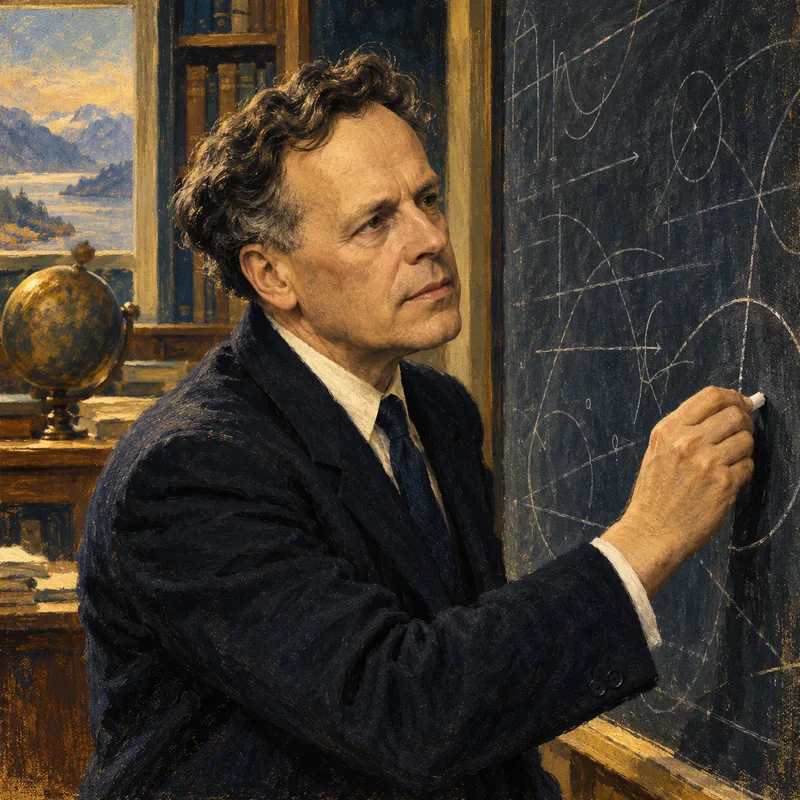
About the chemist
Lars Onsager
1903-1976 · United States · Nobel Chemistry 1968
Reciprocal relations in irreversible processes