The discovery, explained · Chemist no. 139 of 350
Lars Onsager and the Reciprocal Relations: Bringing Order to Irreversible Processes

Classical thermodynamics, as you study it in Class 12 and B.Sc., describes systems at equilibrium. But the real world is full of processes that happen irreversibly: heat flows from hot to cold, ions migrate in an electric field, solutes diffuse. Is there any law that governs these flows? In 1931 the Norwegian-born chemist Lars Onsager found one: the Onsager reciprocal relations. They state that when two flows are coupled, the effect of force 1 on flow 2 equals the effect of force 2 on flow 1. For this discovery, Onsager received the 1968 Nobel Prize in Chemistry. He also improved the Debye-Hückel theory to explain the conductivity of electrolytes, and he solved the two-dimensional Ising model exactly.
The Scientific Problem Before the Discovery
By 1900, equilibrium thermodynamics was complete, but the thermodynamics of non-equilibrium processes was not. Individual laws existed for single flows: Fourier's law for heat conduction, Fick's law for diffusion, Ohm's law for electric current. But experiments showed coupled phenomena. A temperature difference can drive an electric current (thermoelectric Seebeck effect), and a current can create a temperature difference (Peltier effect). William Thomson (Lord Kelvin) had noticed a symmetry between them in the nineteenth century, using a heuristic argument that was not fully justified. A general proof was needed.
A second problem was the theory of strong electrolytes. The Debye-Hückel theory (1923) explained activity coefficients with the ionic atmosphere, but it did not accurately explain how the molar conductivity of strong electrolytes varies with concentration, as described empirically by Kohlrausch: Λm = Λm° − K√c.
The Discovery: Step by Step
- Debye-Hückel conductance (1926-27). As a young engineer-chemist, Onsager noticed a mathematical flaw in Debye and Hückel's treatment of ions: they ignored Brownian motion in calculating how the ionic atmosphere relaxes when an ion moves. By including it, Onsager obtained the correct limiting law for conductivity.
- Microscopic reversibility. Onsager assumed that at the molecular level the equations of motion are symmetric under time reversal. So fluctuations of a quantity about equilibrium are statistically the same going forward and backward in time.
- Linear laws for flows. Near equilibrium, each flux J is a linear function of all the thermodynamic forces X:
J_i = Σ_j L_ij X_j. - Reciprocal relations (1931). Using microscopic reversibility and the regression of fluctuations, Onsager proved that the matrix of coefficients is symmetric,
L_ij = L_ji. He published the result in two papers in Physical Review in 1931.
The Chemistry Behind It
The central quantities of irreversible thermodynamics are:
- Fluxes J_i: heat flow, particle flow, electric current.
- Forces X_i: gradients of temperature (as −∇T/T), of chemical potential (as −∇μ/T) or electric potential.
- Entropy production:
σ = Σ J_i X_i ≥ 0, which is the second law applied to a continuous process.
For two coupled processes:
J₁ = L₁₁ X₁ + L₁₂ X₂
J₂ = L₂₁ X₁ + L₂₂ X₂
Onsager:  L₁₂ = L₂₁
The diagonal coefficients L₁₁ and L₂₂ describe ordinary conduction, and must be positive (to keep σ ≥ 0). The off-diagonal coefficients describe cross effects, such as thermodiffusion (the Soret effect) or the thermoelectric effects. The relation L₁₂ = L₂₁ reduces the number of independent coefficients that must be measured, and links the Seebeck and Peltier coefficients by the Kelvin relation Π = T·S.
Debye-Hückel-Onsager equation. For a strong electrolyte at low concentration:
Λm = Λm° − (A + B·Λm°) √c
Here A arises from the electrophoretic effect, where the ionic atmosphere of opposite charge moves in the opposite direction and drags the solvent, and B from the relaxation (asymmetry) effect, where the atmosphere takes finite time to rebuild around a moving ion, so it lags behind and exerts a retarding pull. Onsager's theory gave A and B in terms of the dielectric constant, viscosity, temperature and ion charges, and confirmed the empirical Kohlrausch law as a limiting form. He also explained the Wien effect (conductivity rises at very high fields because ions escape their atmosphere) and, with Fuoss, the behaviour of weak electrolytes (the second Wien effect and dissociation field effect). The Debye-Falkenhagen effect, increase of conductivity at very high frequencies, follows from the same ionic-atmosphere model.
Other landmark. In 1944 Onsager gave the exact solution of the two-dimensional Ising model of ferromagnetism, proving mathematically that a phase transition appears in a statistical model with only short-range interactions, with a heat capacity that diverges logarithmically at the critical temperature. He also predicted the quantisation of circulation in superfluid helium (1949), later developed by Feynman.
Applications Today
- Thermoelectric devices. Peltier coolers and thermoelectric generators use the coupling between heat and electric current, designed with the help of reciprocal relations.
- Membrane transport and biology. Coupled flows of ions, water and solutes across membranes and nerve cells are modelled with Onsager coefficients.
- Electrochemistry and batteries. Conductivity of electrolytes, ionic liquids and battery electrolytes starts from Debye-Hückel-Onsager theory.
- Chemical engineering. Cross diffusion in multicomponent mixtures, thermal diffusion for isotope separation, and electro-osmosis in micro-channels.
- Materials physics. The Ising model is the standard model of phase transitions and underlies simulations of alloys, magnets and even neural networks.
Exam Corner
- Onsager reciprocal relations: J_i = Σ L_ij X_j with L_ij = L_ji, based on microscopic reversibility.
- Entropy production σ = Σ J_i X_i ≥ 0; applies near equilibrium (linear regime).
- Debye-Hückel-Onsager: Λm = Λm° − (A + BΛm°)√c, with electrophoretic and relaxation effects.
- Wien effect: conductivity increases at very high field strength; Debye-Falkenhagen effect at high frequency.
- 1968 Nobel Prize in Chemistry (awarded to Onsager alone) for the reciprocal relations.
Common Misconceptions
- "Onsager relations apply to any far-from-equilibrium process." They hold only in the linear regime near equilibrium.
- "L₁₂ = L₂₁ means the two forces are equal." It means the coupling coefficients are equal, not the forces or fluxes.
- "Onsager won a Nobel Prize in Physics for the Ising model." His Nobel Prize was in Chemistry, for the reciprocal relations.
Quick Revision Box
- Reciprocal relations (1931): L_ij = L_ji for linear flux-force laws.
- Based on microscopic reversibility and fluctuation regression.
- Entropy production is always non-negative: σ = Σ J_i X_i ≥ 0.
- Electrolytes: Λm = Λm° − (A + BΛm°)√c.
- Exact 2D Ising solution in 1944.
- Nobel Prize in Chemistry 1968, awarded to Onsager alone.
FAQ
What do the Onsager relations say in simple words?
If a temperature difference can push a current, then a voltage can push heat in an equally strong, symmetric way, measured by equal cross coefficients.
Why are they important?
They reduce the number of independent measurements needed and provide a general basis for non-equilibrium thermodynamics.
What are the electrophoretic and relaxation effects?
The first is drag from the oppositely moving ionic atmosphere carrying solvent; the second is the retarding force due to the delayed rebuilding of the atmosphere around a moving ion.
Was Onsager's Nobel Prize in Physics?
No. It was in Chemistry, in 1968.
Published by ABC Chemistry — IIT-JAM | CSIR-NET | GATE Chemistry Coaching. Visit abcchemistry.com
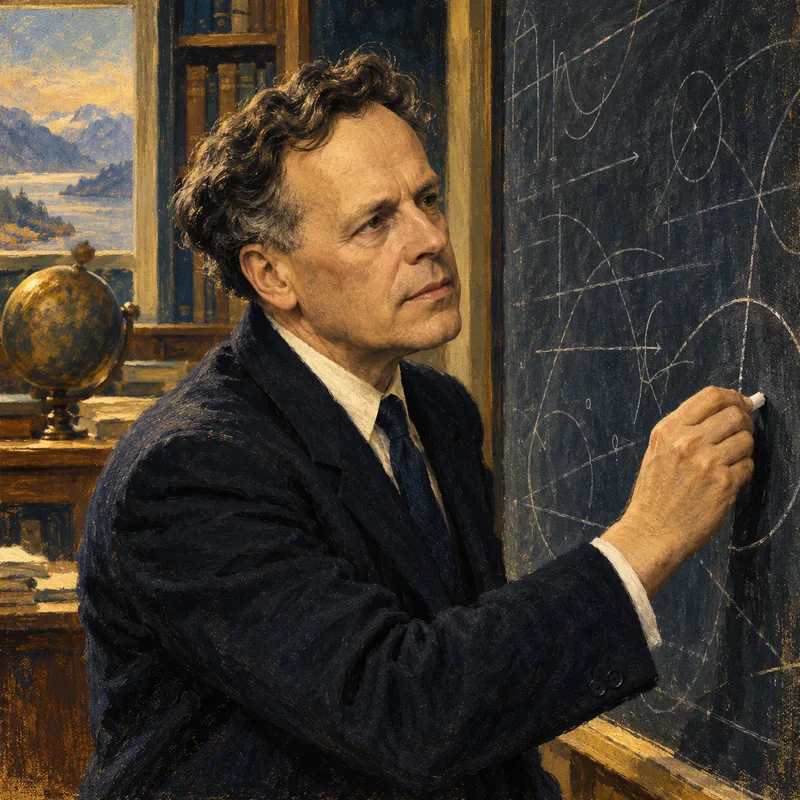
About the chemist
Lars Onsager
1903-1976 · United States · Nobel Chemistry 1968
Reciprocal relations in irreversible processes