Biography · Chemist no. 268 of 350
Paul-Émile Lecoq de Boisbaudran (1838–1912): Master of the Spectroscope
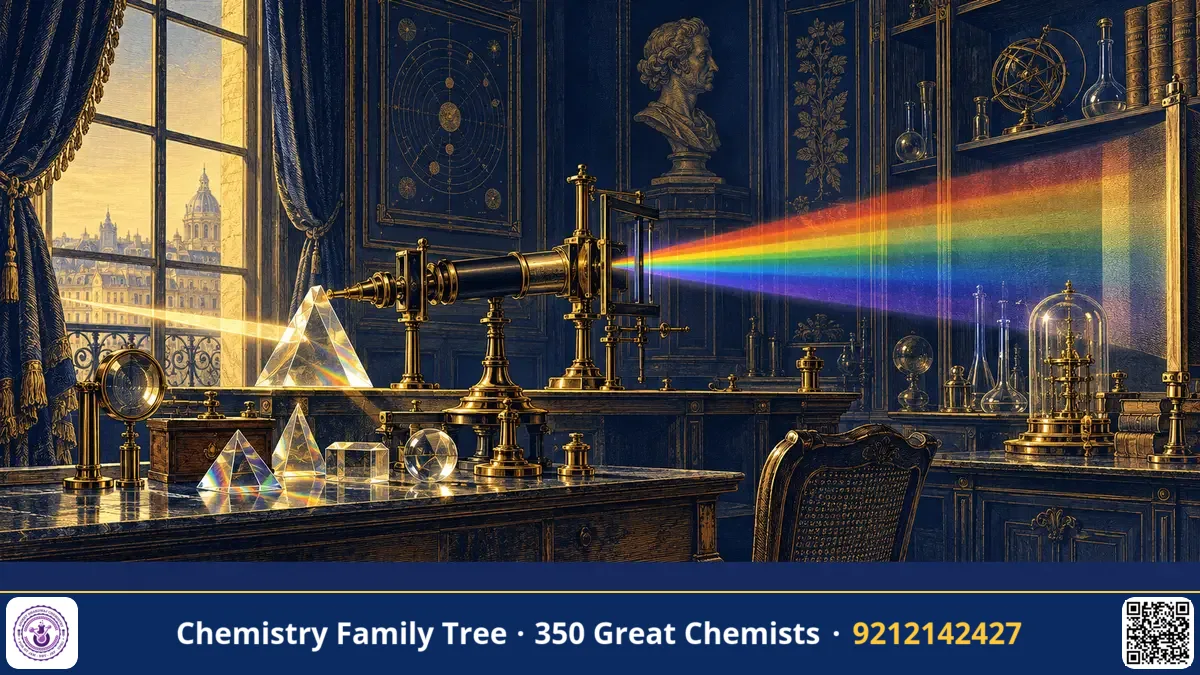
Paul-Émile Lecoq de Boisbaudran, usually called François or "Lecoq", was a French chemist who built his scientific career largely in a private laboratory. He discovered three elements: gallium (1875), samarium (1879) and dysprosium (1886). His life shows what a patient, skilled experimenter can achieve using one powerful tool, the spectroscope, and the story of gallium is one of the great episodes in the history of the periodic table.
Early Life and Family
He was born on 18 April 1838 in Cognac, France, a town famous for its brandy. His family belonged to the Protestant (Huguenot) minority and owned a wine and brandy trading business, with a landed family background that allowed him some independence. The family had the means to support his early scientific interests. The family laboratory in Cognac was the place where he built his early apparatus.
Education and Mentors
He was largely self-taught in chemistry and physics, learning more from reading and experiment than from formal degrees. He continued to carry out research in a private laboratory at Cognac, where he concentrated on spectroscopy. The pioneering work of Bunsen and Kirchhoff (1860) was his inspiration, and he developed his own methods of producing spark spectra from solutions, and made careful measurements of wavelengths of lines.
Career Timeline
| Year | Event |
|---|---|
| 1838 | Born in Cognac, France (18 April). |
| 1860s | Begins serious spectroscopic study in a private laboratory. |
| 1875 | Discovers gallium in zinc blende from the Pyrenees. |
| 1879 | Isolates samarium from the mineral samarskite. |
| 1886 | Announces dysprosium, separated from holmium material. |
| 1890s | Continues work on rare earths, fluorescence and the theory of spectra. |
| 1912 | Dies in Paris (28 May). |
Major Scientific Contributions
Gallium (1875). Using spark spectroscopy, he detected a violet line in a zinc ore, then isolated the metal by electrolysis. It matched Mendeleev's eka-aluminium. Read our discovery blog for the full story, including the density dispute where Mendeleev's prediction corrected the experimenter.
Samarium (1879). From the mineral samarskite (named after Colonel Vasili Samarsky-Bykhovets, a Russian mining official), Lecoq de Boisbaudran separated a new rare earth, which he named samarium. It was the first element named, indirectly, after a person. Samarium has the electronic configuration [Xe] 4f⁶ 6s² and is now used in samarium–cobalt (SmCo₅) permanent magnets, which are strong and heat resistant.
Dysprosium (1886). By repeatedly precipitating holmium oxide fractions with ammonia, an enormous labour of 30 or more steps, he showed that the material contained another element. He named it dysprosium from the Greek dysprositos, meaning "hard to get". Dysprosium is used in strong neodymium magnets for wind turbines and electric vehicles, and in nuclear control materials.
Spectroscopy and rare earths. He also studied the fluorescence of rare earth compounds, and made progress in crystal growth, including supersaturated solutions, to a good level for his time.
Ln³⁺ salts: separated by fractional precipitation / crystallisation
e.g. Dy(OH)₃ ↓ from NH₃ solution; repeated hundreds of cycles
Awards, Honours and Nobel Prize
He received recognition from leading scientific bodies for the discovery of gallium and for his spectroscopic work. He did not receive a Nobel Prize; the prizes began in 1901, when he was in his sixties and past his major discoveries.
Personality, Struggles and Lesser-Known Facts
- Private scientist. He worked mostly alone in his own laboratory, without a university position, and relied on his own funds.
- The rooster legend. "Le coq" means rooster in French, and "gallus" in Latin means both rooster and a Gaul. Critics suggested he named gallium in a hidden tribute to himself; he said the name honoured France.
- Careful about credit. Rare earth chemistry was a crowded field, with several chemists claiming overlapping discoveries, so recording who found what and when mattered a great deal.
- Corrected by a prediction. When Mendeleev told him the density of gallium should be about 5.9 and not 4.7, he re-checked with a purer sample, and said openly that the measurement had been wrong.
- Extreme labour. To obtain the first gram of gallium he processed a very large mass of ore, as the element is present only in traces.
Legacy and Influence on Modern Chemistry
Gallium became central to modern electronics through GaAs and GaN. Samarium and dysprosium are important in high-performance magnets, lasers, data storage and nuclear technology. His discovery of gallium strengthened the acceptance of the periodic law, and with scandium (Nilson, 1879) and germanium (Winkler, 1886), made the table a predictive tool. India has large reserves of monazite sands containing rare earths in Kerala and Odisha, so these elements matter in Indian research and industry.
Lessons for Students
- One good instrument, used with great care, can open a field.
- Repeat measurements, and trust the data even when theory disagrees; also be ready to repeat when theory says your sample may be impure.
- Separation of similar elements (like lanthanides) takes patience, and it explains why ion exchange later became so important.
- Great science is possible outside big institutions.
Quick Facts
- Born: 18 April 1838, Cognac, France.
- Died: 28 May 1912, Paris, France.
- Nationality: French.
- Field: Spectroscopy, inorganic chemistry, rare earths.
- Famous for: Discovery of gallium, samarium and dysprosium.
- Nobel Prize: None.
FAQ
Which elements did Lecoq de Boisbaudran discover?
Gallium (1875), samarium (1879) and dysprosium (1886).
Why is dysprosium named so?
From Greek dysprositos, "hard to get", because it was so difficult to separate from holmium.
What tool did he use most?
The spectroscope, used with electric spark excitation of solutions.
Did he get a Nobel Prize?
No. The first Nobel Prizes were awarded in 1901, long after his main discoveries.
Published by ABC Chemistry — IIT-JAM | CSIR-NET | GATE Chemistry Coaching. Visit abcchemistry.com
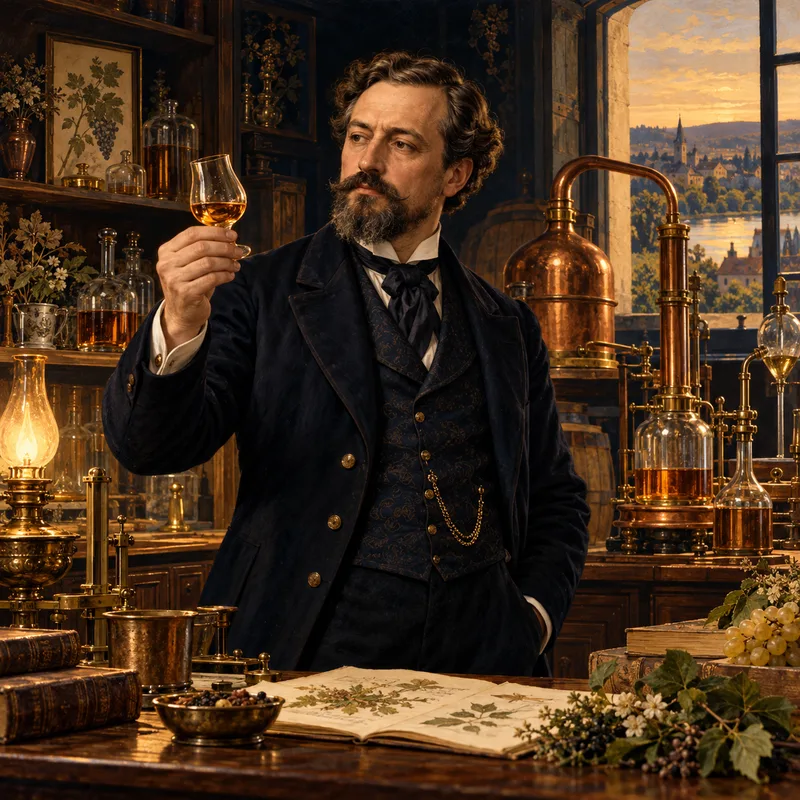
About the chemist
Paul-Émile Lecoq de Boisbaudran
1838-1912 · France
Discovered gallium, samarium, dysprosium