The discovery, explained · Chemist no. 268 of 350
Lecoq de Boisbaudran and the Discovery of Gallium: A Metal That Melts in Your Hand
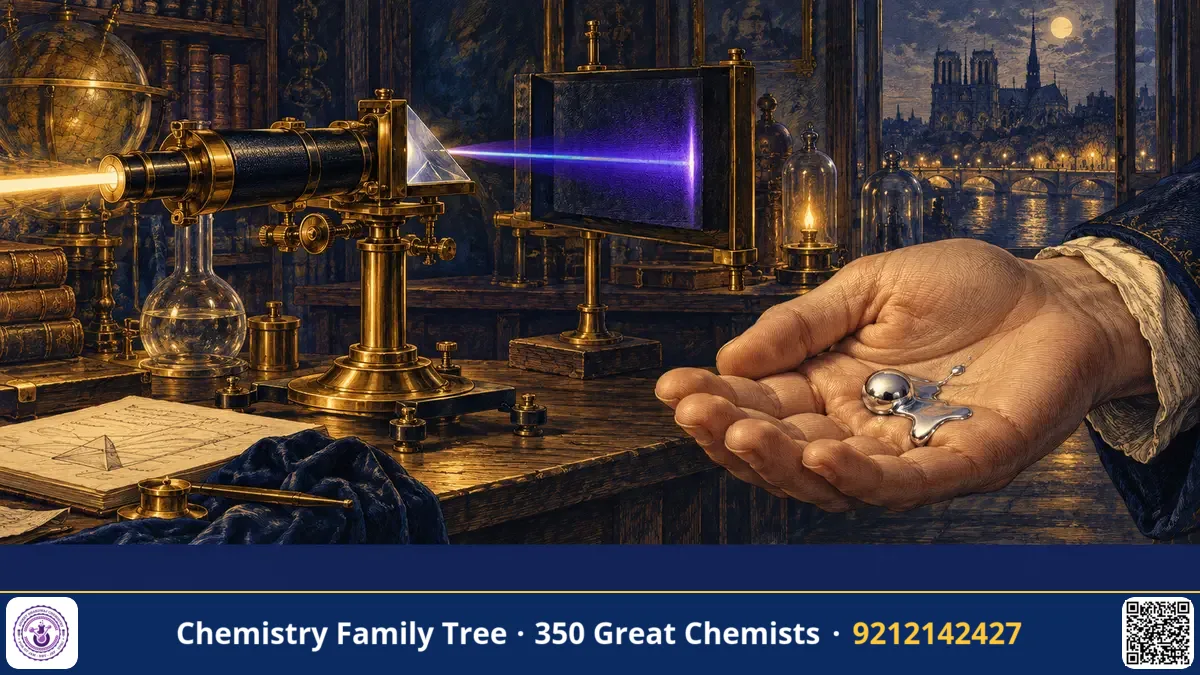
In August 1875, in a Paris laboratory, the French chemist Paul-Émile Lecoq de Boisbaudran looked through a spectroscope at a sample made from a zinc ore. He saw a faint violet line that no known element could produce. Within weeks he had separated a tiny amount of a new metal, which he named gallium (Ga, atomic number 31). It is soft, silvery and so low-melting that it turns to liquid at about 29.8 °C, just above room temperature. Gallium was the first element predicted by Mendeleev (as eka-aluminium) to be discovered, and it gave the periodic law its first dramatic proof.
The Scientific Problem Before the Discovery
Two scientific stories meet in this discovery. The first is spectroscopy. In 1860–61, Robert Bunsen and Gustav Kirchhoff showed that every element, when heated in a flame, emits light of characteristic wavelengths. This gave chemists a new "fingerprint" test that could detect tiny quantities. It led to the discovery of caesium and rubidium (1860–61), thallium (1861) and indium (1863).
The second story is the periodic table. Mendeleev (1869–71) left a gap under aluminium and predicted an element he called eka-aluminium, with an atomic mass of about 68, a low melting point, and a density of about 5.9 g/cm³. At that time, many chemists doubted such predictions. Lecoq de Boisbaudran, who had spent years studying the spectra of elements, was well prepared to find new ones, but he did not discover gallium because of Mendeleev. He found it because of his own spectroscopic skill.
The Discovery: Step by Step
Lecoq de Boisbaudran had been examining zinc blende (sphalerite, ZnS) from the mine at Pierrefitte in the Pyrenees. He suspected that such ores might contain unknown elements.
- Spark spectroscopy: On 27 August 1875 he applied an electric spark to a solution of the zinc ore sample and observed a new violet line at about 417 nm, with a second fainter line.
- Chemical enrichment: He dissolved a large amount of ore (hundreds of kilograms were eventually processed) and used the differences in the solubility of hydroxides and sulfides to concentrate the unknown element away from zinc.
- Electrolysis: He dissolved the gallium hydroxide in potassium hydroxide solution and electrolysed it. Metallic gallium was deposited on the cathode.
- Characterisation: A few days later he had about 0.1 g of the metal and measured the density and other properties.
Ga(OH)₃ + OH⁻ → [Ga(OH)₄]⁻          (dissolution in alkali)
[Ga(OH)₄]⁻ + 3e⁻ → Ga + 4OH⁻         (cathode)
He named the element after "Gallia", the Latin name of France. Some people suggested that the name was also a play on his own name, since "Lecoq" means "the rooster" and "gallus" is Latin for rooster. Lecoq de Boisbaudran denied this, but the joke has remained part of the story.
The famous density dispute. After the announcement, Mendeleev wrote to the Paris Academy of Sciences, pointing out that gallium was his eka-aluminium and that its density should be about 5.9 g/cm³ rather than the 4.7 g/cm³ Lecoq de Boisbaudran had first reported. Lecoq de Boisbaudran repeated the measurement with a purer sample and found 5.9 g/cm³, which is close to the modern value of 5.91. He had been the only person in possession of the metal, and the theoretical prediction corrected his own experiment. This was a powerful moment for the periodic law.
The Chemistry Behind It
Gallium is in Group 13 below aluminium. Its electronic configuration is [Ar] 3d¹⁰ 4s² 4p¹. Important points:
- Oxidation states: +3 is common. +1 is more stable than for aluminium because of the inert pair effect, though Ga(+1) is still not very stable in water.
- Amphoteric behaviour: Like aluminium, Ga₂O₃ and Ga(OH)₃ dissolve in both acids and strong bases.
- Low melting point: Melting point 29.76 °C, but boiling point about 2400 °C. The liquid range is among the longest of any element. The low melting point arises from the weak, partly molecular-like bonding in the solid, which contains Ga₂ pairs.
- Expands on freezing: Like water, gallium expands (about 3%) on solidifying.
- Halides: GaCl₃ is a Lewis acid, similar to AlCl₃, and exists as a dimer Ga₂Cl₆ in the vapour phase.
2Ga + 6HCl → 2GaCl₃ + 3H₂
2Ga + 2NaOH + 6H₂O → 2Na[Ga(OH)₄] + 3H₂
Applications Today
- Semiconductors: Gallium arsenide (GaAs) and gallium nitride (GaN) are III–V semiconductors with direct band gaps.
- LEDs: GaN-based blue LEDs led to white LED lighting and were recognised with the 2014 Nobel Prize in Physics (Akasaki, Amano, Nakamura). This lighting saves energy across India.
- Mobile phones and solar cells: GaAs is used in high-frequency chips and high-efficiency solar cells for satellites.
- Medicine: Radioactive gallium-67 and gallium-68 are used in imaging; gallium nitrate has been used to treat high blood calcium.
- High-temperature thermometers and alloys: Gallium is used in liquid-metal alloys such as galinstan (Ga–In–Sn), which replaces mercury in some thermometers.
Exam Corner
- Gallium (Ga, Z = 31) was discovered by Lecoq de Boisbaudran in 1875 using spectroscopy; it is Mendeleev's eka-aluminium.
- Its melting point (29.8 °C) is low, so it melts in the palm. It expands on freezing.
- Ga(OH)₃ is amphoteric; Ga₂O₃ dissolves in NaOH to give gallate ions.
- GaAs and GaN are III–V semiconductors; GaAs has a direct band gap of about 1.4 eV.
- Anomalous trend in Group 13: gallium's atomic radius is almost the same as aluminium's because of poor shielding by the 3d electrons (d-block contraction).
Common Misconceptions
- "Mendeleev discovered gallium." No. Mendeleev predicted it. Lecoq de Boisbaudran discovered it independently using spectroscopy.
- "Gallium melts like mercury at room temperature." Its melting point is 29.8 °C, so on a cool day it is a solid; it melts when warmed by hand.
- "Gallium is a harmless replacement for mercury in all uses." It is far less toxic, but it can attack aluminium and other metals badly (it embrittles aluminium alloys).
Quick Revision Box
- Gallium, Ga, Z = 31, Group 13, Period 4.
- Discovered in 1875 by Lecoq de Boisbaudran, Paris, from zinc blende.
- Identified by a violet spectral line near 417 nm; isolated by electrolysis in KOH.
- Mendeleev's eka-aluminium; density about 5.9 g/cm³.
- Melting point 29.76 °C; boiling point about 2400 °C.
- Uses: GaAs, GaN, LEDs, solar cells, galinstan.
FAQ
Why is it called gallium?
The name comes from Gallia, the Latin name for France, the home country of the discoverer.
How was gallium detected before it was seen as a metal?
Its characteristic violet emission line in the spark spectrum of a zinc ore solution signalled a new element.
Why does gallium melt so easily?
Solid gallium has a complicated structure with Ga₂ units held together weakly in the crystal, so little energy is required to break the lattice.
Is gallium important in JAM, NET and GATE?
Yes. Questions appear on Group 13 trends, amphoterism, III–V semiconductors and the periodic law, so know these topics well.
Published by ABC Chemistry — IIT-JAM | CSIR-NET | GATE Chemistry Coaching. Visit abcchemistry.com
About the chemist
Paul-Émile Lecoq de Boisbaudran
1838-1912 · France
Discovered gallium, samarium, dysprosium