Biography · Chemist no. 78 of 350
Leo Baekeland: The Chemist-Entrepreneur Who Started the Plastic Age
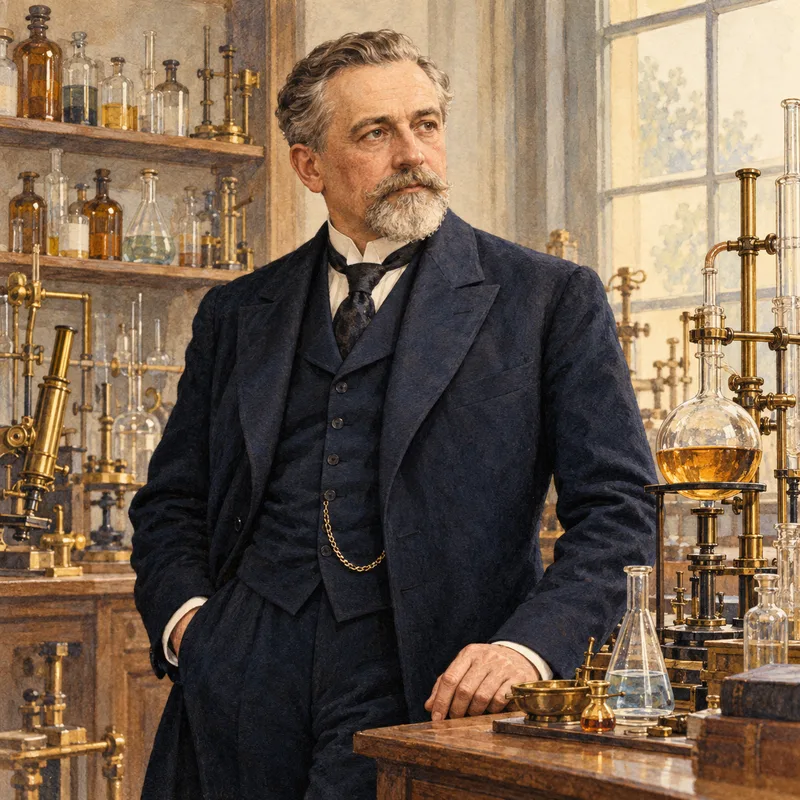
Leo Hendrik Baekeland (1863-1944) was a Belgian-American chemist and inventor who created Velox, the first practical photographic paper that could be developed in artificial light, and Bakelite, the first fully synthetic plastic. He is often called the father of the plastics industry. His legacy in one line: he showed that a chemist could invent a new material from scratch and build an industry around it.
Early Life and Family
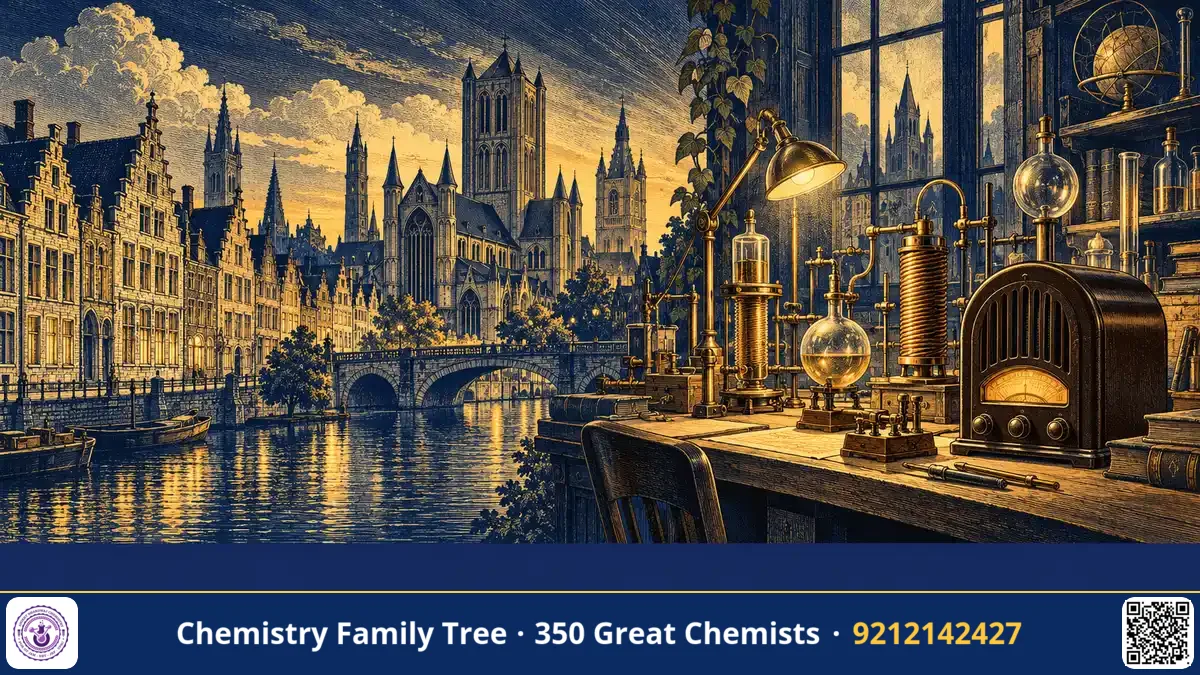
Leo Baekeland was born on 14 November 1863 in Ghent, Belgium. His father was a cobbler and his mother, Rosalie Merchie, had worked as a house servant. The family was not rich, and his father, who had little education, wanted Leo to become a cobbler also. But his mother pushed him to study, and Leo showed excellent ability in school. He attended evening classes at the municipal technical school, which gave him a start in science, and won a scholarship to university.
Education and Mentors
Baekeland studied chemistry at the University of Ghent, where he received his doctorate in 1884 with great distinction at the age of 21. His professor was Theodore Swarts, a well-known organic chemist, and later Baekeland married the professor's daughter, Céline Swarts, in 1889. He also taught for a short time in Bruges and then at Ghent as an associate professor. In 1887 he won a travelling scholarship, which took him to universities in England, Scotland and the United States. During a visit to New York in 1889, he decided to stay in America, where he saw better opportunities for a chemist with an inventive mind.
Career Timeline
| Year | Event |
|---|---|
| 1863 | Born in Ghent, Belgium |
| 1884 | Doctorate at the University of Ghent |
| 1889 | Marries Céline Swarts and moves to the United States |
| 1893 | Starts the Nepera Chemical Company, Yonkers, New York |
| 1899 | Sells Velox rights to Eastman Kodak |
| 1907 | Files patent for Bakelite (phenol-formaldehyde resin) |
| 1909 | Announces Bakelite to the American Chemical Society |
| 1910 | Founds the General Bakelite Company |
| 1924 | Appears on the cover of Time magazine |
| 1939 | Bakelite Corporation merges into Union Carbide; he retires |
| 1944 | Dies in Beacon, New York |
Major Scientific Contributions
Baekeland's first great invention, Velox, was a photographic paper that could be printed under artificial light instead of sunlight, making photography easier for amateurs and professionals. In 1899, he sold the invention to George Eastman for a very large sum, reported to be $750,000. With this money he set up a private laboratory in his house in Yonkers and began a search for a synthetic replacement for shellac. This led to Bakelite in 1907. He also developed the Bakelizer, the high-pressure vessel needed to cure the resin, and studied electrochemical processes, including improvements in the electrolytic production of chemicals. The detailed reactions are explained in our discovery post.
Awards, Honours and Nobel Prize
- He did not receive a Nobel Prize, but he received many other honours.
- Perkin Medal of the Society of Chemical Industry, American Section (1916).
- Willard Gibbs Medal (1913) and the Franklin Medal (1940).
- President of the American Chemical Society (1924-1925).
- Member of the National Academy of Sciences.
- In 1993 the American Chemical Society named the Bakelite process a National Historic Chemical Landmark.
Personality, Struggles and Lesser-Known Facts
- From cobbler's son to millionaire: His story is one of the best examples of social mobility through education and hard work.
- Personal notebooks: He kept detailed diaries throughout his life, which later helped historians to follow his thinking.
- Home laboratory: His private laboratory at his estate "Snug Rock" in Yonkers allowed him to work independently, free from the pressure of company schedules.
- Strong business sense: He protected his patents carefully, and made sure that Bakelite was marketed as the "material of a thousand uses".
- Difficult later years: Late in life, he became more withdrawn and, according to some biographers, difficult with his family and business partners. His son George Washington Baekeland did not take over the company as he had hoped.
- Competition: He was in a race with other chemists, such as James Swinburne in Britain, who also worked on phenol-formaldehyde resins, and he filed his patent just in time.
Legacy and Influence on Modern Chemistry
Bakelite opened the way to all later synthetic plastics, from polystyrene and PVC to nylon and polyethylene. It introduced the idea of the thermosetting polymer, which is still essential in electronics, aerospace composites and adhesives. Phenolic resins are still produced in large quantities. Hermann Staudinger's concept of the macromolecule gave the theoretical explanation of what Baekeland had made empirically. In India, Bakelite is the standard example of a thermosetting polymer in Class 12 chemistry, and questions on its monomers and structure appear often in board and entrance examinations.
Lessons for Students
- Education can change your life, whatever your background.
- Study failures and nuisances carefully; they may hold a hidden opportunity.
- Control the variables one at a time, such as temperature, pressure and catalyst.
- Combine scientific knowledge with practical skills and business thinking.
Quick Facts Box
- Born: 14 November 1863, Ghent, Belgium
- Died: 23 February 1944, Beacon, New York, USA
- Nationality: Belgian-American
- Field: Industrial and polymer chemistry
- Famous for: Bakelite; Velox photographic paper
- Nobel: None
FAQ
What was the first synthetic plastic?
Bakelite, made from phenol and formaldehyde and introduced by Baekeland in 1907, is considered the first fully synthetic plastic.
What was Velox?
A photographic printing paper that could be developed under artificial light, which Baekeland sold to Eastman Kodak in 1899.
Why is it called Bakelite?
The name comes from his surname, Baekeland.
Did Baekeland win a Nobel Prize?
No, but he received many other honours, including the Perkin Medal and the presidency of the American Chemical Society.
Published by ABC Chemistry — IIT-JAM | CSIR-NET | GATE Chemistry Coaching. Visit abcchemistry.com
About the chemist
Leo Baekeland
1863-1944 · Belgium/United States
Bakelite, first synthetic plastic