The discovery, explained · Chemist no. 78 of 350
Leo Baekeland and Bakelite: The Birth of Synthetic Plastics
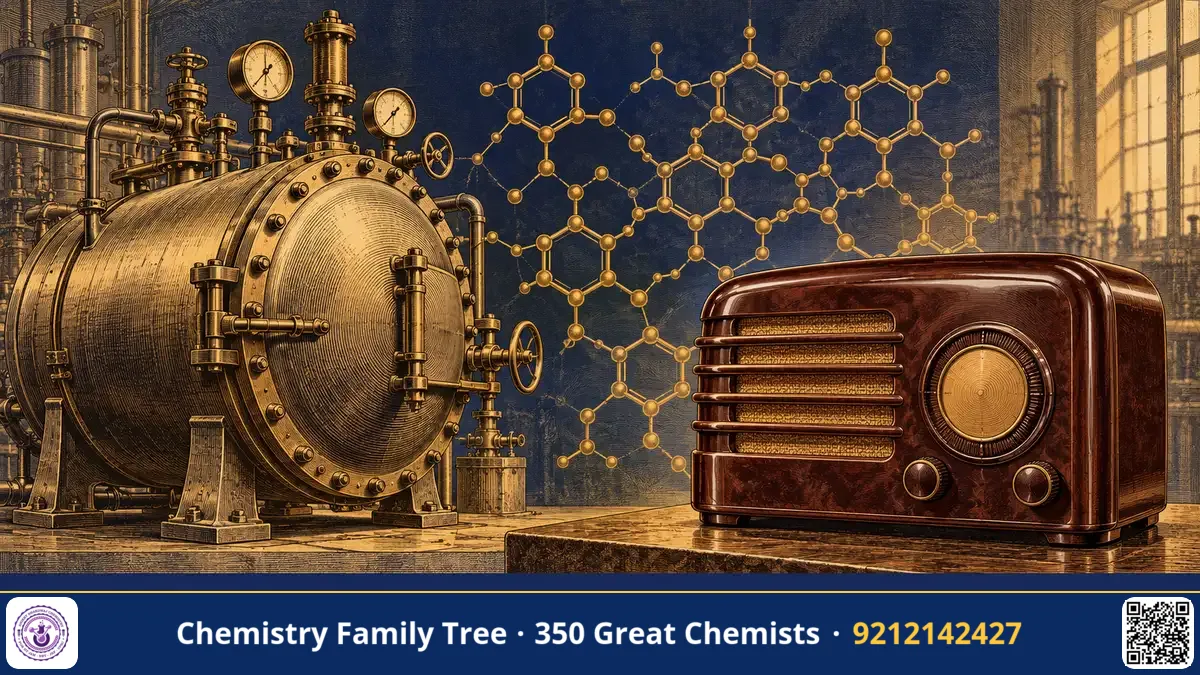
Look at the old black switch on a wall, the handle of a pressure cooker, or the body of an electric plug. Many of them are made of a hard, shiny, brown or black material that does not melt, does not conduct electricity and does not burn easily. This material is Bakelite, the world's first fully synthetic plastic, invented in 1907 by the Belgian-American chemist Leo Hendrik Baekeland. He made it by reacting two simple chemicals, phenol and formaldehyde, under heat and pressure. Before Bakelite, plastics were modified natural materials like celluloid. After Bakelite, chemists knew that they could design entirely new materials in the laboratory. It marked the start of the Plastic Age.
The Scientific Problem Before the Discovery
At the beginning of the twentieth century, the electrical industry was growing fast, and it needed insulating materials. The best natural insulator was shellac, a resin produced by lac insects in India and Southeast Asia, which was expensive and limited in supply. Celluloid, made from cellulose nitrate and camphor, was available but is flammable and softens on heating.
Chemists had known for decades that phenol and formaldehyde react to give a hard, insoluble resinous mass. In 1872 Adolf von Baeyer observed such a product, and others also reported it. But the material was regarded as a nuisance, since it made glassware dirty and was impossible to dissolve or mould. The product was uncontrollable: it could form bubbles and cracks, and no one could use it to make useful objects. Baekeland's task was to control the reaction.
The Discovery: Step-by-Step
- A fortune and a free mind. Baekeland had earlier invented Velox photographic paper, which he sold to Eastman Kodak in 1899. This made him financially independent and let him pursue a new project in his private laboratory at his home in Yonkers, New York.
- Systematic study. He studied the effect of temperature, pressure, catalyst (acid or base) and the ratio of phenol to formaldehyde. He wanted to find conditions that would give a product which could be formed and then set hard.
- A pressure vessel. He found that applying both heat and pressure suppressed the bubbles of water vapour that spoiled the product. He built an iron pressure vessel called the "Bakelizer", resembling a large pressure cooker.
- Controlled stages. He discovered that the reaction could be stopped at an intermediate stage, a fusible and soluble resin that could be ground into powder, mixed with a filler like wood flour and then moulded under heat in a final stage into an infusible solid.
- Patent and production. He filed his main patent in 1907 and announced the material publicly in 1909. In 1910 he formed the General Bakelite Company.
The Chemistry Behind It
The reaction is an electrophilic aromatic substitution followed by condensation. Phenol is activated at its ortho and para positions by the –OH group. Formaldehyde, as its hydrate or protonated form, attacks these positions and gives hydroxymethylphenols:
C6H5OH + HCHO → o- and p-HOCH2–C6H4–OH
These intermediates then react with another phenol, eliminating water and creating methylene bridges (–CH2–) between rings:
HOCH2–C6H4–OH + C6H5OH → HO–C6H4–CH2–C6H4–OH + H2O
Repeated reactions create a three-dimensional network, because phenol has three reactive positions (two ortho and one para) and formaldehyde is difunctional. This is a cross-linked thermosetting polymer.
Two industrial routes exist:
- Resol route (base catalyst, excess formaldehyde): gives a resin with many hydroxymethyl groups. It cures by heat alone to the final network.
- Novolac route (acid catalyst, excess phenol): gives a linear, permanently fusible resin joined by methylene bridges. It needs a hardener such as hexamethylenetetramine (hexamine), which supplies extra formaldehyde-equivalents, to cure.
The stages are called A-stage (resol, soluble and fusible), B-stage (bakelite B, partly cross-linked, swells but does not dissolve) and C-stage (fully cured, infusible and insoluble). Once the C-stage is formed, the process cannot be reversed. This is the difference between thermosetting and thermoplastic polymers: thermoplastics soften on heating and can be remoulded, while thermosets, because of covalent cross-links, burn or decompose instead.
The properties follow the structure. The extensive cross-linking makes Bakelite hard, rigid and heat-resistant. There are no free ions or mobile electrons, so it is an excellent electrical insulator. The aromatic rings give good thermal stability.
Applications Today
- Electrical goods: Switches, sockets, plugs and insulating parts. In India, many older switchboards and electric meters used Bakelite.
- Cookware handles: Handles of pans and pressure cookers, because Bakelite resists heat.
- Automotive and industrial: Brake linings, clutch facings and distributor caps use phenolic resins.
- Laminates: Sunmica-type decorative laminates and printed circuit board substrates use paper or cloth impregnated with phenolic resins.
- Foundry and abrasives: Phenolic resin binders in sand moulds, grinding wheels and plywood adhesives.
- Collectibles: Old radios, telephones and jewellery of Bakelite are valued by collectors.
Exam Corner
- Bakelite is made from phenol and formaldehyde (methanal); it is a thermosetting, cross-linked polymer.
- Novolac is formed with acid catalyst and excess phenol; resol with base catalyst and excess formaldehyde.
- Hexamethylenetetramine is used to cure novolac.
- Thermosetting polymers cannot be remoulded; thermoplastics can.
- Bakelite is a condensation polymer, as water is lost during the formation of –CH2– bridges.
Common Misconceptions
- "Bakelite is a natural resin." It is fully synthetic.
- "Bakelite can be melted and reshaped like polythene." It cannot; the cross-links are permanent.
- "Baekeland discovered the reaction of phenol and formaldehyde." Earlier chemists, including Baeyer, had observed it. Baekeland's achievement was control and commercial use.
Quick Revision Box
- Bakelite: phenol + formaldehyde, 1907, first fully synthetic plastic.
- Made under heat and pressure in a "Bakelizer".
- Methylene bridges (–CH2–) form a 3D network.
- Resol (base) and novolac (acid) routes.
- Thermosetting, insulating, heat resistant.
- Condensation polymer (loses H2O).
FAQ
Why is Bakelite a good electrical insulator?
Its covalently bonded network has no free electrons or mobile ions, so it does not conduct electricity.
What is a thermosetting polymer?
A polymer that becomes permanently hard on heating because of cross-linking and cannot be softened again.
What is the role of formaldehyde?
It provides the methylene (–CH2–) links that connect phenol rings.
Why did Baekeland use pressure?
Pressure keeps water formed in the reaction from forming vapour bubbles, giving a dense and uniform product.
Published by ABC Chemistry — IIT-JAM | CSIR-NET | GATE Chemistry Coaching. Visit abcchemistry.com
About the chemist
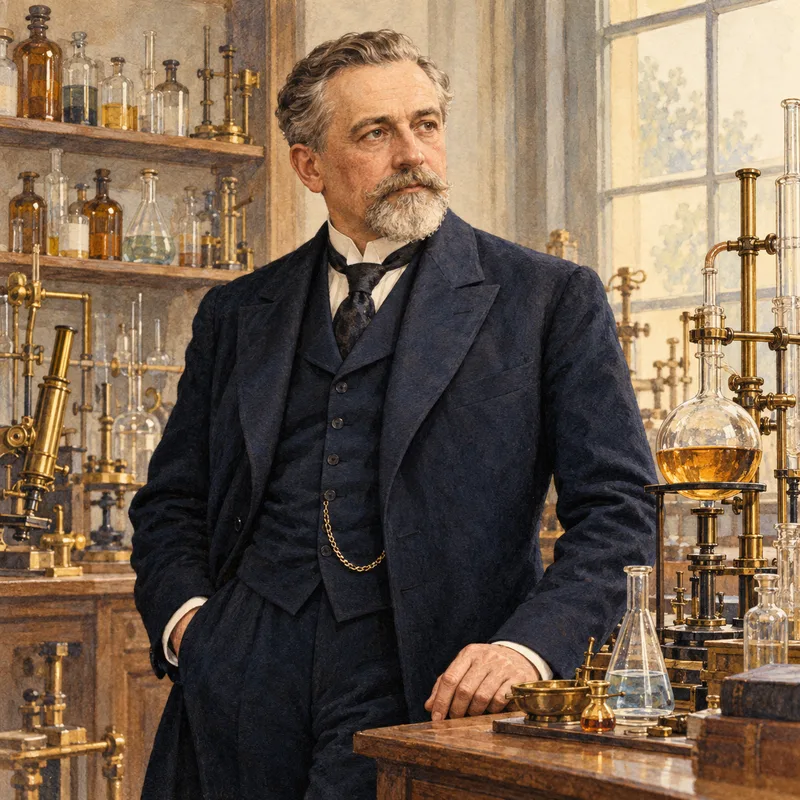
Leo Baekeland
1863-1944 · Belgium/United States
Bakelite, first synthetic plastic