Biography · Chemist no. 5 of 350
Linus Pauling: The Life of the Scientist Who Won Two Unshared Nobel Prizes
Linus Carl Pauling (1901-1994) was an American chemist, biochemist and peace activist. He explained how atoms bond, how proteins fold into helices and how a tiny molecular change in haemoglobin can cause a disease. He is the only person to have received two unshared Nobel Prizes, one in Chemistry (1954) and one for Peace (1962). His legacy in one line: he made the chemical bond understandable through quantum mechanics and used his fame to speak against nuclear weapons.
Early Life and Family
Pauling was born on 28 February 1901 in Portland, Oregon, USA. His father, Herman Pauling, was a pharmacist, and his mother was Lucy Isabelle (Darling) Pauling. The family moved among small towns in Oregon in search of work. When Linus was nine years old, his father died, and the family faced hard times. His mother took in boarders to make ends meet. As a boy, Linus was an eager reader and, inspired by a friend who had a small chemistry set, he built a chemistry laboratory at home with material gathered from an abandoned smelter. He did not complete the high-school requirements in time (he lacked a history credit) and, according to his own account, did not receive the diploma until decades later, in 1962, when the school finally gave him one.
Education and Mentors
- Oregon Agricultural College (now Oregon State University), where he studied chemical engineering, graduating in 1922. To support himself, he also taught chemistry classes there while a student. There he read Lewis's and Langmuir's papers on electron pairs and became interested in bonding.
- California Institute of Technology (Caltech), where he did his PhD in chemistry with a minor in physics and mathematics, graduating in 1925. His main supervisor was Roscoe Dickinson, an X-ray crystallographer, and his work was on the crystal structure of molybdenite (MoS₂).
- Europe, 1926-1927. With a Guggenheim Fellowship he worked with Arnold Sommerfeld in Munich and visited Niels Bohr in Copenhagen and Erwin Schrödinger in Zurich, learning the new quantum mechanics.
Career Timeline
| Year | Event |
|---|---|
| 1901 | Born in Portland, Oregon on 28 February |
| 1922 | Graduates from Oregon Agricultural College; begins graduate study at Caltech |
| 1923 | Marries Ava Helen Miller |
| 1925 | Receives PhD from Caltech |
| 1926-1927 | Studies in Europe on a Guggenheim Fellowship |
| 1927 | Becomes assistant professor at Caltech |
| 1931 | Publishes "The Nature of the Chemical Bond" in the Journal of the American Chemical Society |
| 1939 | Publishes the book The Nature of the Chemical Bond |
| 1949 | Co-authors the paper on sickle-cell anaemia as a molecular disease |
| 1951 | Proposes the alpha helix with Corey and Branson |
| 1954 | Receives the Nobel Prize in Chemistry |
| 1958 | Presents a petition against nuclear testing, signed by thousands of scientists, to the United Nations |
| 1962 | Awarded the Nobel Peace Prize (announced in 1963) |
| 1973 | Founds the Institute of Orthomolecular Medicine, later renamed the Linus Pauling Institute |
| 1994 | Dies at Big Sur, California on 19 August |
Major Scientific Contributions
The chemical bond. He used quantum mechanics to describe covalent bonding, introducing hybridisation, resonance and the electronegativity scale. These ideas, explained in our discovery post on Pauling, are used in every chemistry textbook.
Structure of crystals. His rules for ionic crystals (1929) helped chemists predict structures of minerals, and he determined many structures by X-ray diffraction.
Protein structure. The alpha helix and beta sheet explained how a long polypeptide chain folds with the help of hydrogen bonds. He also showed the peptide bond to be planar due to resonance.
Molecular disease. Using electrophoresis, Pauling and his team showed that sickle-cell haemoglobin has a different electric charge from normal haemoglobin, which linked a molecular change to a hereditary disease.
Other areas. He worked on the theory of anaesthesia, on antibodies and on molecular evolution (with Emile Zuckerkandl). He also wrote the popular textbook General Chemistry.
Awards, Honours and Nobel Prize
- Nobel Prize in Chemistry, 1954, "for his research into the nature of the chemical bond and its application to the elucidation of the structure of complex substances".
- Nobel Peace Prize, 1962, for his campaign against nuclear weapons testing. It was announced in October 1963, on the day that the Partial Test Ban Treaty came into force.
- Davy Medal of the Royal Society (1947), the Lenin Peace Prize (1970) and the US National Medal of Science (1974), among others.
- Foreign Member of the Royal Society (1948).
Personality, Struggles and Lesser-Known Facts
- A close partnership. His wife, Ava Helen Pauling, was an activist who strongly encouraged and shaped his peace work. They had four children.
- Passport trouble. In the early 1950s, in the Cold War climate, the US State Department refused to give him a passport for some time because of suspicion over his political views. This stopped him from attending a scientific meeting in London in 1952, where he would have seen X-ray photographs of DNA. Some historians believe this contributed to his missing the double helix.
- The wrong DNA model. In 1953 he proposed a three-stranded helix with phosphates in the centre, which turned out to be wrong. Watson and Crick then proposed the correct double helix. Pauling accepted the result and congratulated them.
- The press and the Nobel. After the Peace Prize announcement, some critics attacked him in the press, but he continued his work on peace.
- Vitamin C controversy. Late in life he promoted high doses of vitamin C for colds and cancer. Controlled clinical trials did not support his strong claims, and the topic remains controversial. It is a good example of how even a great scientist can be wrong outside his main area.
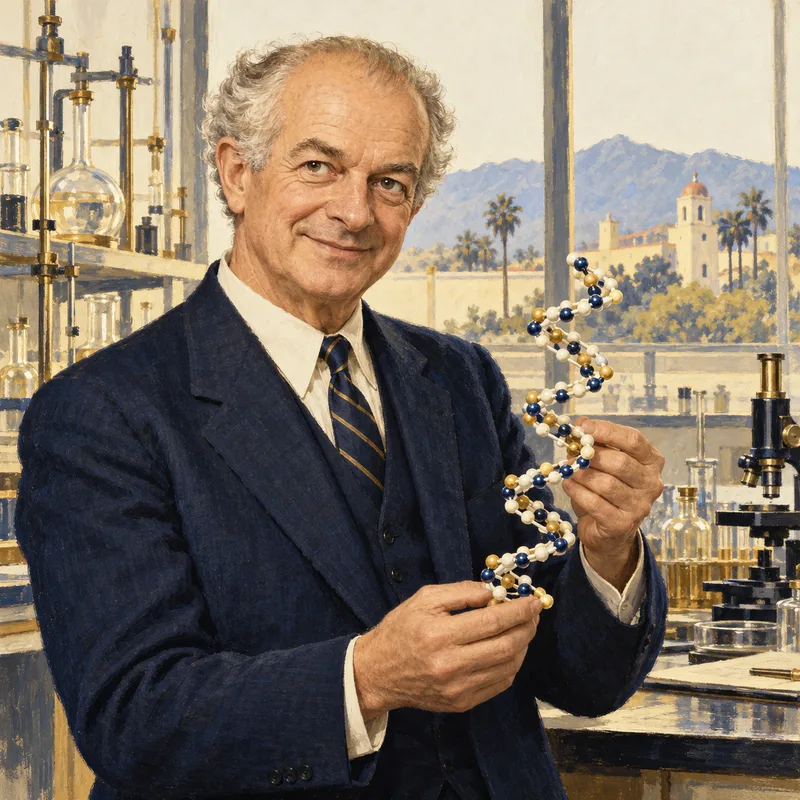
- Models and play. He liked to build models with balls and sticks and to use intuition and pictures to understand structure, and he was an exceptional lecturer.
Legacy and Influence on Modern Chemistry
Almost every organic and inorganic chemistry course uses the language of Pauling: sp³ carbon, resonance hybrids, polarity and electronegativity. His work on protein structure helped to start molecular biology and influenced Max Perutz, Dorothy Hodgkin and Watson and Crick. Computational chemists still use valence bond ideas, and his peace activism established that scientists have a responsibility to society. The Linus Pauling Institute at Oregon State University continues research on nutrition and health.
Lessons for Students
- Learn the new tools. He travelled to Europe to learn quantum mechanics and applied it to chemistry.
- Think visually. Models and diagrams can make complex ideas simple.
- Ask big questions. He asked what holds atoms together and followed the question for decades.
- Accept correction. He admitted that his DNA model was wrong and moved on.
- Use knowledge for society. Science carries social responsibility.
Quick Facts Box
- Born: 28 February 1901, Portland, Oregon, USA
- Died: 19 August 1994, Big Sur, California, USA
- Nationality: American
- Field: Quantum chemistry, structural chemistry, biochemistry
- Famous for: Nature of the chemical bond, hybridisation, electronegativity, alpha helix
- Nobel Prize: Chemistry 1954; Peace 1962
FAQ
Why is Linus Pauling famous?
He explained chemical bonding using quantum mechanics, introduced electronegativity, proposed the alpha helix and won two unshared Nobel Prizes.
Which Nobel Prizes did Pauling win?
The Nobel Prize in Chemistry in 1954 and the Nobel Peace Prize for 1962.
Was Linus Pauling right about vitamin C?
His claims that large doses prevent colds or cure cancer were not supported by controlled studies, though vitamin C remains an essential nutrient.
What is the Pauling electronegativity scale?
It is a relative scale based on bond energies, in which fluorine has the highest value of 4.0.
Published by ABC Chemistry — IIT-JAM | CSIR-NET | GATE Chemistry Coaching. Visit abcchemistry.com
About the chemist
Linus Pauling
1901-1994 · United States · Nobel Chemistry 1954; Peace 1962
Nature of the chemical bond