The discovery, explained · Chemist no. 5 of 350
Linus Pauling and the Nature of the Chemical Bond: Hybridisation, Resonance and Electronegativity
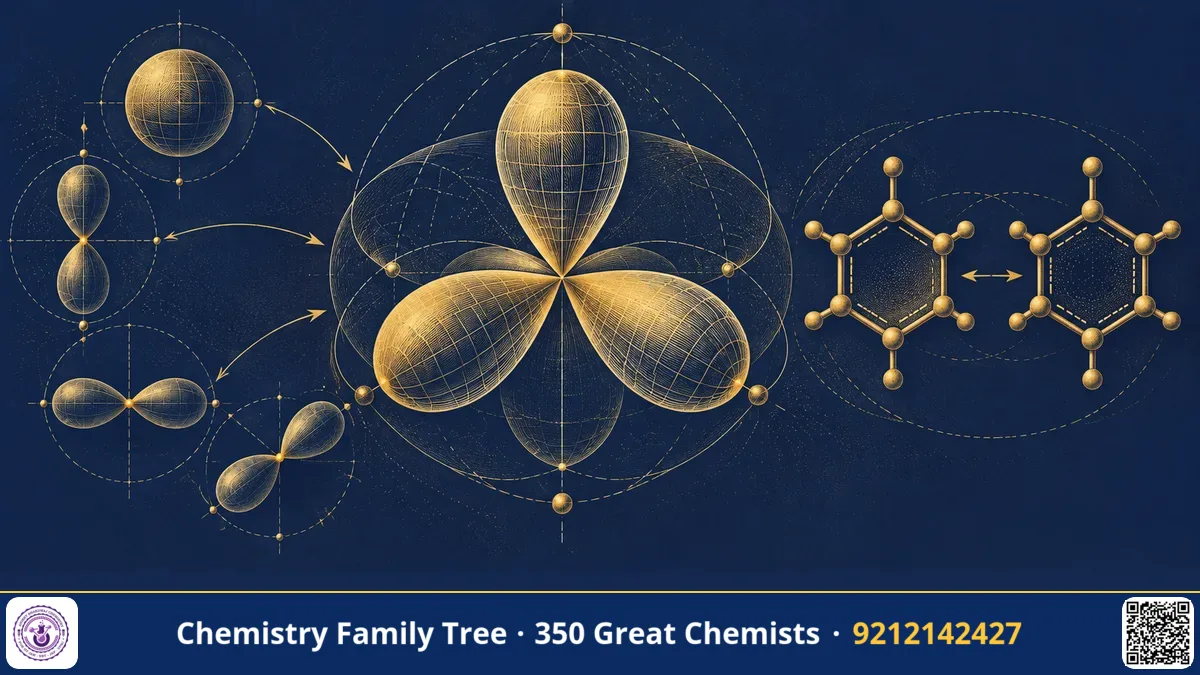
Why is methane tetrahedral when carbon has only two unpaired electrons? Why are all the carbon-carbon bonds in benzene equal in length? Why does HF have such a strong polar bond? These questions sit at the heart of Class 11 and 12 chemistry and also of IIT-JAM, CSIR-NET and GATE. Many of the answers come from one scientist: Linus Pauling. Between 1928 and 1939, he applied the new quantum mechanics to chemistry and produced the language we still use for bonding: hybridisation, resonance and electronegativity. He summarised his work in the book The Nature of the Chemical Bond (1939), and received the Nobel Prize in Chemistry in 1954 for it.
The Scientific Problem Before the Discovery
By the early 1920s, G. N. Lewis had proposed the electron-pair bond and Kossel had explained ionic bonding. But these ideas could not explain geometry or why electrons pair up in a bond. In 1927, Heitler and London used quantum mechanics to explain the hydrogen molecule, which showed that bonding comes from the overlap and exchange of electrons. But their method worked well only for simple molecules. Chemists still asked:
- Carbon has the ground state configuration 1s² 2s² 2p². How can it form four equivalent bonds in CH₄?
- Why is the bond angle in CH₄ 109.5° and not 90°, as 2p orbitals would suggest?
- How should we describe molecules like benzene, where a single Lewis structure does not fit the properties?
- How can we say whether a bond is ionic or covalent, given that most real bonds are in between?
The Discovery: Steps in Pauling's Work
- Training in X-ray crystallography. At Caltech, Pauling determined crystal structures using X-ray diffraction, and in 1929 he formulated a set of rules for the structure of complex ionic crystals (Pauling's rules), which are based on radius ratio and electrostatic valence.
- Learning quantum mechanics in Europe (1926-1927). He studied in Munich with Arnold Sommerfeld and met Bohr and Schrödinger. He returned determined to apply quantum mechanics to chemical problems.
- Hybridisation (1928-1931). He showed that atomic orbitals of an atom can mix to give new, equivalent orbitals with better overlap and directional character. His landmark 1931 paper in the Journal of the American Chemical Society was titled "The Nature of the Chemical Bond".
- Resonance (1930s). For molecules like benzene and carbonate ion, he proposed that the real structure is a hybrid of several contributing structures, with lower energy than any one of them.
- Electronegativity scale (1932). Using bond energy data, he proposed a numerical scale in which fluorine is assigned 4.0.
- The 1939 book. He collected all these ideas in The Nature of the Chemical Bond and the Structure of Molecules and Crystals, which became one of the most cited chemistry books of the twentieth century.
The Chemistry Behind It
Hybridisation
In methane, one 2s electron of carbon is promoted to the empty 2p orbital, giving 2s¹ 2p³. The one 2s and three 2p orbitals then mix to form four equivalent sp³ hybrid orbitals directed to the corners of a tetrahedron.
C (ground): 2s² 2p²  →  C* (excited): 2s¹ 2p³  →  4 × sp³
CH₄: bond angle 109.5°
| Hybridisation | Orbitals mixed | Geometry | Angle | Example |
|---|---|---|---|---|
| sp | 1 s + 1 p | Linear | 180° | BeCl₂, C₂H₂ |
| sp² | 1 s + 2 p | Trigonal planar | 120° | BF₃, C₂H₄ |
| sp³ | 1 s + 3 p | Tetrahedral | 109.5° | CH₄ |
| sp³d | 1 s + 3 p + 1 d | Trigonal bipyramidal | 90°, 120° | PCl₅ |
| sp³d² | 1 s + 3 p + 2 d | Octahedral | 90° | SF₆ |
Note: for exams, remember that hybridisation is a mathematical mixing of orbitals of one atom, not a physical process. The number of hybrid orbitals equals the number of orbitals mixed. Lone pairs in NH₃ and H₂O also occupy hybrid orbitals, so these are sp³ hybridised, with angles reduced to about 107° and 104.5° by lone pair repulsion.
Resonance
Benzene (C₆H₆) is not alternating single and double bonds. All six C-C bonds are equal in length (about 139 pm), between a single bond (154 pm) and a double bond (134 pm). The real molecule is a resonance hybrid of the two Kekulé structures, plus less important ones. The extra stability is called resonance energy, which for benzene is about 150 kJ/mol. Other examples include the carbonate ion (CO₃²⁻), nitrate ion (NO₃⁻) and the carboxylate ion (RCOO⁻).
Benzene: structure I ↔ structure II (double-headed arrow, not an equilibrium)
Electronegativity and partial ionic character
Pauling defined electronegativity as the power of an atom in a molecule to attract electrons to itself. His values include H 2.1, C 2.5, N 3.0, O 3.5, Cl 3.0, F 4.0. He used the difference in electronegativity to estimate how ionic a bond is:
Percent ionic character ≈ [1 − exp(−(χA − χB)² / 4)] × 100
Rule of thumb: difference above about 1.7 → mostly ionic
This ended the sharp division between ionic and covalent bonds and showed that bonds are a continuous range.
Biological structure: the alpha helix
In 1951, Pauling, Robert Corey and Herman Branson proposed the alpha helix and beta sheet as the two main protein secondary structures, stabilised by hydrogen bonds between N-H and C=O groups of the backbone. They also pointed out that the peptide bond is planar due to resonance (partial double-bond character of the C-N bond).
Applications Today
- Predicting molecular shapes. VSEPR and hybridisation are used for every inorganic and organic structure problem.
- Reactivity in organic chemistry. Resonance helps us explain acidity of phenol and carboxylic acids, stability of carbocations, and the reactivity of aromatic rings.
- Drug design. The planar peptide bond and helix structures are crucial for protein modelling and for designing drugs that fit enzyme active sites.
- Materials science. Pauling's rules guide the prediction of crystal structures of minerals and ceramics.
- Molecular medicine. In 1949, Pauling and co-workers showed that sickle-cell anaemia is caused by an abnormal haemoglobin molecule, the first "molecular disease". This is important in a country like India, where sickle-cell disease is common in some tribal regions.
Exam Corner
- Pauling's electronegativity scale: F = 4.0 (highest), Cs/Fr lowest. Pauling is the usual source for numerical values in textbooks. Mulliken's scale uses the average of ionisation energy and electron affinity.
- Number of hybrid orbitals = number of atomic orbitals mixed. sp: 50% s character; sp²: 33%; sp³: 25%. Greater s-character means shorter bond and higher acidity of C-H (alkyne > alkene > alkane).
- Resonance structures differ only in electron positions, not in atom positions. The resonance hybrid is lower in energy than any single contributing structure.
- The alpha helix has 3.6 amino acid residues per turn and is stabilised by intrachain hydrogen bonds.
- Pauling won the Nobel Prize in Chemistry (1954) and the Nobel Peace Prize (1962).
Common Misconceptions
- "Resonance structures are rapidly interconverting forms." No. The molecule has one real structure, the hybrid. The contributing structures are only a drawing device.
- "Hybridisation happens before the bond forms, as a real step." It is a model that helps explain bond geometry and overlap, not a literal process that you can observe.
- "Electronegativity is a fixed property that can be measured directly." It is a derived, relative quantity that depends on the scale, and in a molecule it depends on the environment (for example, the oxidation state and hybridisation).
Quick Revision Box
- Key work: The Nature of the Chemical Bond (1931 paper; 1939 book).
- Hybridisation: mixing of atomic orbitals of one atom; sp³ = 109.5°, sp² = 120°, sp = 180°.
- Resonance: real structure is a hybrid; benzene C-C bond length about 139 pm.
- Electronegativity scale: F = 4.0, O = 3.5, N = 3.0, C = 2.5, H = 2.1.
- Alpha helix (1951) with Corey and Branson; sickle-cell anaemia as a molecular disease (1949).
- Nobel Prizes: Chemistry 1954; Peace 1962.
FAQ
What did Linus Pauling contribute to the theory of chemical bonding?
He introduced orbital hybridisation, the concept of resonance and a numerical electronegativity scale, and used them to explain molecular geometry and bond properties.
Why does carbon form four equivalent bonds in methane?
One 2s and three 2p orbitals mix to form four equivalent sp³ hybrid orbitals, each pointing to a corner of a tetrahedron, with an angle of 109.5°.
How does Pauling's electronegativity differ from Mulliken's?
Pauling's is based on bond energies and thermochemical data, while Mulliken's is based on the average of the ionisation energy and electron affinity of an atom.
Did Pauling discover the structure of DNA?
No. He proposed a three-stranded model of DNA in 1953 that turned out to be wrong. The correct double helix was proposed by Watson and Crick.
Published by ABC Chemistry — IIT-JAM | CSIR-NET | GATE Chemistry Coaching. Visit abcchemistry.com
About the chemist
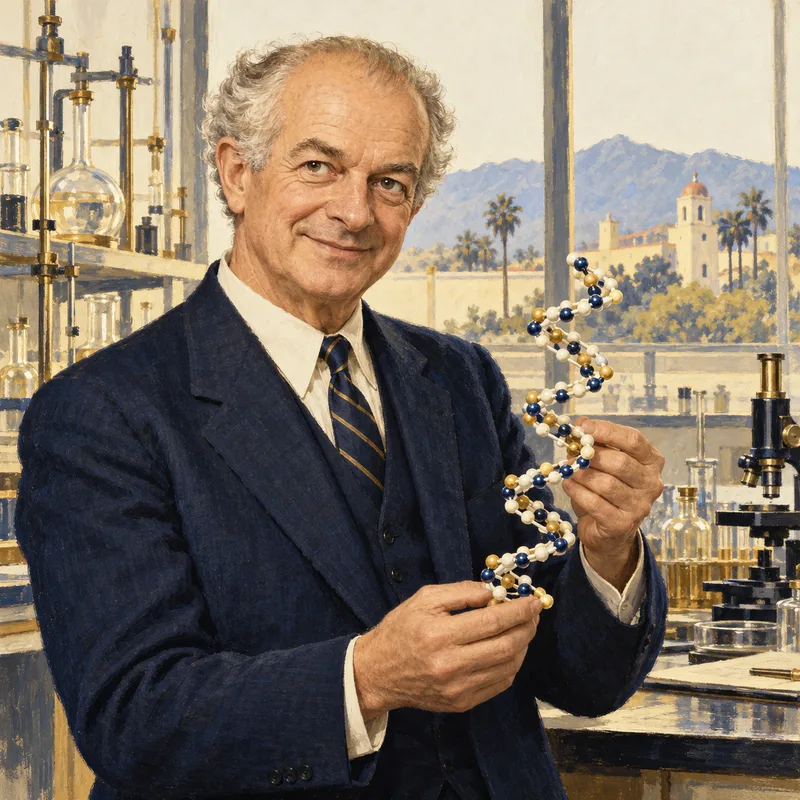
Linus Pauling
1901-1994 · United States · Nobel Chemistry 1954; Peace 1962
Nature of the chemical bond