Biography · Chemist no. 36 of 350
Lise Meitner: The Scientist Who Explained Fission
Introduction
Lise Meitner (1878-1968) was an Austrian-born physicist who worked for more than thirty years in Germany and then spent the rest of her life in Sweden and Britain. With Otto Hahn she discovered the element protactinium. In 1938-39, as a refugee, she and her nephew Otto Frisch gave the first theoretical explanation of nuclear fission. She was nominated many times for the Nobel Prize but never received it. Her legacy in one line: she showed that persistence, mathematics and moral courage can change science even when the world does not give credit.
Early Life and Family
Elise Meitner (she later preferred Lise) was born on 7 November 1878 in Vienna, Austria-Hungary, in a Jewish family. She was one of eight children. Her father, Philipp Meitner, was one of the first Jewish lawyers in Vienna, and the family valued education and culture. As a girl she showed a great talent for mathematics. At that time, girls in Austria were not allowed to attend school beyond the age of 14. She had to study privately to catch up with the school-leaving examination, which she passed in 1901 in a group of a few young women.
Education and Mentors
Meitner entered the University of Vienna in 1901, soon after women were admitted. She studied physics under Ludwig Boltzmann, whose enthusiasm for atoms and kinetic theory inspired her. She received her doctorate in 1906, becoming the second woman to receive a physics doctorate from the University of Vienna. After a few years of research on radioactivity in Vienna, she went to Berlin in 1907 to hear the lectures of Max Planck and to work in the field of radioactivity. There she met the chemist Otto Hahn. Women were not allowed in the laboratories of the Chemical Institute at that time, so the two worked in a former carpentry workshop in the basement with a separate entrance. Planck soon made her his assistant and supported her career.
Career Timeline
| Year | Event |
|---|---|
| 1878 | Born in Vienna (7 November) |
| 1906 | Doctorate in physics at the University of Vienna |
| 1907 | Moves to Berlin; begins collaboration with Otto Hahn |
| 1912 | Joins the Kaiser Wilhelm Institute for Chemistry in Berlin-Dahlem |
| 1915-16 | Serves as an X-ray nurse and technician with the Austrian army during the First World War |
| 1917-18 | With Hahn, discovers protactinium |
| 1922 | Habilitation; reports the emission of electrons after an inner-shell vacancy (Auger effect) |
| 1926 | Becomes extraordinary professor of physics at the University of Berlin |
| 1933 | Loses her teaching licence under Nazi laws |
| 1938 | Flees Germany in July; settles in Stockholm |
| 1938-39 | With Otto Frisch, explains nuclear fission |
| 1960 | Retires to Britain |
| 1966 | Receives the Enrico Fermi Award with Hahn and Strassmann |
| 1968 | Dies in Cambridge, England (27 October) |
Major Scientific Contributions
- Protactinium (1917-18): discovery of the long-lived isotope of element 91 with Hahn.
- Nuclear recoil and isomerism work: work with Hahn on beta-ray spectra and radioactive decay series.
- Auger electron emission (1922): she observed the radiationless transition that is now associated with the name of Pierre Auger.
- Beta-ray spectrum research: she worked on gamma rays and the origin of beta spectra, later influencing discussion of the neutrino.
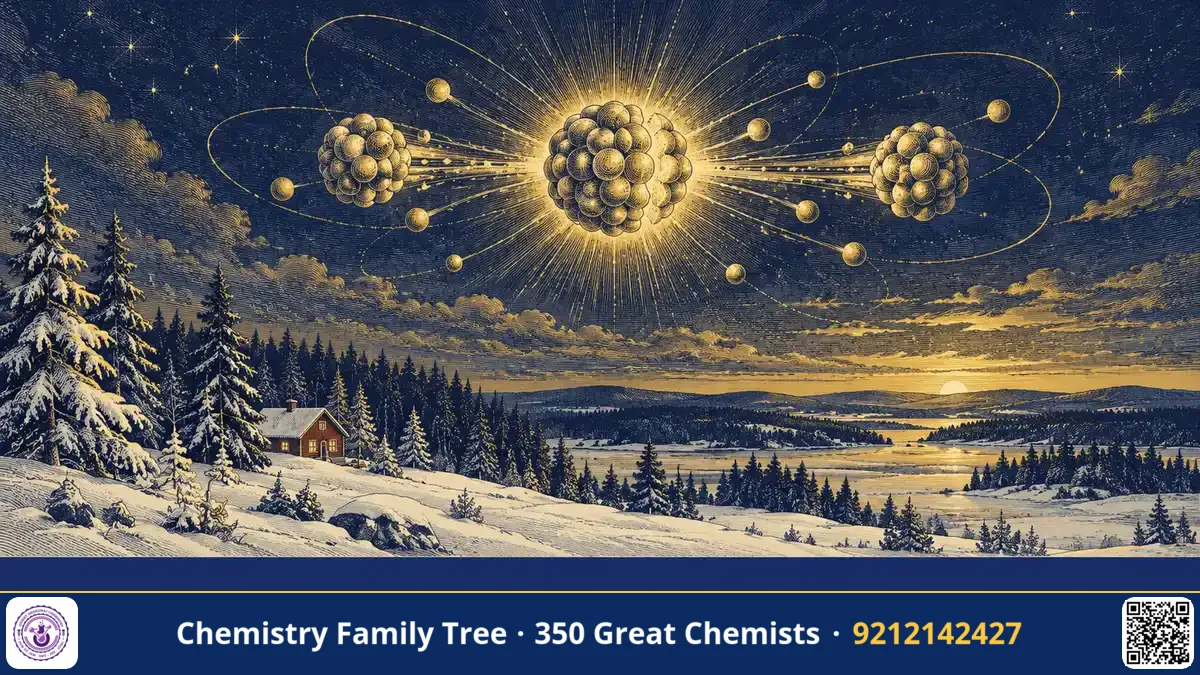
- Explanation of nuclear fission (1938-39): with Frisch, she applied the liquid drop model, calculated the energy of about 200 MeV and described the process physically.
The details are in our companion post on Lise Meitner and nuclear fission.
Awards, Honours and Nobel Prize
- Nobel Prize: none. She was nominated many times, in both physics and chemistry, but the 1944 Chemistry prize went to Hahn alone.
- Enrico Fermi Award (1966): shared with Otto Hahn and Fritz Strassmann, a major US government honour for nuclear science.
- Member of the Royal Swedish Academy of Sciences, and foreign member of other academies, including the Royal Society of London.
- Element 109, meitnerium (Mt), was named in her honour in 1997. It is the only element named in honour of a woman scientist alone, since curium honours both Marie and Pierre Curie.
Personality, Struggles and Lesser-Known Facts
- Working in the basement. Because of rules against women, she was kept away from the main laboratory at first and worked unpaid for years.
- Fleeing the Nazis. Although she was baptised as a Protestant as a young adult, the Nazi laws treated her as Jewish. After Austria was annexed in March 1938, her situation became dangerous. In July 1938, with the help of Dutch colleagues Dirk Coster and Adriaan Fokker, she crossed into the Netherlands and then went to Sweden.
- Isolation in Sweden. In Stockholm she was given modest laboratory facilities at Manne Siegbahn's institute and felt isolated from her friends. She continued her work through letters with Hahn.
- Refused to build the bomb. She was invited to join the Manhattan Project in the United States and refused, saying she would have nothing to do with a bomb. The press sometimes called her the "mother of the atomic bomb," a title she disliked.
- Hurt but dignified. After the war, she remained in contact with Hahn but was disappointed that he did not fully acknowledge her role in his published accounts.
- Love of music. She loved music and played the piano.
Legacy and Influence on Modern Chemistry
Fission is now the basis of nuclear power and has reshaped the world. Meitner's insight turned a chemical anomaly into a physical theory, and her calculation of the energy released explained why fission could be so powerful. Her story has become a symbol for women in science and for the problem of unrecognised contributions. The Lise Meitner Programme in Austria supports women researchers, and several research institutes, schools and craters bear her name. Meitnerium (Z = 109) is the permanent record of her work in the periodic table.
Lessons for Students
- Do not give up. She succeeded in a field that did not welcome her.
- Combine physics and chemistry. Hahn's chemistry and Meitner's physics together explained a new phenomenon.
- Use mathematics boldly. A quick calculation of the energy showed that fission was real.
- Stand by your ethics. She refused to work on weapons.
- Credit matters. Acknowledge the contributions of all collaborators in your own work.
Quick Facts Box
- Born: 7 November 1878, Vienna, Austria-Hungary
- Died: 27 October 1968, Cambridge, England
- Nationality: Austrian, later Swedish citizen
- Field: Nuclear physics and radiochemistry
- Famous for: Protactinium, explanation of nuclear fission
- Nobel Prize: None (nominated many times)
FAQ
Did Lise Meitner win a Nobel Prize?
No. She was nominated many times but the 1944 Nobel Prize in Chemistry was awarded to Otto Hahn alone.
What was Meitner's role in fission?
She and Otto Frisch explained fission theoretically in December 1938 and January 1939, using the liquid drop model and calculating the energy released.
Which element is named after her?
Meitnerium, element 109.
Why did she leave Germany?
Under the Nazi regime her Jewish ancestry put her in danger, so she fled in July 1938.
Published by ABC Chemistry — IIT-JAM | CSIR-NET | GATE Chemistry Coaching. Visit abcchemistry.com
About the chemist
Lise Meitner
1878-1968 · Austria/Sweden
Explained nuclear fission