The discovery, explained · Chemist no. 36 of 350
Lise Meitner and the Physics Behind Nuclear Fission
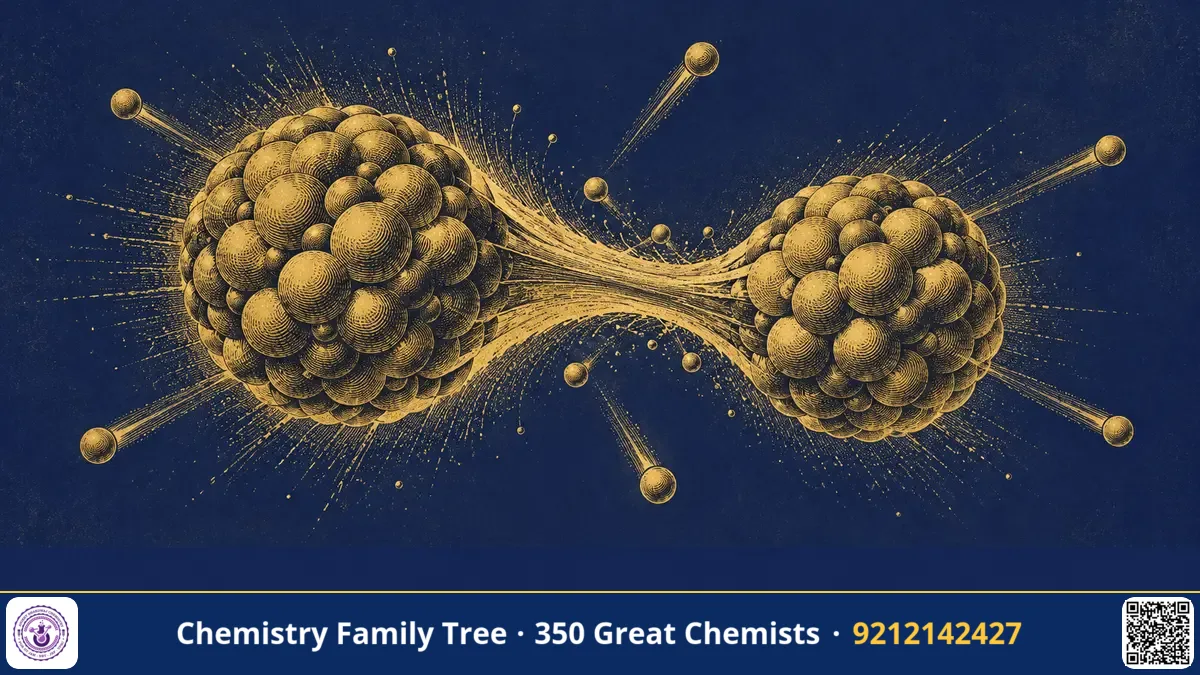
When Otto Hahn wrote to Lise Meitner in December 1938 about a strange result, that uranium bombarded with neutrons seemed to produce barium, most physicists would have thought it impossible. A nucleus changing by emitting an alpha or beta particle was well known. A nucleus breaking in two was not. Meitner, an Austrian-born physicist living in exile in Sweden, did not dismiss the result. Together with her nephew Otto Robert Frisch she worked out within days how it could happen, calculated the energy released, and named the process nuclear fission. Meitner is one of the most important figures in twentieth-century nuclear science, even though she never received a Nobel Prize. Element 109, meitnerium, is named after her.
The Scientific Problem Before the Discovery
For years after Fermi's experiments of 1934, scientists believed that bombarding uranium with neutrons created transuranium elements. Meitner, Hahn and Strassmann spent several years in Berlin trying to sort out the products, which seemed to be a confusing mixture of radioactive substances with many half-lives. Some of them looked chemically like radium, others like thorium or actinium, but they did not fit a neat sequence.
In 1938 Irène Joliot-Curie and Pavle Savić reported a product that behaved like lanthanum. Hahn and Strassmann repeated the experiments with increasing care. By December they had shown that what they thought were radium isotopes behaved like barium. Their chemical conclusion was firm, but the physics was shocking: no known process in nuclear physics could chop a heavy nucleus into two roughly equal parts using slow neutrons. Hahn was a chemist and wrote to Meitner for her opinion as a physicist.
The Discovery: Step by Step
Step 1: A walk in the snow
Meitner had left Berlin in July 1938 after the annexation of Austria, because her Jewish ancestry made her position dangerous. She was working in Stockholm. At Christmas 1938 she visited friends in Kungälv, a small town in western Sweden, and her nephew Otto Frisch, a physicist working with Niels Bohr in Copenhagen, joined her. According to Frisch's later account, they discussed Hahn's letter while walking in the snow, he on skis and she on foot.
Step 2: The liquid drop model
They used the liquid drop model of the nucleus, developed by George Gamow and Bohr. In this model, the nucleus is like a drop of charged liquid:
- The strong nuclear force acts like surface tension, holding the drop together.
- The electrostatic repulsion between the 92 protons acts to push the drop apart.
In a heavy nucleus such as uranium, these two effects almost balance. If the nucleus absorbs a neutron, it is excited and begins to oscillate. It may stretch into a dumbbell shape. If the repulsion between the two ends beats the surface tension, the nucleus can pinch in the middle and split into two fragments.
Step 3: Calculating the energy
Meitner knew the masses of nuclei from Aston's data and used the mass defect. The two fragments together would have a total mass about one fifth of a proton mass less than the original uranium nucleus. By Einstein's equation:
ΔE = Δm c² Δm ≈ 0.2 u → ΔE ≈ 0.2 × 931.5 MeV ≈ 200 MeV
This matched an independent estimate of the electrostatic energy of two fragments of charge about 46 each pushed apart, roughly 200 MeV. The two approaches agreed. This calculation, completed in a short time, convinced them that the process was real.
Step 4: Naming and testing
Frisch asked an American biologist working in Copenhagen how cells divide, and borrowed the word "fission". On returning to Copenhagen in January 1939 he carried out a direct physical experiment: he showed that bursts of ionisation of the size expected from 200 MeV fragments were produced when uranium was exposed to neutrons. Meitner and Frisch's paper appeared in Nature in February 1939. Bohr announced the news in the United States, and fission was confirmed by many laboratories within weeks.
²³⁵₉₂U + ¹₀n → ²³⁶₉₂U* → ¹⁴¹₅₆Ba + ⁹²₃₆Kr + 3 ¹₀n + ~200 MeV
Her earlier discoveries
Meitner had already discovered, with Hahn in 1917-18, the element protactinium (Z = 91), the parent of actinium. She also found in 1922 the radiationless transition that is now called the Auger effect: an atom with an inner-shell vacancy can emit an electron rather than an X-ray photon. Pierre Auger described it independently in 1923, and the effect is named after him in most books.
The Chemistry Behind It
Binding energy per nucleon
The binding energy per nucleon rises with mass number to a maximum near iron-56 (about 8.8 MeV per nucleon) and then falls slowly. Uranium has about 7.6 MeV per nucleon. Fragments of mass number 90 to 140 have about 8.5 MeV per nucleon. The difference of about 0.9 MeV per nucleon, multiplied by 236 nucleons, gives roughly 200 MeV.
Why fission needs a neutron
Uranium-235 absorbs a thermal neutron and forms uranium-236 in an excited state with enough energy to cross the fission barrier. Uranium-238 needs fast neutrons with energy above about 1 MeV to fission. This is why only U-235, Pu-239 and U-233 are fissile.
Mass defect
Δm = (Z mₚ + (A - Z) mₙ) - m(nucleus) E(binding) = Δm × 931.5 MeV/u
Neutron emission and chain reaction
Fission fragments are neutron-rich, so they emit neutrons promptly. The average number per fission is 2 to 3. These neutrons can cause further fission, making a chain reaction possible, as soon as Meitner and Frisch's idea was accepted.
Applications Today
- Nuclear power plants: controlled fission produces heat for electricity in reactors around the world, including India's pressurised heavy water reactors.
- Medical isotopes: molybdenum-99, produced from uranium fission, is the parent of technetium-99m used in millions of diagnostic scans.
- Research: neutron sources and reactors use fission for materials research.
- Nuclear propulsion: submarines and some ships use fission reactors.
- Understanding nuclei: the liquid drop model leads to the semi-empirical mass formula, widely taught in nuclear chemistry.
Exam Corner
- Fission energy is about 200 MeV per U-235 nucleus, from mass defect: 1 u corresponds to 931.5 MeV.
- Liquid drop model: surface tension corresponds to the strong force, and Coulomb repulsion promotes breakup.
- Fissile nuclei: U-233, U-235, Pu-239. Fertile: Th-232, U-238.
- Protactinium (Pa, Z = 91) was discovered by Hahn and Meitner in 1917-18.
- Element 109, meitnerium (Mt), is named after Lise Meitner.
Common Misconceptions
- "Hahn alone discovered fission." The chemical discovery was by Hahn and Strassmann, and the physical explanation by Meitner and Frisch.
- "Meitner worked on the atomic bomb." She declined to join the Manhattan Project.
- "The Auger effect was discovered by Auger only." Meitner observed it first, but the name follows Auger.
Quick Revision Box
- 1917-18: Hahn and Meitner discover protactinium.
- December 1938: Meitner and Frisch explain fission using the liquid drop model.
- Energy released: about 200 MeV per fission from the mass defect (E = mc²).
- Name "fission" proposed by Frisch from biology.
- Element 109 meitnerium honours her.
- No Nobel Prize, despite several nominations.
FAQ
What was Lise Meitner's role in the discovery of fission?
She provided the physical explanation and the energy calculation, and she had led the Berlin research programme for years.
Why wasn't Meitner given the Nobel Prize?
The 1944 prize went to Hahn alone. Historians point to wartime circumstances, her exile, the divide between physics and chemistry, and committee bias.
What is the liquid drop model?
It treats the nucleus as a charged droplet of incompressible liquid, balancing surface tension against electrostatic repulsion.
What is the Auger effect?
It is a process where an atom with an inner-shell vacancy emits an electron instead of an X-ray photon.
Published by ABC Chemistry — IIT-JAM | CSIR-NET | GATE Chemistry Coaching. Visit abcchemistry.com
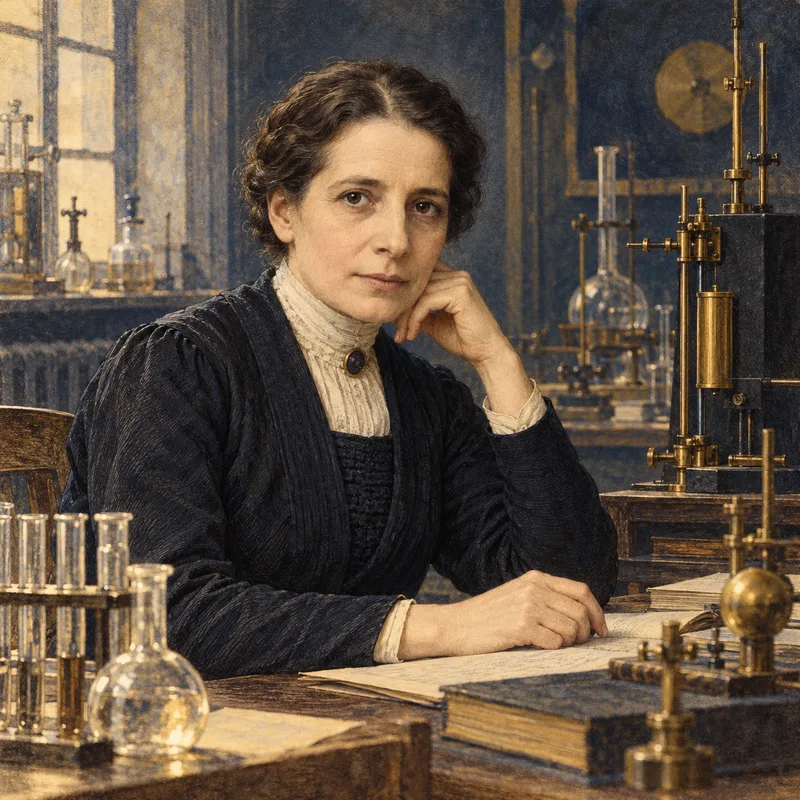
About the chemist
Lise Meitner
1878-1968 · Austria/Sweden
Explained nuclear fission