Biography · Chemist no. 255 of 350
Lothar Meyer (1830-1895): The German Chemist Who Graphed the Periodic Law
Introduction
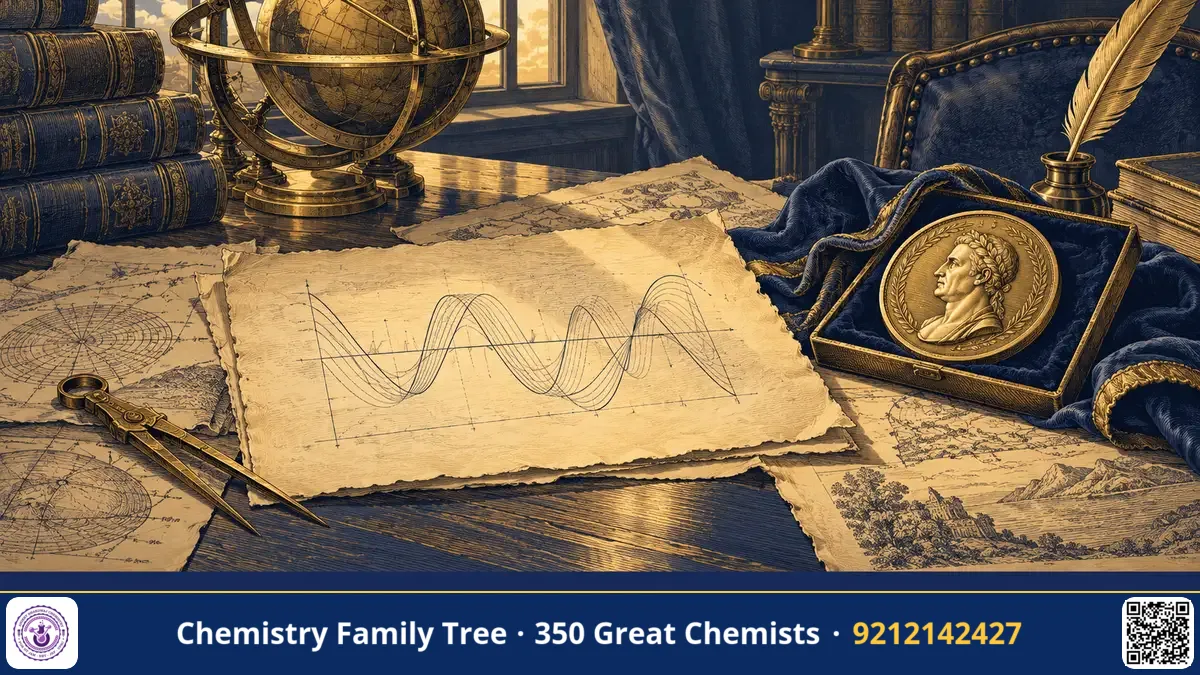
Julius Lothar Meyer was a German chemist and teacher who, independently of Dmitri Mendeleev, discovered that the properties of the chemical elements repeat periodically when the elements are arranged by atomic weight. His atomic volume curve is one of the most famous graphs in the history of chemistry. His legacy in one line: he showed the periodic law in the language of physical properties and gave chemistry its first great picture of periodicity.
Early Life and Family
Meyer was born on 19 August 1830 in Varel, in the Duchy of Oldenburg in northern Germany. His father was a physician, and the family had a background in medicine. The young Meyer grew up in a house where science and health were daily topics. His younger brother Oskar Emil Meyer became a well-known physicist, remembered for work on the kinetic theory of gases and the viscosity of gases. The two brothers remained intellectually close for life.
Education and Mentors
Following his father, Meyer first studied medicine. He studied at Zürich and Würzburg, and later at Heidelberg, where he worked in the laboratory of Robert Bunsen. At Würzburg he came under the influence of the physiologist and pathologist Rudolf Virchow, and in 1854 he received his doctorate in medicine. At Heidelberg he also met Kirchhoff and other leading scientists. His interest slowly moved from medicine to chemistry and physiology of gases. He studied the gases of blood, and his work showed that oxygen is carried in blood in a loose chemical combination, not simply dissolved. He then studied physical chemistry at Breslau, where he took a second doctorate in 1858 with work on the effect of carbon monoxide on blood.
Career Timeline
| Year | Event |
|---|---|
| 1830 | Born in Varel, Oldenburg |
| 1854 | Doctorate in medicine at Würzburg |
| 1858 | Doctorate at Breslau; studied blood gases |
| 1859 | Became Privatdozent at Breslau |
| 1860 | Attended the Karlsruhe Congress |
| 1864 | Published Die modernen Theorien der Chemie |
| 1866 | Professor at the Forestry Academy, Eberswalde |
| 1868 | Professor at Karlsruhe Polytechnic |
| 1870 | Published the atomic volume curve |
| 1876 | Professor of chemistry at Tübingen |
| 1882 | Davy Medal (shared with Mendeleev) |
| 1895 | Died in Tübingen, 11 April |
Major Scientific Contributions
- Periodic classification: His 1864 book contained a table of 28 elements by valence, and his 1870 paper presented the atomic volume curve. See our discovery blog for details of the graph.
- Blood gases: His early research on how oxygen and carbon monoxide combine with blood was a pioneer step in the chemistry of respiration. The reaction can be written as Hb + O₂ ⇌ HbO₂ and Hb + CO → HbCO, the latter being much more stable.
- Theoretical chemistry teaching: His book Die modernen Theorien der Chemie was widely read and went through several editions. It spread Cannizzaro's ideas on atomic weights and valence across Germany.
- Physical chemistry: He was also a notable early contributor to the study of chemical physics, including work on the relationship between atomic weight and physical properties of elements.
Awards, Honours and Nobel Prize
Lothar Meyer received the Davy Medal of the Royal Society in 1882, shared with Mendeleev, for the discovery of the periodic relations of the atomic weights. He did not receive a Nobel Prize. The first Nobel Prizes were awarded in 1901, six years after his death, so he could not have been considered in his lifetime. He was a respected professor and was recognised by the scientific community across Europe.
Personality, Struggles and Lesser-Known Facts
- Meyer was a careful and modest man. He did not make bold predictions from his tables, unlike Mendeleev, and that caution cost him wider fame.
- Reading Cannizzaro's pamphlet at Karlsruhe in 1860 changed his view of chemistry. He later arranged for the pamphlet to be republished in the series Ostwald's Klassiker, an act that helped bring it to many students. This is a known fact in the history of chemistry.
- He was a physician-turned-chemist. His medical training explains his interest in blood gases.
- A priority dispute with Mendeleev arose in the 1870s about who had first understood the periodic law. Meyer defended his own work, though the argument was never bitter in the way of some scientific disputes.
- His brother Oskar Emil Meyer was a physicist, and both contributed to the study of gases from different sides.
- At Tübingen he built a respected school of chemistry and trained many students.
Legacy and Influence on Modern Chemistry
Meyer's graph taught chemists that periodicity is a real property of nature, not a clever filing system. His atomic volume curve is still used in classrooms because it makes the idea visible. The modern periodic table, with its s, p, d and f blocks explained by quantum mechanics, rests on the same truth that Meyer saw: properties repeat as atomic number increases. The periodic law is one of the foundations of everything you study in inorganic chemistry, from ionisation energy trends to the chemistry of transition metals.
Lessons for Students
- Plot your data. A graph can reveal a law that a table hides.
- Learn from other fields. Medicine and physics both shaped Meyer's chemistry.
- Clear fundamentals matter. Correct atomic weights made the periodic law possible.
- Caution is good, but courage is rewarded. Mendeleev's bold predictions earned him lasting fame.
- Credit is shared. Great ideas often arise in many minds at the same time.
Quick Facts Box
- Born: 19 August 1830, Varel, Oldenburg
- Died: 11 April 1895, Tübingen
- Nationality: German
- Field: Physical and inorganic chemistry
- Famous for: Atomic volume curve; periodic law
- Nobel Prize: None (died before the prizes began)
FAQ
Was Lothar Meyer a doctor?
Yes. He first trained in medicine and took a medical doctorate at Würzburg in 1854 before turning to chemistry.
Did Lothar Meyer win a Nobel Prize?
No. He died in 1895, before the first Nobel Prizes of 1901. He did win the Davy Medal in 1882.
How is Meyer different from Mendeleev?
Meyer stressed physical properties such as atomic volume and made a graph. Mendeleev stressed chemical properties and predicted new elements.
Where did Meyer teach?
He taught at Breslau, Eberswalde, Karlsruhe and Tübingen, where he stayed until his death.
Published by ABC Chemistry — IIT-JAM | CSIR-NET | GATE Chemistry Coaching. Visit abcchemistry.com
About the chemist
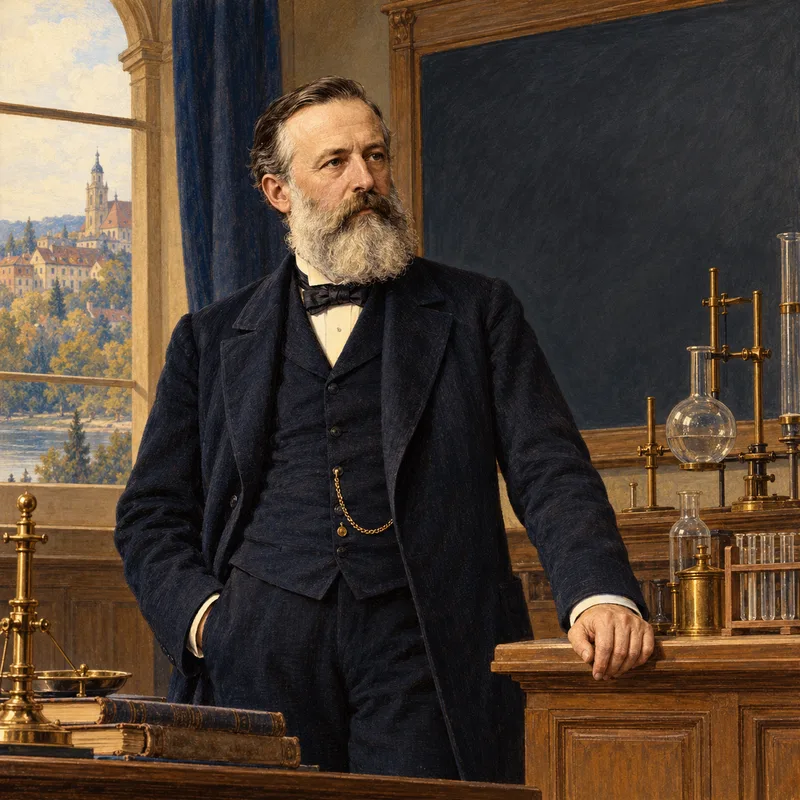
Lothar Meyer
1830-1895 · Germany
Periodic table; valence arrangement of elements