Biography · Chemist no. 291 of 350
Louis Plack Hammett (1894-1987): The Man Who Measured Substituent Effects
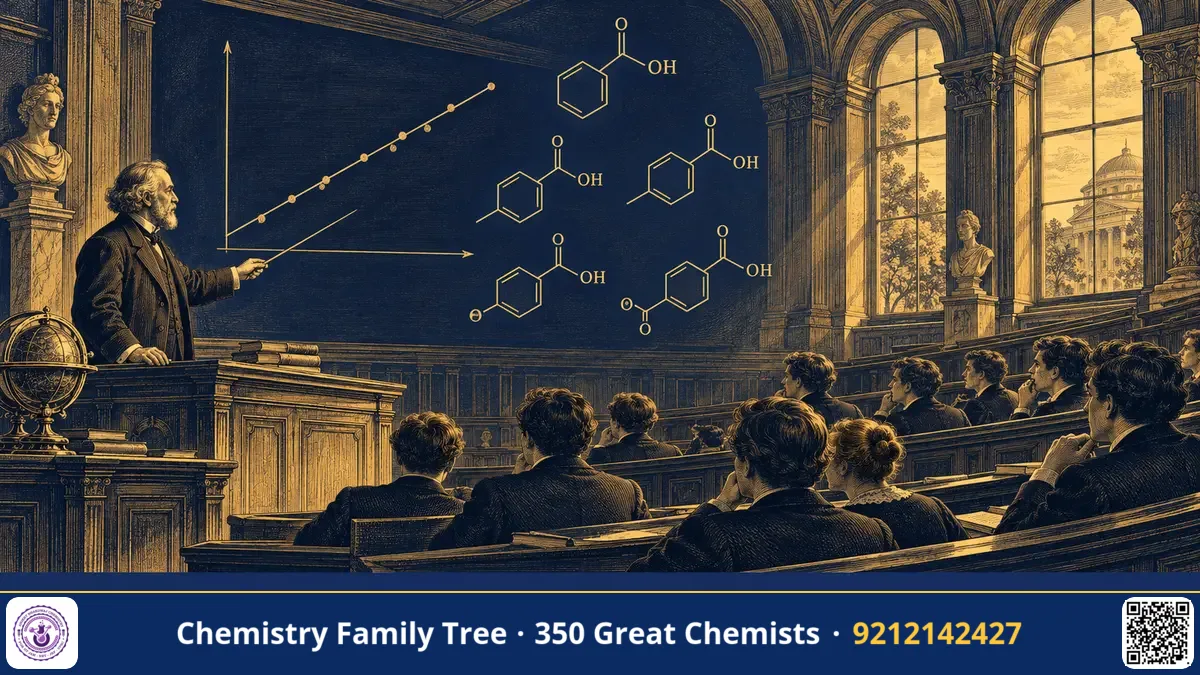
Introduction
Louis Plack Hammett was an American chemist who gave organic chemistry some of its most useful numbers. His Hammett equation linked structure to reactivity in a quantitative way, and his acidity function H₀ allowed chemists to measure the strength of acids far stronger than any aqueous solution. His 1940 book Physical Organic Chemistry gave a new branch of chemistry its name. For Indian students, his legacy appears every time a question asks why p-nitrobenzoic acid is stronger than benzoic acid, or what a positive rho value means.
Early Life and Family
Hammett was born on 7 April 1894 in Wilmington, Delaware, in the United States. Wilmington was a centre of the American chemical industry, home to the DuPont company, and many young people of that era grew up in an atmosphere where chemistry was seen as a practical career. Few personal details of his childhood are well documented, so this article concentrates on the facts that historians have recorded reliably.
What is clear is that he grew up in an America where chemistry was becoming a serious university subject, and where European laboratories, especially in Germany and Switzerland, still set the standard. Like many ambitious American chemists of his generation, he looked to Europe to complete his training.
Education and Mentors
Hammett studied at Harvard University, where he completed his undergraduate degree in 1916. After that he spent time in Europe, working in Zürich, Switzerland, at a time when the aftermath of the First World War had disrupted science across the continent. He then returned to the United States and joined Columbia University in New York as an instructor around 1920. At Columbia he completed his doctorate in the early 1920s.
His early training was in physical chemistry, and especially in the careful measurement of equilibria and reaction rates. This background is important: it explains why his later work on organic compounds was so quantitative. He treated organic reactions with the discipline of a physical chemist, using numbers, graphs and thermodynamic reasoning rather than only structural arguments.
Career Timeline
| Year | Event |
|---|---|
| 1894 | Born in Wilmington, Delaware, USA |
| 1916 | Completes undergraduate degree at Harvard |
| c. 1920 | Joins Columbia University, New York |
| 1932 | With Alden Deyrup, publishes the acidity function H₀ for strong acids |
| 1935 | Publishes on the relation between rates and equilibria of organic reactions |
| 1937 | Publishes the Hammett equation relating structure and reactivity |
| 1940 | Publishes Physical Organic Chemistry, the book that named the field |
| 1961 | Retires from Columbia as a professor emeritus |
| 1987 | Dies in the United States at the age of 92 |
Major Scientific Contributions
1. The acidity function
In concentrated acids, pH loses meaning because water is no longer the solvent. Hammett and Deyrup used a ladder of coloured indicator bases and defined H₀ = pK(BH⁺) + log([B]/[BH⁺]). This let chemists rank very strong acids and later underpinned superacid chemistry, which was developed further by George Olah, a Nobel laureate in 1994.
2. The Hammett equation
The relation log(k/k₀) = ρσ lets the effect of any meta or para substituent be predicted once σ (substituent constant) and ρ (reaction constant) are known. It is the best-known example of a linear free-energy relationship. You can read more about the equation, sigma values and the meaning of rho in our companion article on his discovery.
3. Founding physical organic chemistry
His textbook brought together kinetics, equilibria, acid-base catalysis and structural theory into one framework for explaining organic reaction mechanisms. Later leaders of the field, such as Saul Winstein and Christopher Ingold in different traditions, worked in the same quantitative spirit.
Awards, Honours and Nobel Prize
Hammett did not win a Nobel Prize. He was, however, recognised by his peers as a leader of American chemistry. He was elected to the United States National Academy of Sciences, and received the Priestley Medal of the American Chemical Society in 1961, the society's highest honour, as well as the National Medal of Science in the United States in 1967. He also served the profession in leadership roles at Columbia, where his teaching and administration shaped generations of students.
Personality, Struggles and Lesser-Known Facts
- A physical chemist at heart. He often said, in effect, that organic reactions deserve the same quantitative treatment as gases and solutions. His career is a lesson in applying one discipline's tools to another.
- The name matters. The phrase "physical organic chemistry" was popularised by his book. Before 1940 the field existed in scattered form but had no common title.
- Easily confused names. Students often mix up Hammett (the equation) with Hammond (the postulate on transition states). They are different scientists.
- Indicators in superacid history. His method of using coloured indicators, which is simple and cheap, was a stepping stone to modern spectroscopic studies of carbocations.
- A teacher's scientist. His influence passed through his students and his textbook as much as through his research papers.
Legacy and Influence on Modern Chemistry
Almost every later correlation of structure and reactivity descends from his idea. The Taft equation extended it to aliphatic systems, the Swain-Scott and Grunwald-Winstein equations extended it to nucleophilicity and solvent effects, and modern QSAR (quantitative structure-activity relationships) in pharmaceutical research continues the tradition by using descriptors like σ. Computational chemists still benchmark their calculated electronic effects against Hammett constants. In analytical chemistry and catalysis, tuning a ligand or a dye by changing a para substituent follows the Hammett logic.
Lessons for Students
- Look for patterns in data. Hammett saw straight lines where others saw scattered numbers.
- Define a clear reference (benzoic acid, σ = 0 for H) before comparing anything.
- Combine fields. Physical chemistry methods unlocked organic chemistry problems.
- Know the limits of a model. The equation fails for ortho groups, and a good chemist says so.
- Write clearly. A good textbook can create a whole discipline.
Quick Facts Box
- Born: 7 April 1894, Wilmington, Delaware, USA
- Died: 1987, aged 92
- Nationality: American
- Field: Physical organic chemistry
- Famous for: Hammett equation, acidity function H₀, textbook Physical Organic Chemistry
- Nobel Prize: None; Priestley Medal 1961, National Medal of Science 1967
FAQ
Who was Louis Hammett?
He was an American chemist at Columbia University who created the Hammett equation and the Hammett acidity function, and who wrote the book that gave physical organic chemistry its name.
Did Louis Hammett win a Nobel Prize?
No. He received other major honours, including the Priestley Medal in 1961 and the US National Medal of Science in 1967.
What is the Hammett acidity function used for?
It measures the acid strength of concentrated or non-aqueous acid solutions where pH cannot be used. It is defined using the protonation ratio of weak indicator bases.
Why is Hammett important for competitive exams?
Questions on substituent effects, relative acidity, sign of rho and mechanism change appear frequently in IIT-JAM, CSIR-NET and GATE chemistry. Understanding the Hammett equation allows quick and logical answers.
Published by ABC Chemistry — IIT-JAM | CSIR-NET | GATE Chemistry Coaching. Visit abcchemistry.com

About the chemist
Louis Hammett
1894-1987 · United States
Hammett equation; acidity function